In Philadelphia, the struggle over historical memory has moved from the courtroom to the waterfront. Following the federal government's removal of exhibits documenting the reality of slavery from a national historic park earlier this year, the city has responded with both a lawsuit and a new wave of public art. At the center of this cultural friction is Ona Judge, who in 1796 fled the household of George and Martha Washington to secure her own freedom — a figure whose story has long occupied an uncomfortable margin in the nation's founding mythology.
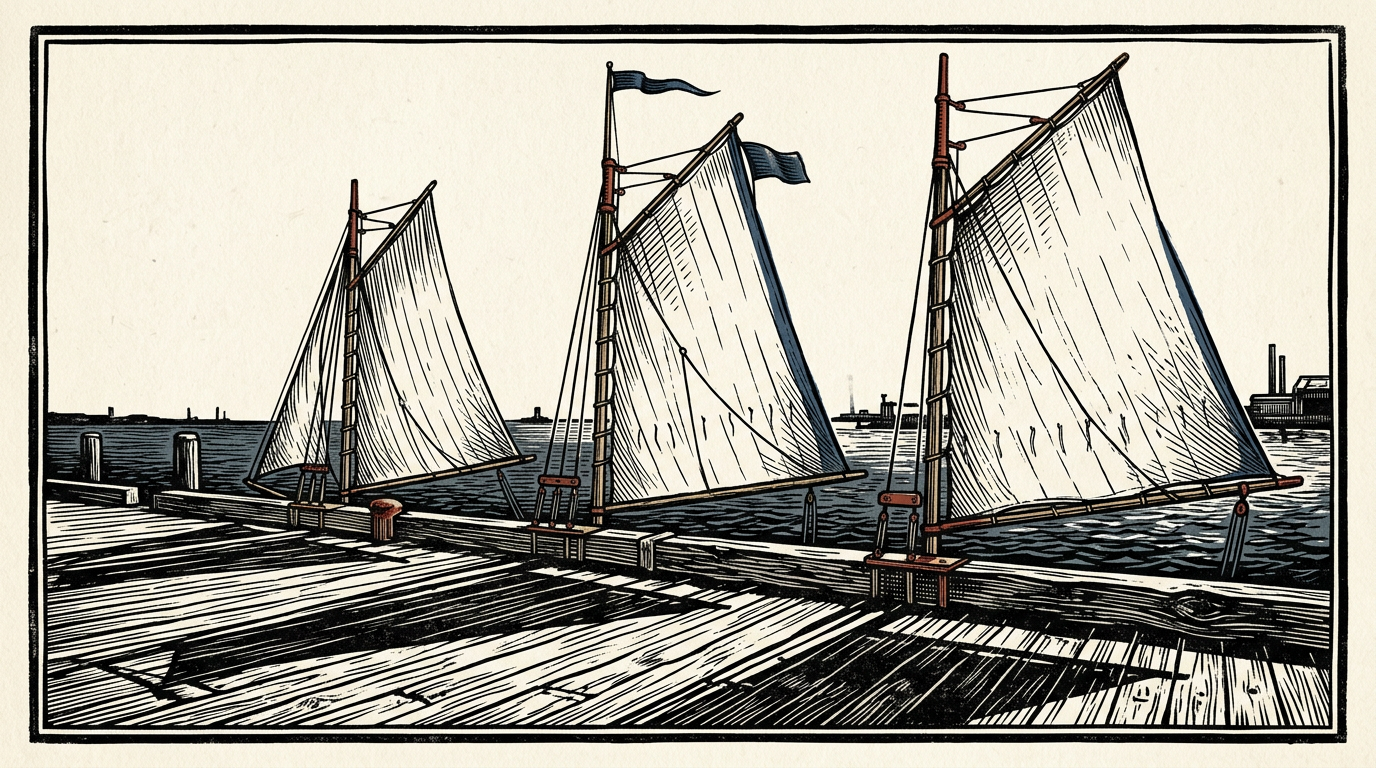
As part of the inaugural ArtPhilly festival, New York-based conceptual artist indira allegra will unveil Sail Through This to That on May 28 at Spruce Street Harbor. The installation consists of three sprawling schooner sails, a direct reference to the maritime escape route Judge took to New Hampshire. The work arrives as the United States approaches the 250th anniversary of the Declaration of Independence, a milestone that has increasingly become a flashpoint for how national institutions navigate presidential mandates to portray the founding era's history.
The erasure that prompted the art
The removal of slavery-related exhibits from Independence National Historical Park — the site where the Liberty Bell sits and where the President's House once stood — set off a legal and cultural confrontation that extends well beyond museum curation. Philadelphia's lawsuit against the federal government frames the removals as a violation of obligations to present historically accurate narratives at publicly funded sites. The President's House site, in particular, had been the product of years of advocacy by historians, descendants, and community organizations who pushed for the excavation and interpretation of the enslaved quarters that once existed on the property. Its partial erasure reopened questions about whose stories national monuments are designed to preserve.
Ona Judge's biography sits at the intersection of these tensions. Enslaved from birth as the property of the Custis-Washington household, Judge served as Martha Washington's personal attendant before escaping Philadelphia in May 1796, reportedly aboard a ship bound for Portsmouth, New Hampshire. George Washington pursued her return through legal and extralegal channels for years, yet Judge lived the remainder of her life in New Hampshire, never formally emancipated but never recaptured. Her story, documented in part through interviews she gave late in life, complicates the sanitized image of the nation's first president and underscores the degree to which enslaved people exercised agency even within the most powerful households of the early republic.
Layered memory, layered meaning
Allegra's installation does not confine itself to the eighteenth century. The sails incorporate neon aesthetics associated with Rem'mie Fells, a 27-year-old Black transgender woman and aspiring fashion designer murdered in Philadelphia in 2020. By intertwining Judge's flight with a tribute to a modern victim of violence, the work positions the harbor not merely as a site of historical transit, but as a space for reckoning with the persistent precarity of Black life across centuries.
This layering is characteristic of allegra's broader practice, which has explored themes of tension, bondage, and liberation through textile and structural forms. The choice of schooner sails as the medium carries both literal and metaphorical weight: sails are instruments of departure, shaped entirely by the forces acting upon them, yet capable of redirecting those forces toward a chosen destination. Placed along the Delaware River waterfront — the same waterway Judge would have navigated — the installation collapses the distance between past and present in a manner that didactic exhibits, however well-intentioned, rarely achieve.
The timing of the ArtPhilly festival's launch, coinciding with the semiquincentennial preparations and the ongoing legal dispute, places temporary public art in direct dialogue with permanent institutional choices. Philadelphia has a long history of using public monuments to negotiate contested narratives — from the Octavius Catto statue unveiled in 2017 to the ongoing debates over the city's Civil War memorials. Allegra's sails join that lineage, though their impermanence raises its own question: whether a temporary monument can hold space that permanent institutions have chosen to vacate.
The federal lawsuit remains unresolved. The sails will eventually come down. What persists is the tension between a government's authority to curate national memory and a city's insistence that the historical record is not a discretionary exhibit. Whether public art can bear the weight of that argument — or whether it functions best as a parallel channel, reaching audiences that policy battles do not — remains an open question, one that Philadelphia is now testing in real time.
With reporting from Hyperallergic.
Source · Hyperallergic