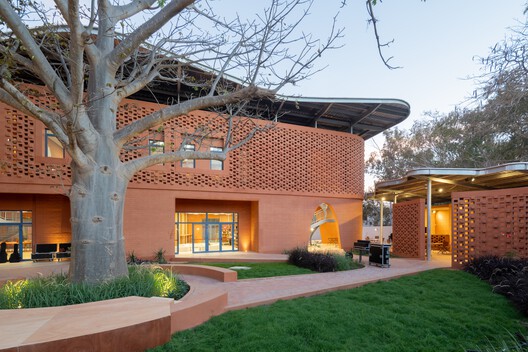
In Dakar, the construction of the new Goethe-Institut marks a significant chapter in West Africa's architectural evolution. Designed by Pritzker Prize-winner Francis Kéré, the 1,800-square-meter facility is set to become a permanent home for the German cultural center, which has operated in the Senegalese capital for over six decades. The project, slated for completion in 2026, moves beyond the standard institutional aesthetic, opting instead for a structure that responds to the rhythms of the city and its climate.
Kéré, who became the first African architect to receive the Pritzker Prize in 2022, has built a body of work defined by the conviction that architecture should emerge from the conditions of its site rather than be imposed upon them. His earlier projects — including the Lycée Schorge Secondary School in Burkina Faso and the Serpentine Pavilion in London — established a design vocabulary rooted in locally sourced materials, passive environmental strategies, and the social rituals of the communities he serves. The Goethe-Institut Sénégal extends that logic into the realm of institutional diplomacy, where the building itself becomes an argument about how cultural exchange should feel.
Materiality as Method
The design utilizes a palette of materials calibrated to Dakar's coastal climate. Passive cooling and natural light are prioritized over mechanical systems, a strategy consistent with Kéré's longstanding emphasis on reducing energy dependence in regions where infrastructure can be unreliable. By integrating vernacular construction techniques — thick walls, shaded courtyards, elevated roof structures that promote air circulation — into a contemporary form, the building avoids the glass-and-steel uniformity that characterizes many international cultural outposts.
This approach carries broader implications for how foreign institutions choose to build in African cities. The Goethe-Institut network operates in dozens of countries, and the architectural identity of its facilities has historically varied from adapted colonial-era buildings to generic modernist boxes. Kéré's design represents a deliberate departure: rather than importing a template, the institution commissioned an architect whose practice is grounded in the very context the building will inhabit. The result is a structure designed for dialogue — not just between cultures, but between the built environment and the elements.
Institutional Architecture in a Changing City
The new institute will house classrooms, a library, and performance spaces, all organized to foster openness and community access. The programmatic mix reflects the Goethe-Institut's dual mandate of language education and cultural programming, but the spatial arrangement suggests something more porous than a typical institutional floor plan. Public and semi-public zones appear designed to draw in residents who may have no formal connection to the institute's programming — a strategy that aligns with a broader trend in cultural architecture toward dissolving the boundary between institution and neighborhood.
Dakar itself provides fertile ground for this experiment. The city has steadily expanded its profile as a regional hub for contemporary art, music, and technology. The Dak'Art Biennale, one of the continent's most established contemporary art events, has helped position the Senegalese capital as a destination for cultural production rather than mere consumption. Against that backdrop, the Goethe-Institut project arrives not as a novelty but as an addition to an existing ecosystem — one where the question of who builds, how, and for whom carries particular weight.
Kéré's design does not attempt to answer that question with a monumental gesture. It is a quiet, deliberate addition to the city's built fabric, emphasizing the enduring logic of place-based design over spectacle. Whether it becomes a model for other international cultural institutions operating across the continent depends on factors beyond architecture alone — funding structures, institutional will, and the willingness to cede design authority to local knowledge. The building, once complete, will stand as a test case: proof that sustainability and cultural specificity can coexist with institutional requirements, or a reminder of how difficult that balance is to replicate at scale.
With reporting from ArchDaily.
Source · ArchDaily