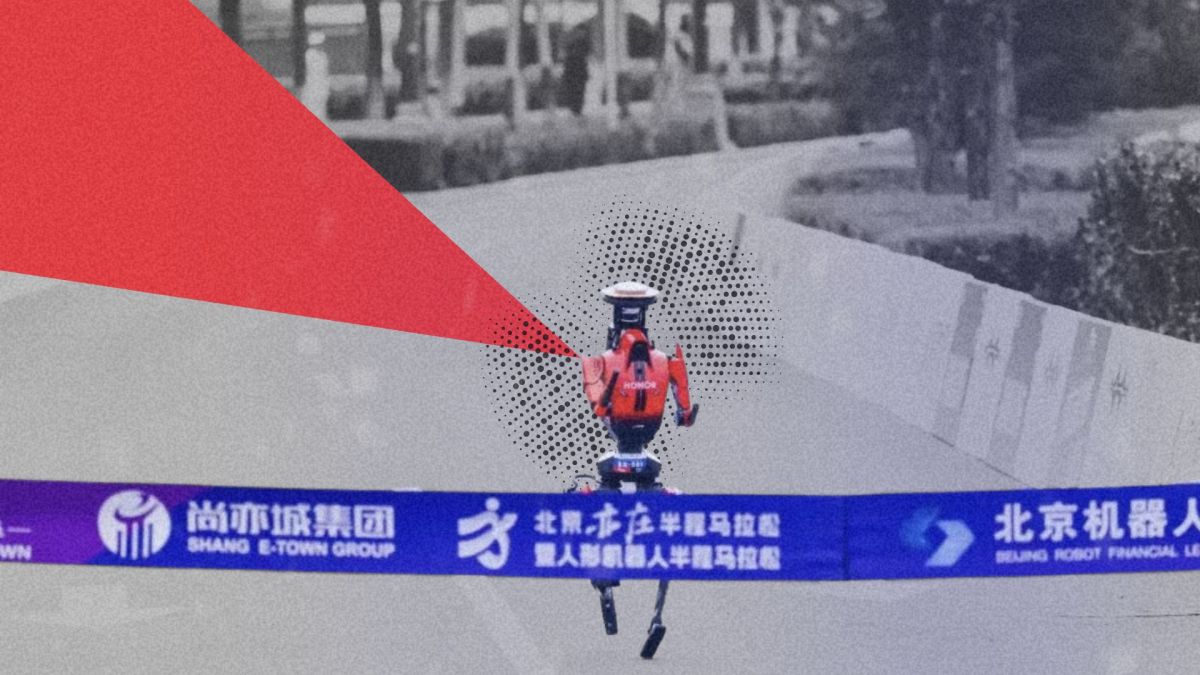
The half-marathon has long served as a benchmark for human cardiovascular efficiency and mechanical resilience. At 21.1 kilometers, the distance demands a rare combination of sustained aerobic output and structural durability — qualities that have made it a proving ground not only for elite athletes but, increasingly, for machines. In Beijing, that proving ground shifted decisively. "Lightning," an autonomous humanoid robot developed by the Chinese electronics firm Honor, completed the course in 50 minutes and 26 seconds, finishing well ahead of the human world record of 57 minutes and 31 seconds.
The result is striking not merely for its margin but for its context. Honor is a company primarily known for consumer smartphones, not robotics. That a firm outside the traditional robotics establishment could produce a bipedal machine capable of this performance — reportedly in less than a year of development — says something about the current state of the field and the speed at which engineering capabilities are converging.
From static dexterity to sustained locomotion
Much of the recent progress in humanoid robotics has centered on manipulation: picking up objects, navigating indoor environments, performing warehouse tasks. Companies such as Boston Dynamics, Agility Robotics, and several Chinese competitors including Unitree have demonstrated increasingly fluid movement, but the emphasis has largely been on controlled, short-duration activity. Long-range bipedal locomotion at speed presents a fundamentally different engineering challenge.
Maintaining balance on two legs over 21 kilometers of sustained high-impact movement requires real-time computation at a scale that static tasks do not. Each stride generates forces that must be absorbed and redirected without toppling the machine. Variations in road surface, wind resistance, and accumulated mechanical stress compound over distance. The fact that Lightning completed the course autonomously — without remote piloting or tethered support — suggests meaningful advances in onboard sensor fusion, actuator endurance, and energy management.
The achievement also reflects a broader pattern in Chinese robotics development. Over the past several years, a growing number of Chinese firms have entered the humanoid robotics space, often moving from prototype to public demonstration at a pace that compresses timelines familiar in Western research labs. The competitive dynamics of this market — driven in part by government industrial policy and in part by the ambitions of consumer technology companies seeking new verticals — have accelerated the cadence of visible milestones.
What a machine marathon means — and what it does not
It is worth being precise about what Lightning's performance demonstrates. The robot outran the fastest human half-marathon time on record, but the comparison is inherently asymmetric. Human runners contend with biological fatigue, oxygen debt, lactic acid accumulation, and thermoregulation — constraints that do not apply to an electromechanical system. A machine does not experience pain, does not need to manage glycogen reserves, and can theoretically sustain a fixed pace without degradation until its power source is depleted. The achievement, then, is less about "beating" humans and more about proving that bipedal robots can now sustain high-speed locomotion over meaningful distances without failure.
That distinction matters for the practical implications. The industries most likely to benefit from advances in sustained bipedal mobility — logistics, search and rescue, infrastructure inspection, defense — care less about raw speed than about reliability over uneven terrain and extended operational windows. A robot that can run a half-marathon on a paved Beijing road is not the same as one that can traverse rubble or forest for hours, but it is a necessary precursor.
For Honor specifically, the strategic logic is less obvious. The company has no publicly established robotics business line, and the leap from smartphone manufacturing to humanoid locomotion is not a natural adjacency. Whether Lightning represents the beginning of a serious product effort or a high-profile technology demonstration designed to signal engineering ambition remains an open question.
What is clear is that the performance envelope for bipedal machines has expanded faster than most observers anticipated. The gap between what a humanoid robot can do in a controlled lab and what it can do on a public road, over a competitive distance, has narrowed considerably. Whether that gap continues to close — and whether the firms pushing it forward are the ones best positioned to commercialize the results — is the tension worth watching.
With reporting from Numerama.
Source · Numerama