Mark Jenkin's third feature, Rose of Nevada, centers on an image of haunting stillness: a red and white fishing boat adrift in an oceanic expanse where sky and water blur into a singular, suffocating blue. It is a film that operates on the periphery of reality, a Cornish yarn that treats time not as a linear progression but as a tide that can, inexplicably, wash back what was long thought lost.
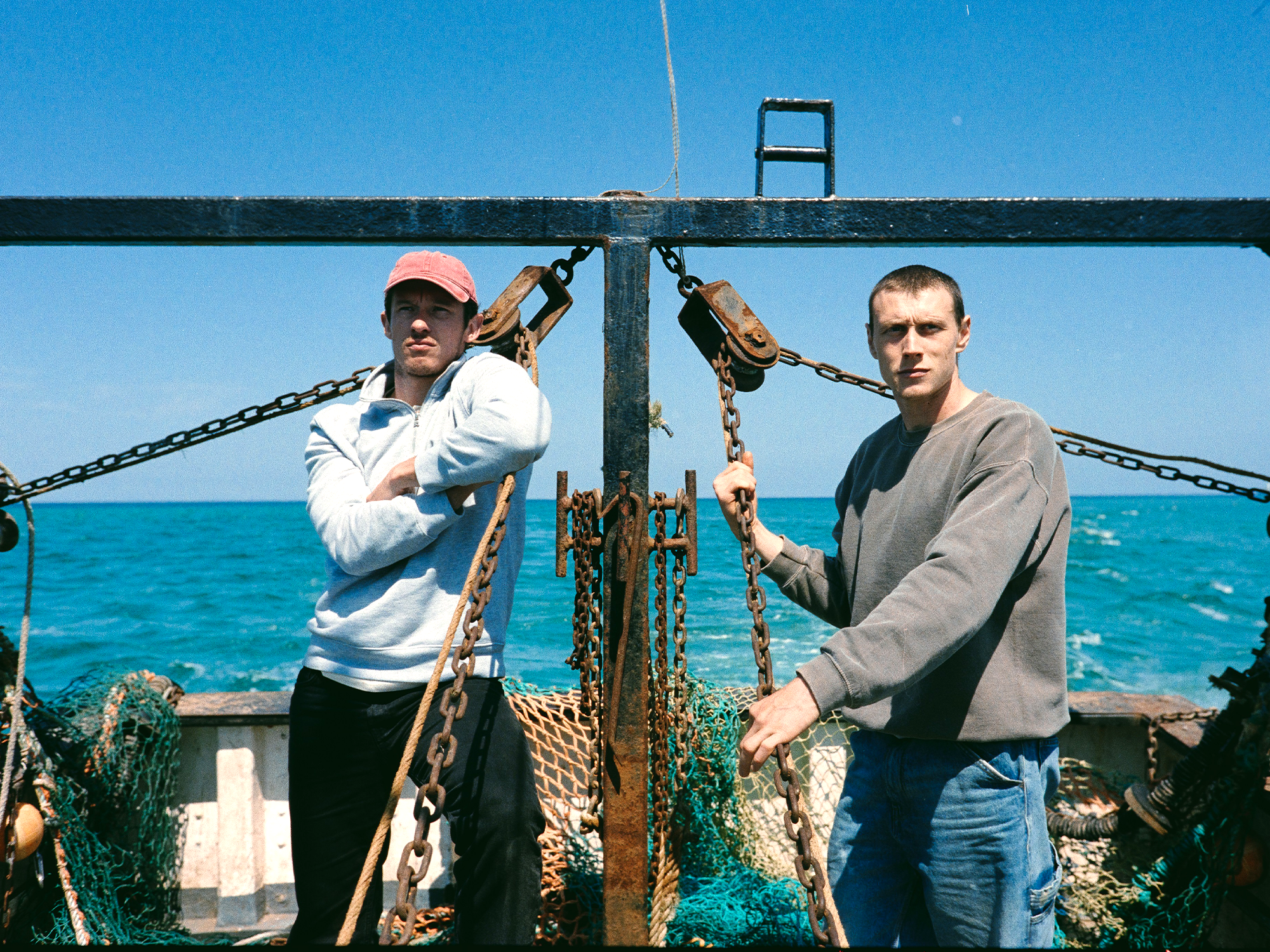
The titular vessel vanished thirty years ago, becoming a local legend of loss. When it suddenly reappears in the harbor, it finds a village transformed by decay and economic scarcity. Nick (George MacKay), a young man born after the boat's disappearance, is struggling to maintain a leaking roof and provide for his family. For him, the Rose of Nevada is not a ghost story but a rare opportunity for work, leading him to join a crew that includes a newcomer, Liam (Callum Turner), and the veteran sailor Murgey.
A filmmaker shaped by Cornwall's margins
Jenkin has built his body of work almost entirely within the landscape and communities of Cornwall. His debut feature, Bait (2019), shot on 16mm black-and-white film and hand-processed by the director himself, drew international attention for its abrasive portrait of a Cornish fishing village caught between its working heritage and the creep of tourism and gentrification. The film's formal choices — its grainy texture, post-synchronized sound, and rhythmic editing — were inseparable from its subject matter, a technique that positioned Jenkin as one of British cinema's most distinctive regional voices. His follow-up, Enys Men (2022), pushed further into atmospheric territory, using a 1970s folk-horror register to explore isolation and ecological unease on a remote Cornish island.
Rose of Nevada appears to extend these preoccupations while shifting the register once more. Where Bait was rooted in social realism and Enys Men in genre abstraction, this third feature occupies a liminal space between the two — a supernatural conceit layered over the material hardship of a coastal community. The progression suggests a filmmaker refining a singular thematic concern: what happens to places and people when the economic structures that once sustained them disappear, and what residues — cultural, psychological, spectral — remain.
The ghost ship as economic parable
The returned vessel functions on multiple registers. At the narrative level, it is a source of dread and mystery, a ship that should not exist arriving in a harbor that barely does. But Jenkin uses this supernatural conceit to examine the weight of communal sacrifice against the immediate pressures of individual survival. Nick's decision to board the Rose of Nevada is not driven by curiosity or superstition but by necessity. The leaking roof, the absent prospects — these are the forces that propel him toward a ship that every instinct might counsel him to avoid.
This tension between pragmatism and foreboding places the film within a longer tradition of British cinema that uses genre frameworks to articulate class experience. The fishing communities of Cornwall have faced decades of contraction — the decline of quota allocations, the rising cost of fuel and equipment, the gravitational pull of tourism economies that offer seasonal work but erode the infrastructure of older trades. Jenkin does not deliver a policy argument; instead, the decaying village and the impossibly returned boat become a single metaphor for communities living among the remnants of industries that once gave them coherence.
As the characters navigate the "metal carcass" of the returned ship, the film balances a sense of dread with a grounded portrayal of a community on the brink. The casting of MacKay — whose recent work has gravitated toward physically demanding roles in constrained environments — and Turner as the outsider Liam suggests a dynamic built on friction between local knowledge and external ambition, though the film appears less interested in resolving that friction than in letting it accumulate.
What lingers is the question Jenkin leaves suspended rather than answered: whether the past returns as a resource or as a claim. The Rose of Nevada offers work, but work on terms that no one in the village fully understands. It is a meditation on how the past haunts the present — not just through spectral ships, but through the enduring struggle of those left behind in the wake of industry and time. The boat is back. The conditions that made it leave have only deepened. Whether that constitutes a second chance or a repetition is the tension the film refuses to collapse.
With reporting from Little White Lies.
Source · Little White Lies