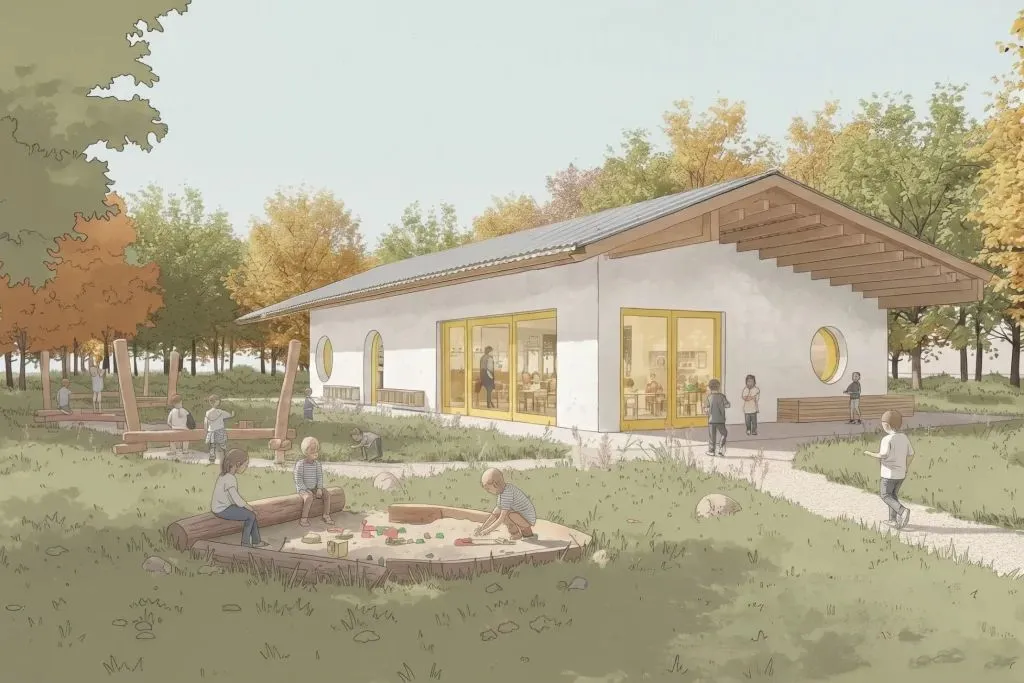
London-based architecture practice Alma-nac has submitted a planning application to expand an existing nursery in Penzance, Cornwall. The proposal, filed with the local planning authority, seeks to extend the childcare facility, though specific details of the scheme's scale and design approach remain limited in public reporting so far.
Penzance, a coastal town at the western tip of Cornwall, has seen a mix of heritage conservation and modest development activity in recent years. Any new planning submission in the area must navigate the particular sensitivities of building in a town with a significant stock of listed structures and proximity to protected landscapes.
Alma-nac's design approach and the challenge of small civic projects
Alma-nac, founded in 2013, has built a portfolio that spans residential, cultural, and community projects, often characterised by an interest in material honesty and spatial inventiveness at modest scales. The practice has gained recognition for work that treats smaller briefs — housing extensions, community buildings, adaptive reuse — with the same design seriousness typically reserved for larger commissions. A nursery extension in a Cornish town fits squarely within that ethos.
Childcare architecture, while rarely headline-grabbing, carries particular design constraints. Early-years environments must balance safeguarding requirements, natural light provision, acoustic separation, outdoor play access, and the practical realities of supervision ratios. Regulatory frameworks set by Ofsted in England impose minimum space standards per child, meaning that any expansion of a nursery is not simply a matter of adding floor area but of reconfiguring how space is used, accessed, and experienced by very young children and their carers.
The best nursery design tends to blur the boundary between indoor and outdoor environments, a principle well-suited to Cornwall's relatively mild climate. Whether Alma-nac's Penzance proposal follows this pattern is not yet clear from available documentation, but the practice's previous work suggests an attentiveness to context and landscape that would lend itself to such an approach.
Childcare infrastructure and the rural provision gap
The submission arrives against a backdrop of persistent strain on childcare provision across England, particularly in rural and coastal areas. Cornwall has faced well-documented challenges in maintaining adequate early-years capacity, driven by a combination of demographic pressures, workforce shortages in the childcare sector, and the financial fragility of many nursery operators. The expansion of an existing facility, rather than the construction of a new one, reflects a pragmatic response: building on established operations and community relationships rather than starting from scratch.
Government policy in recent years has expanded funded childcare entitlements for younger age groups, increasing demand for places without a corresponding increase in the supply of suitable buildings. For many providers, particularly those in older or adapted premises, physical space has become the binding constraint. Architectural intervention — even at the scale of a single extension — can unlock additional capacity that policy alone cannot deliver.
Penzance's position as a relatively remote service centre means that nursery provision there serves not just the town itself but a wider rural catchment. The viability of such facilities has broader implications for local economic participation, particularly for parents and carers whose ability to work depends on accessible, affordable childcare.
How the local planning authority weighs the proposal will depend on familiar variables: design quality, neighbour impact, transport considerations, and compatibility with the local plan. For Alma-nac, the project represents the kind of quiet, civic-minded commission that rarely attracts attention but shapes daily life in tangible ways. For Penzance, the question is whether the built environment can keep pace with the demands being placed on its social infrastructure — a tension playing out in small towns across the country, one planning application at a time.
With reporting from Architects Journal.
Source · Architects Journal