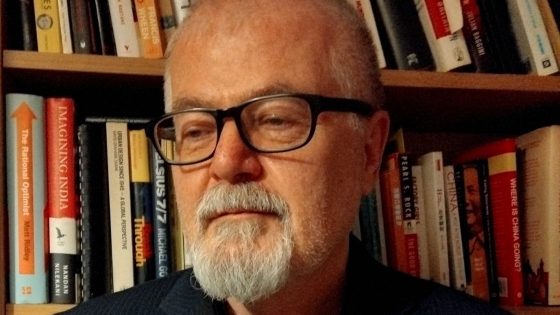
Austin Williams, an author and academic with a background in architectural journalism, has announced his candidacy for the next presidency of the Royal Institute of British Architects (RIBA). Williams, who previously served as a technical editor for The Architects' Journal, is running on a platform he describes as rooted in "common sense."
The announcement adds another name to what is shaping up as a contested race for the leadership of British architecture's most prominent professional body. RIBA, founded in 1834, represents tens of thousands of chartered architects across the United Kingdom and holds considerable influence over professional standards, education accreditation, and the broader cultural positioning of the discipline.
A candidacy from the margins of the profession
Williams is not a conventional candidate. His career has straddled architecture, journalism, and academia, and he is perhaps better known as a cultural commentator and author than as a practitioner leading a major studio. His published work has engaged with themes of development, progress, and what he has framed as an excessive caution in contemporary design culture. That intellectual profile places him outside the typical mold of RIBA presidential candidates, who have more often emerged from large practices or established institutional roles within the architecture world.
The framing of a "common sense" platform, while deliberately broad, signals a candidacy pitched against what its proponent likely views as ideological drift within the institute. RIBA, like many professional bodies, has in recent years expanded its public positioning beyond narrow technical concerns into areas such as climate policy, social equity, and procurement reform. Whether that expansion represents mission creep or necessary evolution is itself a live debate among members.
RIBA presidential elections have historically attracted modest turnout relative to the institute's membership, a pattern common across professional bodies where day-to-day practice leaves little bandwidth for institutional politics. Yet the presidency carries real weight: it sets the tone for RIBA's public advocacy, shapes its engagement with government on planning and housing policy, and influences how the profession presents itself to the public.
The stakes of institutional leadership
The timing of this race matters. British architecture operates in a period of overlapping pressures. Housing targets remain politically contentious. The regulatory landscape shifted after the Grenfell Tower fire and the subsequent overhaul of building safety legislation. Meanwhile, the profession faces structural questions about fee erosion, the pipeline of new architects, and the role of artificial intelligence in design workflows.
Any incoming RIBA president will need to navigate these forces while maintaining institutional cohesion across a membership that spans sole practitioners, global firms, academics, and students. The challenge is less about vision statements than about credibility — whether the president can speak with authority both to government ministers and to an architect running a small practice in a regional town.
Williams's entry into the race raises a question that extends beyond RIBA: what role should professional institutes play in a period when the boundaries of professional identity are themselves shifting? Architecture, like law and medicine, faces pressure from adjacent disciplines and from technology platforms that automate or redistribute tasks once considered core to the profession. An institute that focuses too narrowly on traditional concerns risks irrelevance; one that reaches too broadly risks losing the confidence of members who want practical representation.
The contest will ultimately be decided by RIBA's voting membership, and the full field of candidates may not yet be settled. What is already visible, however, is that the race is becoming a proxy for a broader argument about institutional purpose — whether RIBA should function primarily as a professional guild, a cultural authority, or something in between. Williams's candidacy, whatever its electoral prospects, sharpens that question.
With reporting from Architects Journal.
Source · Architects Journal