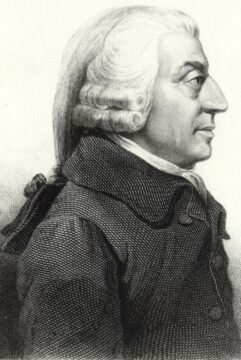
Adam Smith is frequently invoked as the architect of the modern free market, his legacy often reduced to the "invisible hand" and the cold calculations of self-interest. Yet Smith's foundational economic theories were originally tethered to a deeply humanistic moral philosophy. His first major work, The Theory of Moral Sentiments, published in 1759 — seventeen years before The Wealth of Nations — laid out a vision of human nature in which commerce was secondary to something more fundamental: the capacity to feel what others feel.
Long before Milton Friedman wore neckties emblazoned with his image, Smith was preoccupied not with the "utility monster" of modern capitalism, but with the "moral sentiments" that allow individuals to coexist. The fact that this earlier work is so rarely cited in popular discourse says less about Smith than about the selective memory of the intellectual traditions that claim him.
The Is-Ought Gap and the Bridge of Sympathy
Drawing on the work of David Hume, Smith grappled with what has become one of the most durable problems in moral philosophy: the "is-ought" problem. Hume argued that one cannot derive a moral truth from a simple statement of fact; there is always a leap required to move from what is to what ought to be. No amount of empirical observation about the world can, by itself, generate a binding ethical claim. The gap is logical, not merely rhetorical.
For Smith, that bridge was built from sympathy — a natural, reflexive concern for the well-being of others that he believed was hardwired into the human experience. Smith's concept of sympathy was not charity or pity in the modern colloquial sense. It was closer to what contemporary psychology might call empathic resonance: the involuntary mirroring of another person's emotional state. When a spectator winces at the sight of a stranger's injury, Smith argued, something morally significant is happening — an act of imaginative projection that forms the raw material of ethical judgment.
Smith formalized this intuition through the figure of the "impartial spectator," an internalized observer whose imagined approval or disapproval guides moral conduct. The impartial spectator is not a set of rules or a divine command. It is a psychological mechanism, shaped by social experience, that allows individuals to evaluate their own behavior as if from the outside. In this framework, moral reasoning is not a solitary exercise in logic but a fundamentally social process, rooted in the capacity to imagine oneself in another's position.
Feeling as Foundation in an Algorithmic Age
This architecture of the mind suggests that responsibility is not merely a social contract or a survival strategy of the "selfish gene," but a product of emotional capacity. The implications extend well beyond eighteenth-century Edinburgh. Contemporary moral philosophy has seen a sustained revival of virtue ethics — the Aristotelian tradition that emphasizes the cultivation of character traits over adherence to abstract rules. Smith's approach shares some of that spirit but diverges in a critical respect: where Aristotle grounded virtue in rational habituation, Smith grounded it in feeling.
That distinction carries particular weight in an era increasingly defined by data and algorithmic efficiency. The dominant frameworks for ethical decision-making in technology — utilitarian cost-benefit analyses, compliance checklists, fairness metrics — tend to treat morality as a problem of optimization. Smith's moral philosophy offers a different lens, one in which the irreducible messiness of human sympathy is not a bug to be engineered away but the very foundation on which ethical life is built.
The tension is not easily resolved. A moral system anchored in feeling is vulnerable to the well-documented biases of empathy: its parochialism, its susceptibility to narrative, its tendency to favor the proximate over the distant. Critics from Peter Singer to Paul Bloom have argued that empathy, left unregulated by reason, can distort moral priorities as easily as it can illuminate them. Smith himself was not naive about this — the impartial spectator was, in part, his answer to empathy's limitations, an attempt to discipline feeling without discarding it.
What remains provocative in Smith's framework is the insistence that no amount of rational scaffolding can substitute for the initial moral impulse. Logic can refine ethical judgment; it cannot generate it from nothing. Whether that claim holds under the pressures of a world increasingly mediated by systems that feel nothing at all is a question Smith could not have anticipated — but one his work helps to frame with unusual clarity.
With reporting from 3 Quarks Daily.
Source · 3 Quarks Daily