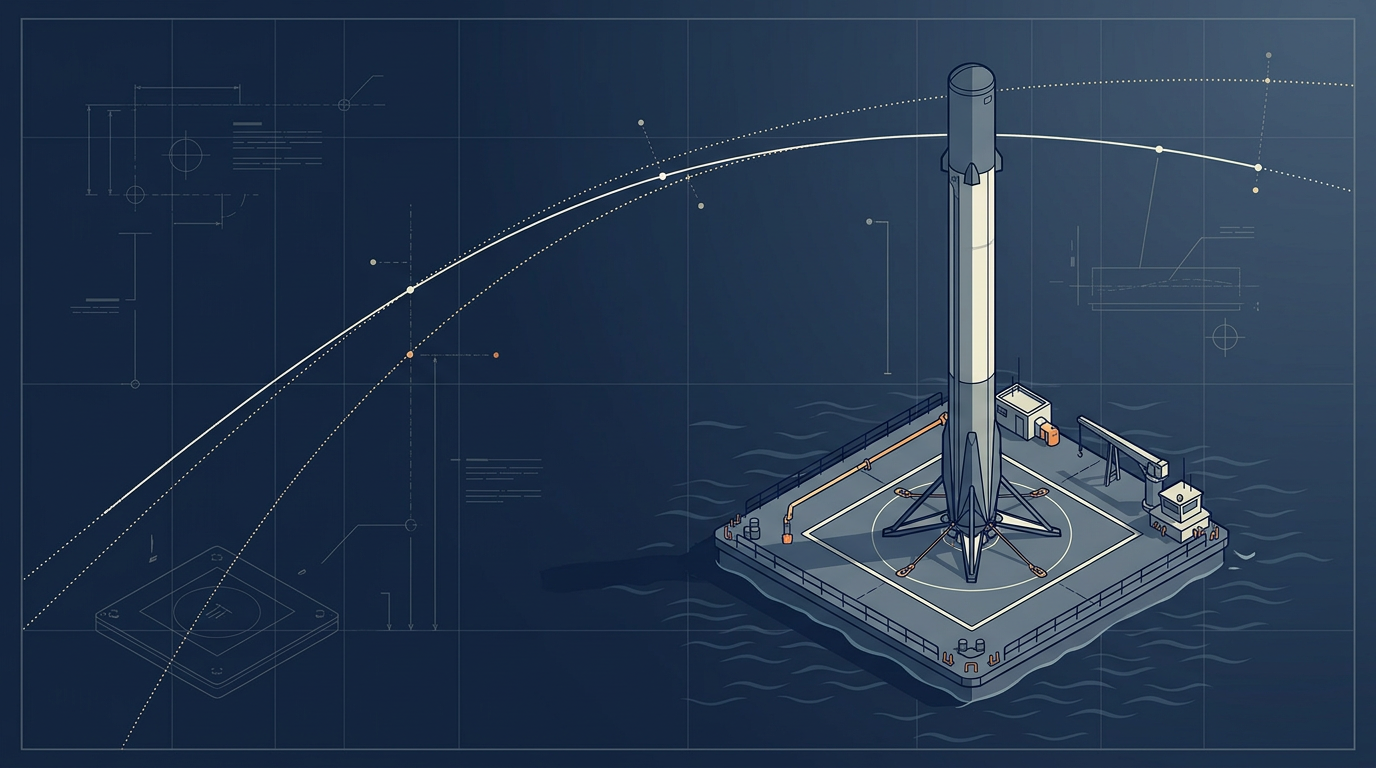
For years, the narrative of the private space race has been one of a widening chasm between SpaceX and its competitors. While Elon Musk's firm turned rocket reuse into a routine industrial process — Falcon 9 boosters have now flown and landed well over 300 times — Jeff Bezos's Blue Origin remained largely confined to suborbital hops with the smaller New Shepard. That dynamic shifted this week when Blue Origin successfully launched and recovered a previously flown New Glenn first-stage booster, matching a technical feat that has, until now, been the exclusive domain of SpaceX.
The achievement marks a significant maturation for the New Glenn program. Unlike New Shepard, designed for brief tourist flights to the edge of space, New Glenn is a heavy-lift orbital vehicle built to compete for lucrative satellite deployment contracts and NASA missions. Reusing its first-stage booster is a prerequisite for the economic viability Bezos has long promised. Landing the same booster a second time signals that the company has begun to master the complex thermal and structural stresses of atmospheric reentry at orbital velocities — a challenge qualitatively different from anything New Shepard ever faced.
A milestone with an asterisk
The celebration, however, was tempered by a critical failure in the mission's primary objective. While the booster returned to Earth as intended, the satellite payload was deployed into an incorrect orbit. In the exacting world of aerospace, a successful landing is a secondary triumph if the customer's hardware ends up in the wrong place. Orbital insertion demands precision across a chain of systems — upper-stage ignition timing, guidance software, separation sequencing — and a fault anywhere in that chain can render the payload commercially useless or force costly corrective maneuvers.
The error invites comparison with SpaceX's own early trajectory. Falcon 9's first successful booster landing in December 2015 came after years of spectacular failures at sea and on land. Yet by the time SpaceX was routinely recovering hardware, its upper stage and payload delivery had already achieved a high degree of reliability. Blue Origin appears to be navigating both learning curves simultaneously: proving reuse while still refining the end-to-end mission accuracy that paying customers require. That overlap compresses risk in a way SpaceX largely avoided.
For the broader launch market, the incident matters beyond Blue Origin's internal roadmap. The company holds contracts with commercial satellite operators and is a partner in NASA's Artemis program through its selection for a lunar lander variant. Customers evaluating launch providers weigh not just price and cadence but mission assurance — the statistical confidence that a payload will reach its intended orbit. A single delivery error does not define a program, but it does reset the clock on the track record Blue Origin needs to build.
The economics of catching up
Booster reuse is ultimately an economic argument. SpaceX demonstrated that flying a first stage multiple times collapses the marginal cost of access to orbit, enabling pricing that legacy providers such as Arianespace and United Launch Alliance have struggled to match. Blue Origin's ability to refly a New Glenn booster suggests it can, in principle, offer a similar cost structure. But cost competitiveness only materializes at scale — and scale requires a flight cadence that Blue Origin has not yet established.
The company's manufacturing base in Huntsville, Alabama, and its launch infrastructure at Cape Canaveral represent substantial capital investments oriented toward higher tempo operations. Whether that tempo arrives in the near term depends on how quickly engineers diagnose the payload delivery anomaly and whether the fix is procedural or demands hardware changes to the upper stage. Each delay in cadence pushes the per-flight economics further from the reuse dividend that justifies the entire architecture.
The duality of this mission — a breakthrough in hardware sustainability coupled with a failure in delivery precision — captures the current state of competition in heavy-lift launch. Blue Origin is no longer a spectator in the orbital market, but it occupies an uncomfortable middle ground: technically capable enough to recover a booster, not yet consistent enough to guarantee the mission that booster is meant to serve. The question facing Bezos's aerospace venture is whether the market will grant it the same runway of iterative failure that SpaceX enjoyed a decade ago, or whether expectations — from customers, from NASA, from investors in adjacent space infrastructure — have moved beyond that tolerance.
With reporting from Xataka.
Source · Xataka