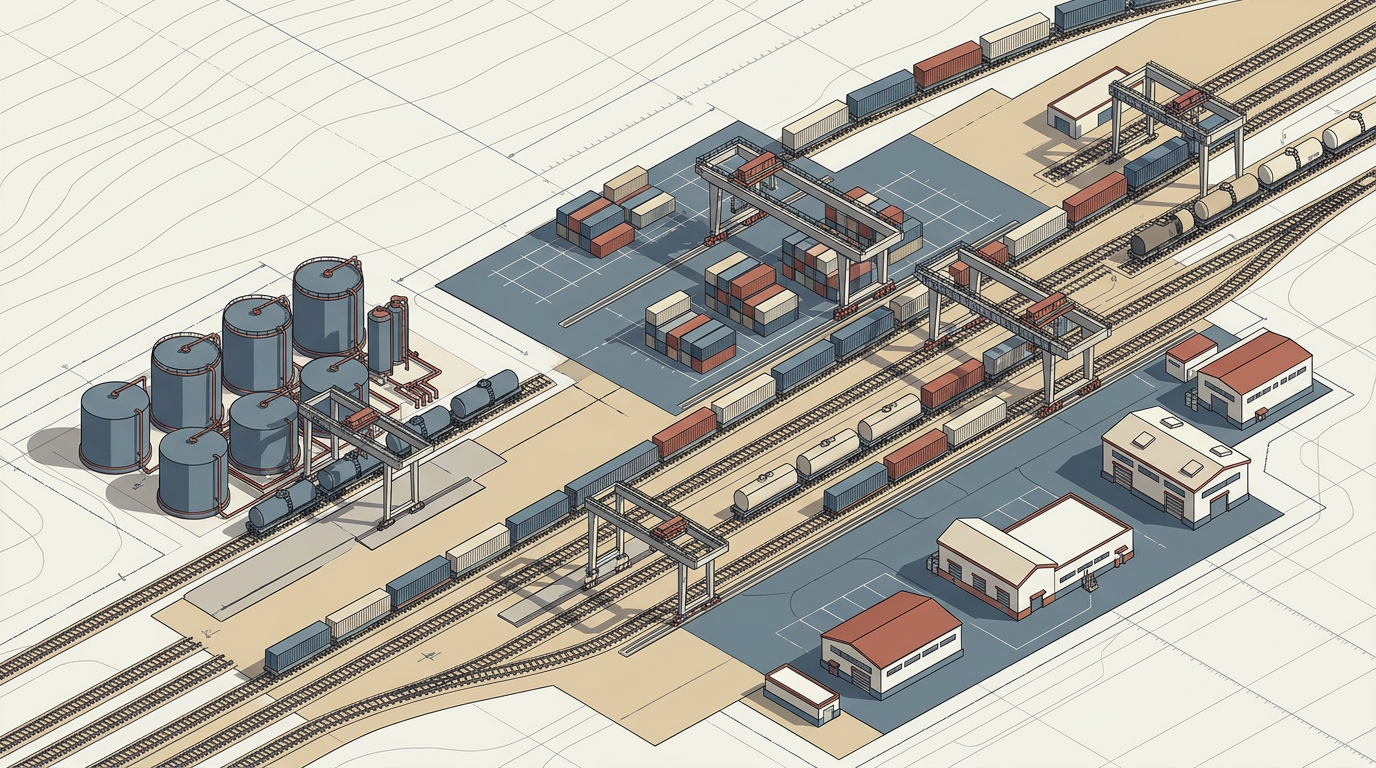
Bulkmatic, a major operator in North American bulk logistics, has announced a $600 million investment plan stretching from 2026 to 2036, aimed at building and expanding multimodal rail terminals across Mexico. The initiative targets liquid fuel storage and transport as its centerpiece, with new facilities planned in strategic locations that align with some of the country's most ambitious federal infrastructure projects.
The company intends to roughly double its current operational capacity. Francisco Melo, Bulkmatic's commercial director, has stated that the plan would add approximately 3,000 rail car movements per month to the existing average of 3,500. Supporting that throughput are large-scale storage projects in Tula, Pesquería, and Hermosillo, designed to hold hundreds of thousands of barrels of fuel. Additional terminals in Coatzacoalcos, Salina Cruz, and Progreso are planned to interface directly with the Interoceanic Corridor and the Maya Train — two flagship programs of the Mexican government's regional development agenda.
Logistics as Industrial Policy
The timing and geography of Bulkmatic's expansion are difficult to separate from Mexico's broader economic trajectory. The Interoceanic Corridor, which aims to create a land bridge for cargo between the Pacific and Gulf coasts via the Isthmus of Tehuantepec, has been positioned by the federal government as a counterweight to the Panama Canal and a catalyst for industrial development in Mexico's historically underinvested south. The Maya Train, meanwhile, is reshaping transit infrastructure across the Yucatán Peninsula. Both projects have drawn scrutiny over cost overruns and environmental concerns, but they are also generating demand for precisely the kind of ancillary logistics capacity Bulkmatic is proposing to build.
By embedding terminals at key nodes along these corridors, Bulkmatic is making a bet that Mexico's state-led infrastructure push will produce durable freight demand — not just during the construction phase, but over the longer arc of industrial reshoring and energy distribution that the projects are designed to catalyze. The emphasis on fuel logistics is particularly telling. Mexico's downstream energy sector has undergone significant restructuring in recent years, with shifting dynamics between state oil company Pemex and private operators. A company that controls storage and rail distribution of liquid fuels at scale occupies a strategically valuable position in that evolving supply chain.
Nearshoring Tailwinds and Structural Questions
Bulkmatic's investment also arrives in the context of the nearshoring wave that has reshaped corporate planning across North America. As manufacturers diversify supply chains away from Asia, northern Mexico has attracted a surge of industrial investment, particularly in states like Nuevo León — where Pesquería, one of Bulkmatic's planned storage sites, is located. The industrial corridor running from Monterrey to the U.S. border has become one of the most active logistics markets on the continent, and rail capacity there is increasingly constrained.
The southern terminals tell a different story. Coatzacoalcos, Salina Cruz, and Progreso are not yet established as high-volume freight hubs in the way that Monterrey or Guadalajara are. Their viability depends heavily on whether the Interoceanic Corridor and Maya Train deliver the connectivity and commercial activity the government has projected. That makes Bulkmatic's southern expansion a longer-duration wager — one that could pay off handsomely if the corridors mature, or prove premature if political priorities shift or infrastructure timelines slip.
The ten-year horizon of the plan offers some insulation against short-term volatility, but it also means the company is committing capital across at least two presidential administrations. Infrastructure policy in Mexico has historically been subject to discontinuity between sexenios, and private operators who align closely with one government's flagship projects do not always find the same support from the next.
What Bulkmatic is ultimately testing is whether Mexico's logistics infrastructure can evolve fast enough to match the industrial ambitions being placed upon it — and whether a private operator can profitably fill the gaps that public investment leaves behind. The answer will depend not only on the company's execution, but on the durability of the political and economic forces currently reshaping the country's industrial geography.
With reporting from Expansión MX.
Source · Expansión MX