:format(jpg)/f.elconfidencial.com%2Foriginal%2F580%2F8cf%2Fea7%2F5808cfea7d571deaf6eafcd0a38f935b.jpg)
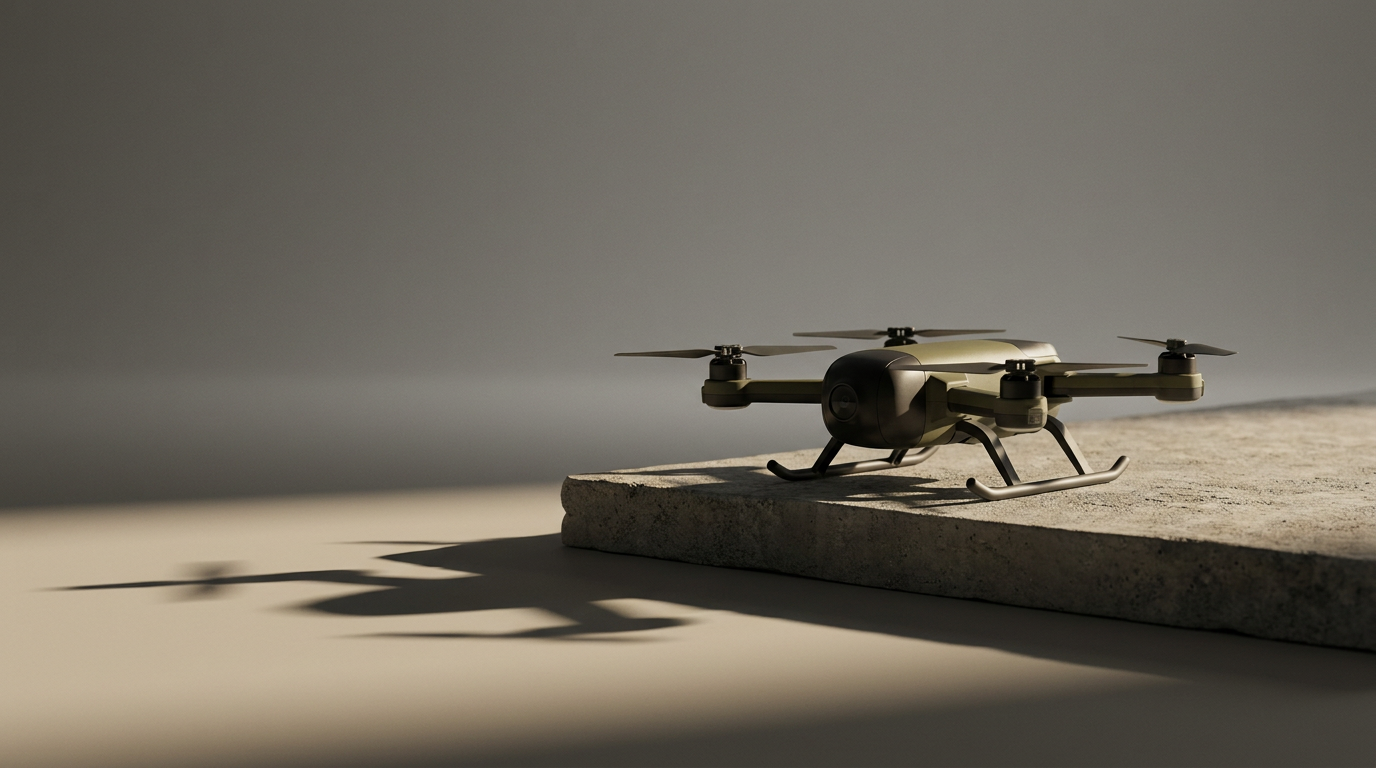
A research paper authored within China's People's Armed Police (PAP) outlines a system in which autonomous armored vehicles, aerial drones, and quadrupedal robots — commonly referred to as "robot dogs" — would replace human officers on the front lines of domestic crowd control. The study envisions these machines handling the full spectrum of riot-response tasks: aerial reconnaissance, public-address warnings, perimeter enforcement, and the deployment of non-lethal deterrents such as tear gas or rubber projectiles. Human operators would remain in the loop only at a supervisory level, removed from direct physical confrontation with civilians.
The PAP, a paramilitary force distinct from the People's Liberation Army, is responsible for internal security duties including border defense, counterterrorism, and the suppression of civil unrest. Its interest in unmanned systems reflects a broader trajectory within Chinese security policy, one that treats technological modernization not merely as a force multiplier but as a doctrinal imperative.
The logic of removing the human officer
The paper's central argument rests on two pillars: force protection and operational consistency. Removing personnel from volatile street-level encounters eliminates casualties among officers — a politically sensitive outcome for any government — and, in theory, reduces the unpredictability introduced by human judgment under stress. An autonomous system operating on pre-programmed escalation protocols does not panic, does not retaliate out of anger, and does not hesitate when ordered to hold a line.
This framing is not unique to China. Military and police forces worldwide have pursued unmanned platforms for decades, from bomb-disposal robots to surveillance drones deployed during protests in the United States and Europe. What distinguishes the PAP proposal is its scope: not a supplementary tool for specific high-risk tasks, but a comprehensive replacement architecture designed to mechanize the entire interface between state authority and civilian dissent. The ambition is systemic, not incremental.
The technological components described — autonomous ground vehicles capable of navigating dense urban terrain, quadrupedal robots with sensor arrays, coordinated drone swarms — are individually within reach of current engineering capabilities. China's commercial robotics sector, led by firms such as Unitree Robotics in the quadruped space and DJI in drones, has already demonstrated platforms that approximate the hardware requirements. The integration challenge lies in command-and-control software robust enough to manage heterogeneous robot teams in the chaotic, unstructured environment of a street protest.
Dissent against a machine
The deeper implications sit at the intersection of governance and political theory. Riot control has historically been shaped by a reciprocal dynamic: protesters confront officers who are themselves citizens, subject to fatigue, conscience, and the social costs of violence against their neighbors. That friction — inefficient from a command perspective — has also served as an informal constraint on state force. Officers who refuse orders, or whose visible discomfort generates public sympathy, have at times altered the trajectory of political crises.
An autonomous system eliminates that variable by design. When the entity enforcing a curfew or dispersing a crowd is a machine, the moral calculus shifts. Protesters cannot appeal to the conscience of an algorithm. Public opinion, domestically and internationally, may respond differently to footage of robots deploying tear gas than to images of baton-wielding officers. Whether that difference favors the state or the demonstrators is not yet clear, and likely depends on cultural and political context.
China's broader "technological security" agenda — encompassing mass surveillance networks, facial-recognition systems, and predictive policing tools — provides the institutional scaffolding into which autonomous crowd control would fit. Each layer reduces the state's dependence on the discretion of individual human agents. The PAP paper is, in that sense, a logical extension of an existing philosophy rather than a departure from it.
The question left open is not whether such systems can be built — the engineering trajectory suggests they can — but what political order emerges when the state's monopoly on force is exercised by platforms that feel nothing about exercising it. The traditional feedback loop between governed and governor narrows. Whether it closes entirely depends on choices that remain, for now, unmade.
With reporting from El Confidencial.
Source · El Confidencial — Tech