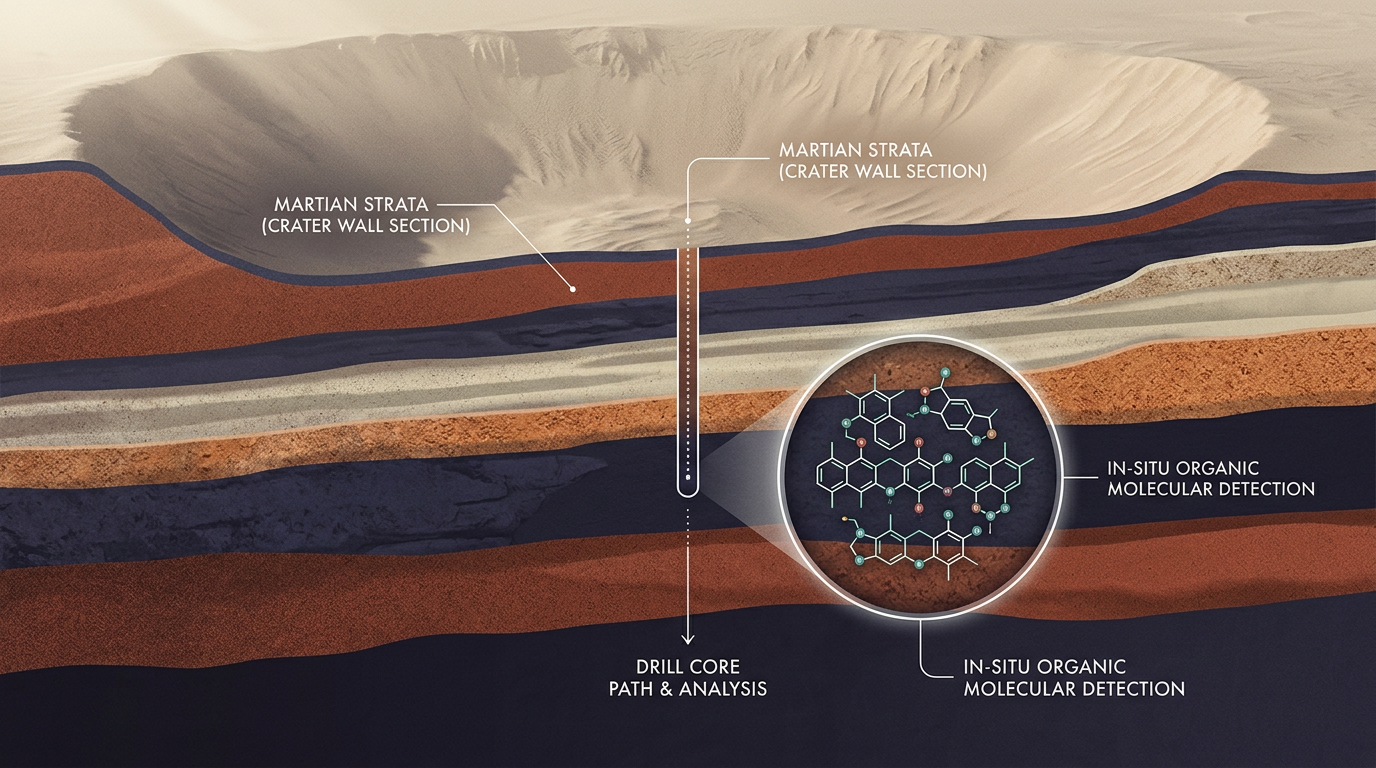
The Gale Crater has long served as a geological archive of Mars' wetter, more hospitable past. Recent data from NASA's Curiosity rover has added a significant entry to that record: a diverse suite of organic molecules, including a nitrogen-bearing compound with a structure similar to the precursors of DNA. It is a level of chemical complexity that, until now, had eluded detection on the Red Planet.
The discovery does not provide a definitive confirmation of extraterrestrial life, but it does refine the parameters of what was once chemically possible on Mars. These molecules are the essential scaffolding of biological systems. Their presence suggests that ancient Mars possessed the necessary ingredients to support prebiotic chemistry — or perhaps something beyond it.
From simple carbon to complex nitrogen-bearing structures
Curiosity has been analyzing Martian soil and rock samples since its landing in the Gale Crater in 2012, using its Sample Analysis at Mars (SAM) instrument suite — a set of tools designed to heat samples and identify the gases they release. Over the years, the rover has detected simple organic molecules such as chlorobenzene and thiophenes. Each finding represented a step forward, but none carried the structural complexity now reported.
The identification of nitrogen-bearing organic compounds marks a qualitative shift. Nitrogen is a critical element in the architecture of amino acids and nucleobases, the molecular building blocks of proteins and nucleic acids respectively. On Earth, these compounds are inextricable from biology. On Mars, their detection does not carry the same implication by default — nitrogen-containing organics can also form through abiotic processes, including meteoritic delivery and photochemical reactions in planetary atmospheres. But the specific variety and structural character of the molecules found in the Gale Crater narrow the range of plausible formation pathways and raise the analytical stakes considerably.
The Gale Crater itself is a compelling setting for such a discovery. The site is believed to have once hosted a lake system sustained over millions of years, with evidence of sedimentary layering, clay minerals, and fluctuating water chemistry. It is, in effect, the kind of environment where prebiotic chemistry could have had time and conditions to progress — a feature that distinguishes it from many other explored regions of Mars.
The line between chemistry and biology
As planetary scientists weigh the implications, the central challenge remains unchanged: distinguishing organic chemistry from biology. The presence of complex organic molecules is a necessary condition for life, but not a sufficient one. Meteorites that have landed on Earth, such as the Murchison meteorite that fell in Australia in 1969, have been shown to contain amino acids and nucleobases formed entirely through non-biological processes. Mars, bombarded by similar material over billions of years, could have accumulated organic complexity without any living system ever emerging.
What makes the Gale Crater findings notable is not any single molecule in isolation but the ensemble — the diversity of compounds, their structural specificity, and their geological context within an ancient habitable environment. Taken together, these factors do not prove biology, but they make the abiotic explanation work harder.
The discovery also reframes expectations for upcoming missions. NASA's Perseverance rover, operating in Jezero Crater — another ancient lake bed — is collecting sealed rock samples intended for eventual return to Earth, where laboratory instruments far more sensitive than anything deployable on Mars could analyze them. The European Space Agency's Rosalind Franklin rover, designed to drill beneath the Martian surface where organic molecules would be better shielded from radiation degradation, represents another vector of investigation. Each mission builds on findings like Curiosity's, refining where and how to look.
The trajectory of Mars exploration has moved from asking whether the planet was ever habitable to asking what kind of chemistry its habitable environments actually produced. Curiosity's latest results push that inquiry further along the spectrum — closer to biology, but not yet there. Whether the gap closes depends less on a single dramatic revelation and more on the slow accumulation of molecular evidence, sample by sample, crater by crater. The question is no longer whether Mars had the right conditions. It is what those conditions ultimately yielded.
With reporting from Olhar Digital.
Source · Olhar Digital