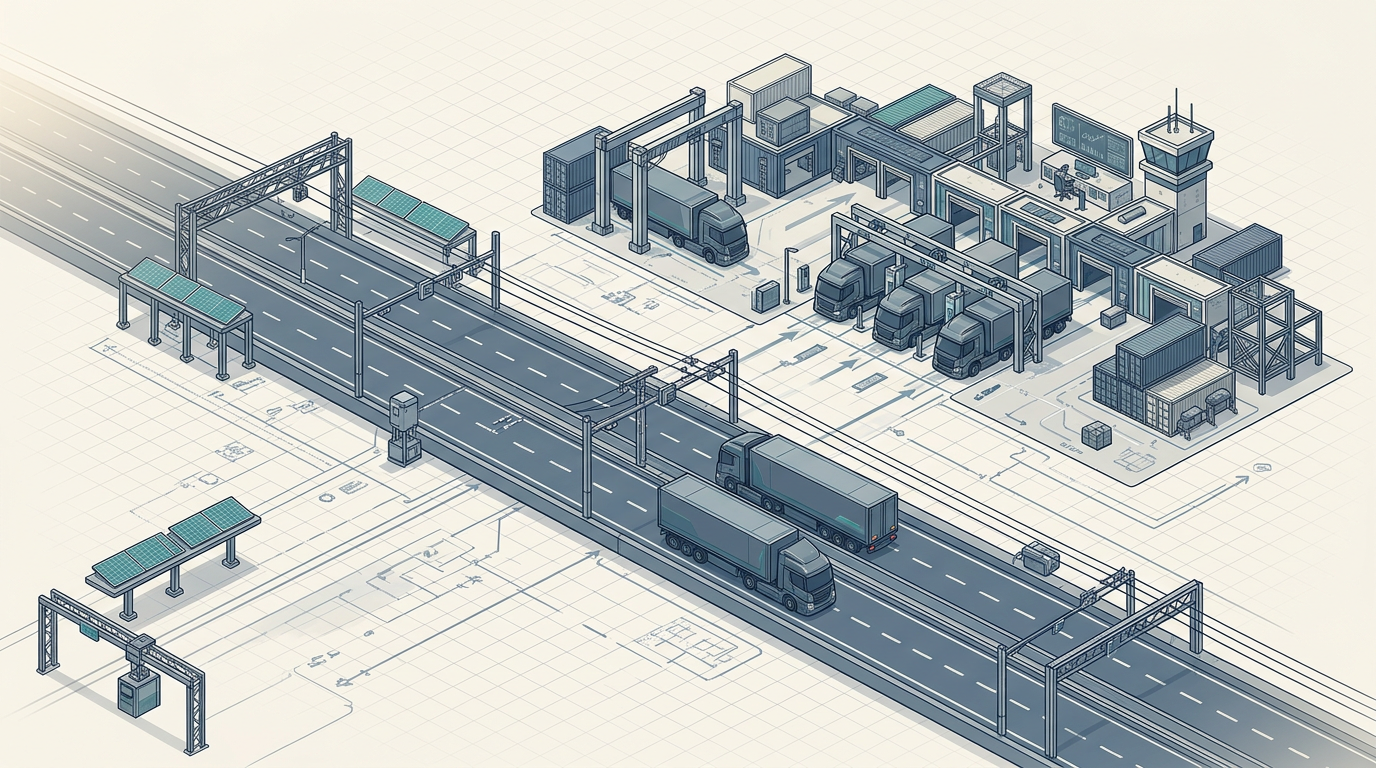
The logistics of the future are increasingly being written in the industrial hubs of China, where DeepWay is attempting to bridge the gap between experimental autonomous technology and the grueling demands of long-haul freight. The Hefei-based company, backed by search giant Baidu, recently secured $310 million in pre-IPO financing. The round is notable not just for its size, but for its composition: the inclusion of an Australian superannuation fund suggests that DeepWay's vision for clean, automated shipping is beginning to resonate with institutional capital far beyond its domestic borders.
To date, DeepWay has delivered 6,400 intelligent electric heavy-duty trucks within China — a significant fleet size for a sector still grappling with the complexities of real-world deployment. As it prepares for a public listing on the Hong Kong stock market, the company is signaling its intent to transition from a regional player to a global contender in autonomous logistics.
The convergence of electrification and autonomy
DeepWay's strategy hinges on a dual thesis: that long-haul trucking can be simultaneously electrified and automated, and that combining both transitions into a single platform creates a defensible advantage over companies pursuing only one. The logic is straightforward in theory. Electric powertrains reduce fuel costs and emissions; autonomous driving software reduces labor costs and human-error risk. Together, they promise to reshape the unit economics of freight in ways that neither technology achieves alone.
The challenge is that each transition, taken individually, remains unsolved at scale. Battery-electric trucks face range limitations and charging infrastructure gaps that make them difficult to deploy on routes exceeding a few hundred kilometers. Autonomous driving, meanwhile, continues to face regulatory uncertainty and edge-case safety questions that have slowed commercialization across the industry. Combining the two multiplies the engineering complexity.
DeepWay's approach — integrating autonomous driving capabilities with a purpose-built electric powertrain — mirrors a broader pattern in Chinese industrial policy, where government support for both electric vehicles and autonomous systems has created favorable conditions for companies willing to pursue vertical integration. Baidu's involvement is central to this equation. The company operates Apollo, one of the most extensive autonomous driving platforms in China, and its software stack gives DeepWay access to perception, mapping, and decision-making tools that would be prohibitively expensive for a standalone hardware startup to develop independently.
Capital, credibility, and the road to Hong Kong
The $310 million pre-IPO round serves a dual purpose. It provides the capital necessary to expand manufacturing and begin international market entry, but it also functions as a credibility signal ahead of a Hong Kong listing. The participation of international institutional investors — particularly a superannuation fund, a category of allocator known for long time horizons and conservative risk frameworks — lends the round a weight that purely domestic financing would not carry.
Still, the path to commercial viability remains steep. Like many of its peers in the capital-intensive hardware space, DeepWay has yet to turn a profit. Autonomous trucking startups globally have faced a pattern of high initial enthusiasm followed by sobering encounters with the cost of scaling physical operations. Several Western competitors have narrowed their ambitions or pivoted to asset-light software licensing models after discovering that building and deploying trucks at scale demands a different kind of organizational discipline than developing algorithms.
DeepWay's fleet of 6,400 delivered trucks gives it an operational footprint that few autonomous freight companies anywhere can match. Whether that footprint translates into sustainable economics — or simply into a larger base of capital-consuming assets — is the question the Hong Kong IPO will ultimately test.
The upcoming listing arrives at a moment when public markets have grown more skeptical of autonomous vehicle companies that promise transformation without demonstrating a clear path to profitability. At the same time, freight decarbonization remains a policy priority across major economies, and the appetite for credible solutions has not diminished. DeepWay sits at the intersection of these two forces: investor caution on one side, structural demand on the other. How the market weighs one against the other will say as much about the state of autonomous trucking as it does about the company itself.
With reporting from The Next Web.
Source · The Next Web