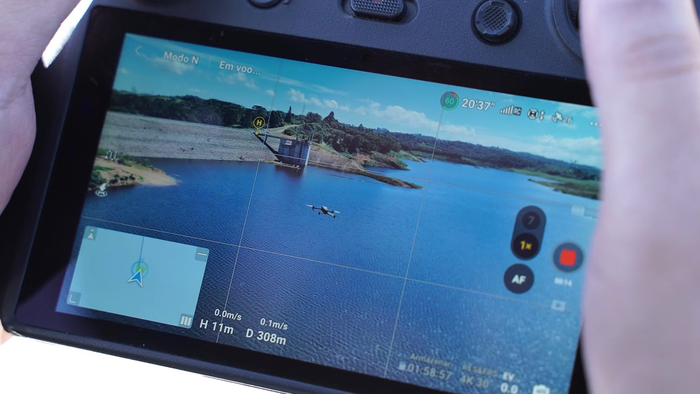
The Miringuava Reservoir in southern Brazil is undergoing a quiet but consequential digital transformation. Sanepar, the state of Paraná's water and sanitation utility, has deployed a fleet of drones and high-precision sensors to map the basin's topography with a level of granularity previously reserved for high-end urban planning. By capturing thousands of aerial images from an altitude of 120 meters and anchoring them with high-precision GNSS antennas — Global Navigation Satellite Systems that triangulate position data from multiple satellite constellations — engineers have produced a digital terrain model with a resolution of 20 centimeters. That represents a massive leap from the five-meter contour lines used in previous decades to plan and manage the same infrastructure.
The result is what the industry calls a digital twin: a virtual replica of a physical asset detailed enough to run simulations against real-world scenarios. In this case, the twin allows Sanepar's engineers to model how the reservoir fills under different rainfall regimes, how it behaves during extreme drought, and how water levels interact with the surrounding terrain and ecosystem. For the Curitiba metropolitan region, which the Miringuava Reservoir is designed to help supply, the stakes are not abstract. Southern Brazil has experienced increasingly erratic precipitation cycles in recent years, and the gap between peak supply and peak demand continues to narrow.
From cartography to prediction
The shift from static contour maps to dynamic, centimeter-resolution models reflects a broader trend in infrastructure management. Digital twins originated in aerospace and manufacturing, where companies like NASA and later industrial firms used virtual replicas to monitor equipment performance and anticipate failures. Over the past decade, the concept has migrated into civil infrastructure — bridges, power grids, and now water systems. The underlying logic is the same: if the model is precise enough, it becomes cheaper and faster to test scenarios digitally than to wait for reality to deliver its verdict.
What makes the Miringuava project instructive is the context in which it operates. Brazil's water infrastructure was largely built during decades of rapid urbanization, often using survey data that was adequate for construction but insufficient for the kind of predictive management that climate volatility now demands. Retrofitting that legacy infrastructure with modern sensing technology — drones, GNSS, photogrammetry — is not a replacement for physical upgrades, but it changes the decision-making framework. Engineers can identify vulnerabilities before they manifest as crises, allocate maintenance budgets with greater precision, and justify capital investments with simulation data rather than historical averages that may no longer hold.
The project also illustrates a practical, less glamorous application of drone technology. Beyond flood and drought simulation, the high-resolution data helped manage the final stages of vegetation removal in the reservoir's footprint, ensuring that clearing was executed with surgical accuracy. That kind of operational detail rarely makes headlines, but it is where digital twins deliver compounding value — not in a single dramatic insight, but in dozens of incremental decisions made with better information.
The resource that resists abstraction
Water infrastructure occupies an unusual position in the digital-twin landscape. Unlike a jet engine or a factory floor, a reservoir is an open system shaped by weather, geology, land use, and political decisions about allocation. Modeling it with fidelity requires not just topographic precision but integration with hydrological, meteorological, and demand-side data. The 20-centimeter terrain model is a foundation, not a finished product.
Cities across the world face a version of the same problem. Urban populations continue to grow, climate patterns are shifting faster than infrastructure replacement cycles, and the cost of building new reservoirs or treatment plants is rising. The appeal of digital twins in this context is that they extend the useful life and operational intelligence of existing assets — a pragmatic response to constraints that are unlikely to ease.
Whether Sanepar's approach becomes a template for other Brazilian utilities or remains an isolated initiative depends on factors that extend well beyond technology: regulatory incentives, institutional capacity, and the willingness to invest in monitoring systems whose payoff is measured in avoided crises rather than visible construction. The tension between long-term resilience planning and short-term budget pressures is familiar to every public utility. What has changed is the cost of ignorance — and the falling cost of the tools that can reduce it.
With reporting from Canaltech.
Source · Canaltech