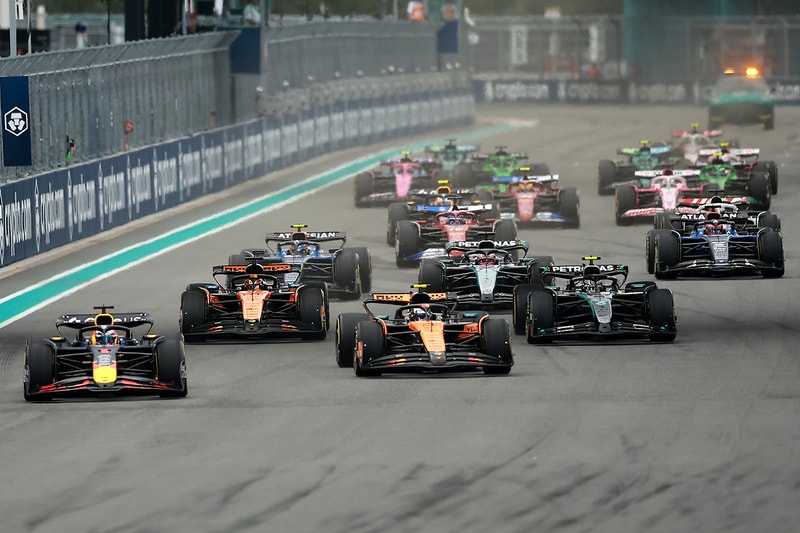
The pursuit of efficiency in Formula 1 often collides with the raw mechanics of safety. Ahead of the Miami Grand Prix, the FIA and F1 stakeholders have finalized a series of technical refinements for the 2026 season, designed to mitigate the risks inherent in the sport's next-generation hybrid power units. The adjustments follow an emergency summit where team principals and manufacturers addressed growing concerns over extreme speed differentials — a phenomenon where cars harvesting energy move significantly slower than those on a full-deployment lap.
The catalyst for this regulatory pivot was a high-profile collision at Suzuka involving Oliver Bearman and Franco Colapinto, which highlighted the dangers of "lift-and-coast" tactics — the practice of drivers lifting off the throttle early and coasting into corners to conserve battery energy. Under the new framework, the maximum permitted energy recharge during qualifying has been reduced from 8MJ to 7MJ. By tightening the parameters of energy management, the FIA aims to ensure that drivers can maintain more consistent speeds, reducing the hazardous "superclip" effect that occurs when a car abruptly loses power at the end of a straight to harvest energy.
A Familiar Tension Between Innovation and Safety
The 2026 regulations represent the most ambitious overhaul of Formula 1's technical framework since the hybrid era began in 2014. That earlier transition introduced turbocharged V6 engines paired with energy recovery systems, a shift that drew criticism for muffled engine notes and complexity but ultimately reshaped the sport's engineering culture. The 2026 rules push further: a greater share of total power is expected to come from the electric motor, making energy deployment strategy even more central to lap performance.
The problem, as the Suzuka incident underscored, is that energy harvesting creates variable speeds on track. When one car is in a recharge phase — deliberately shedding speed to replenish its battery — and another is on a full-power deployment lap, the closing rates between the two can become dangerous. This is not an entirely new concern. Throughout the hybrid era, teams have managed energy deployment to optimize lap times, but the 2026 power units amplify the effect. The electrical component accounts for a larger proportion of total output, meaning the gap between a car harvesting and a car deploying is wider than anything the sport has previously experienced.
Reducing the qualifying recharge ceiling from 8MJ to 7MJ is a calibrated response. It limits how aggressively teams can harvest on track, which in turn narrows the speed differential between cars in different energy states. The trade-off is a marginal reduction in the total electrical energy available per lap, which may compress qualifying performance slightly but keeps closing speeds within safer margins.
The Starting Grid and the Limits of Regulation
Beyond energy harvesting, the updated rules introduce a low-power start detection system to eliminate hazards on the starting grid. The concern here is distinct but related: if a car fails to deploy adequate power off the line, it becomes a near-stationary obstacle for the field accelerating behind it. A detection system that flags low-power conditions before lights-out adds a procedural safeguard to what has historically been one of the most chaotic moments in any race.
These tweaks reflect a broader tension in modern motorsport — the need to project a future of sustainable, high-tech engineering while preserving the flat-out, visceral competition that defines the sport. Formula 1 has staked its commercial and regulatory identity on the hybrid platform. Manufacturers entering or remaining in the sport have done so partly on the premise that the technology has road-car relevance. Walking back the electrical ambition entirely is not a realistic option. But neither is a regulatory framework that produces speed differentials dangerous enough to cause serious incidents.
The question facing the FIA is whether incremental adjustments — a megajoule here, a detection system there — can resolve what may be a structural issue with the 2026 concept. If the fundamental architecture demands aggressive energy harvesting to be competitive, teams will find ways to push the boundaries of whatever limits are set. Regulation in Formula 1 has always been a moving target; the sport's engineers are paid to find performance within constraints, and often at the edges of them. Whether the Miami-era tweaks hold through the season or invite further revision will depend on how the cars behave once the theory meets the tarmac.
With reporting from Hypebeast.
Source · Hypebeast