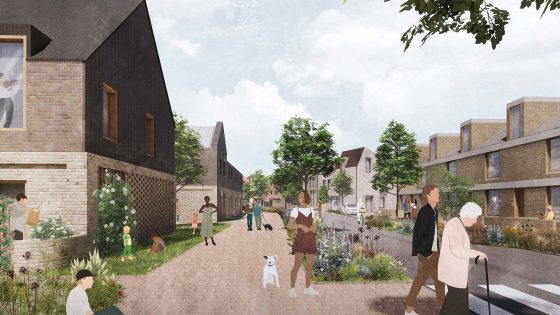
A proposed 7,750-home development in Essex is drawing attention as a potential template for the United Kingdom's next generation of new towns. Led by a team of prominent architects, the garden city-style project aims to demonstrate how large-scale residential planning can integrate housing delivery with environmental design, community infrastructure, and long-term stewardship — principles that have historically struggled to survive contact with commercial development pressures.
The proposal arrives at a moment when the political appetite for new towns in England has returned with unusual force. The current government has signaled ambitions to accelerate housebuilding at scale, and garden city principles — originally articulated by Ebenezer Howard in the late nineteenth century — have resurfaced as a conceptual framework for doing so. Howard's original vision combined affordable housing, green space, and community ownership of land value uplift. Whether any modern development can faithfully translate those ideals into built reality remains an open and contested question.
The Garden City Tradition and Its Modern Tensions
The garden city movement produced two canonical examples in England: Letchworth, begun in 1903, and Welwyn Garden City, started in 1920. Both were planned as self-contained communities with generous green space, mixed land uses, and mechanisms to capture rising land values for community benefit. The post-war new towns programme — which delivered places like Milton Keynes, Stevenage, and Harlow — drew on similar planning ambitions, though with varying degrees of fidelity to Howard's original social model.
What distinguished the early garden cities was not merely their physical layout but their governance structure. Land was held in trust, and increases in value were reinvested locally rather than extracted by private landowners. Modern proposals that invoke the garden city label often adopt the aesthetic vocabulary — green corridors, walkable neighbourhoods, mixed-use centres — without replicating the economic model that underpinned the originals. The Essex scheme's capacity to serve as a genuine blueprint depends in large part on whether it addresses this structural dimension or confines itself to design quality alone.
The involvement of a roster of established architects is notable. Large-scale housing delivery in England has been dominated by volume housebuilders whose commercial incentives tend to favour standardised product over placemaking. Architect-led masterplanning at this scale signals an ambition to prioritise design coherence, though the history of British new towns suggests that the quality of the initial vision matters less than the institutional arrangements that govern delivery over decades.
What a Blueprint Requires Beyond Design
For any single development to function as a replicable model, it must demonstrate viability across multiple dimensions: planning consent, infrastructure funding, community governance, and long-term maintenance of shared assets. The post-war new towns had the advantage of development corporations with compulsory purchase powers and central government backing. Contemporary proposals operate in a more fragmented institutional landscape, where local authorities face capacity constraints and infrastructure funding often depends on complex negotiations between developers and public bodies.
Essex itself presents a specific context. The county sits within London's commuter belt, where housing demand is persistent but where local opposition to large-scale development — often characterised as the politics of the green belt — has historically constrained supply. A garden city proposal in this geography must navigate not only planning policy but the deeper political economy of land use in south-east England.
The question the Essex scheme raises is whether design excellence and environmental ambition can be institutionalised at scale, or whether they remain dependent on the particular alignment of willing landowners, sympathetic planning authorities, and architects with sufficient influence to resist value engineering. The garden city label carries aspirational weight, but the distance between aspiration and delivery has historically been where such projects succeed or fail. Whether this proposal can bridge that gap — and whether its lessons prove transferable to other sites with different ownership structures and political conditions — remains the central tension to watch.
With reporting from Architects Journal.
Source · Architects Journal