The European Commission's Horizon Europe program, a €95 billion research and innovation initiative launched in 2021, has placed the continent's urban fabric at the center of its climate adaptation agenda. One of the more structurally ambitious projects to emerge from that agenda is ReGreeneration, a transnational consortium led by C40 Cities that brings together nine municipalities, research institutions, and design firms including ARUP. Its mandate: to rethink the fundamental mechanics of the neighborhood as a unit of climate resilience.
The project operates on a premise that is gaining traction across European urban policy — that the traditional European city, characterized by dense masonry, impervious surfaces, and rigid gray infrastructure, is increasingly mismatched with the thermal and hydrological realities of a warming continent. To preserve livability, the consortium advocates for what it calls "urban renaturing," an approach that integrates ecological systems directly into the built environment. The term signals something more than the aesthetic addition of greenery to streetscapes. It describes a systemic overhaul of how public health, infrastructure, and neighborhood-scale design interact.
From gray infrastructure to living systems
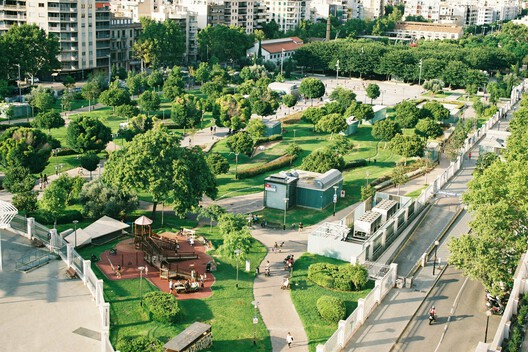
The concept of renaturing sits within a broader shift in urban design thinking that has accelerated over the past decade. Nature-based solutions — green roofs, bioswales, permeable pavements, urban wetlands — have moved from the margins of landscape architecture into mainstream infrastructure planning. Cities like Copenhagen, Rotterdam, and Singapore have become reference cases for integrating water management and biodiversity into dense urban cores. What distinguishes the ReGreeneration framework is its scale of ambition: rather than retrofitting individual buildings or parks, it targets the neighborhood as the operative unit of transformation.
The "complete neighborhood" concept that underpins the project borrows from decades of urban planning discourse around walkability, mixed-use zoning, and the 15-minute city. But it layers on an ecological dimension that earlier iterations largely lacked. A complete neighborhood, in this framing, is not merely one where residents can access services on foot. It is one where biological systems — tree canopy, soil permeability, water retention capacity — actively co-manage the environmental stresses that gray infrastructure alone can no longer absorb. Heat islands, flash flooding, and air quality degradation are treated not as externalities to be mitigated after the fact, but as design parameters from the outset.
By distributing the project across nine distinct cities, the consortium creates a set of living laboratories operating under different climatic, regulatory, and cultural conditions. This geographic diversity is deliberate. A solution that functions in a Nordic city with moderate summer temperatures may fail in a Mediterranean context where peak heat loads are far more severe. The cross-city structure is designed to test which interventions are genuinely transferable and which remain context-dependent.
The tension between scalability and specificity
The central challenge facing projects of this kind is familiar to anyone who has followed large-scale EU research initiatives: the gap between blueprint and implementation. Horizon Europe funds research and demonstration, but the actual adoption of new neighborhood typologies depends on municipal budgets, local building codes, land ownership structures, and political will — none of which the consortium controls. European cities have a long history of producing exemplary pilot districts that remain isolated showcases rather than replicable models.
There is also an inherent tension in the idea of a scalable blueprint for something as context-sensitive as urban ecology. Soil conditions, water tables, native plant species, and microclimates vary not just between cities but between neighborhoods within the same city. The more precisely a renaturing strategy is tuned to local conditions, the harder it becomes to generalize. The more it is generalized, the less ecologically effective it may prove.
What makes the ReGreeneration project worth tracking is not the certainty of its outcomes but the structural bet it represents: that the neighborhood, rather than the building or the city, is the right scale at which to integrate ecological function into urban form. Whether that bet produces durable change or another generation of well-documented pilots that struggle to propagate beyond their original sites remains the open question — one that will be answered less by the consortium's research than by the political and fiscal choices of the municipalities that host it.
With reporting from ArchDaily.
Source · ArchDaily