The global energy transition demands more than the substitution of fossil fuels for cleaner alternatives. It raises an uncomfortable question about legacy: what should be done with the landscapes left behind by decades of extraction? Across Central Europe, open-pit lignite mining carved out enormous voids in the earth, displacing communities and stripping topsoil on an industrial scale. In the Lusatian region of eastern Germany, straddling the states of Brandenburg and Saxony between Berlin and Dresden, the answer has taken the form of one of the most ambitious land reclamation projects ever attempted.
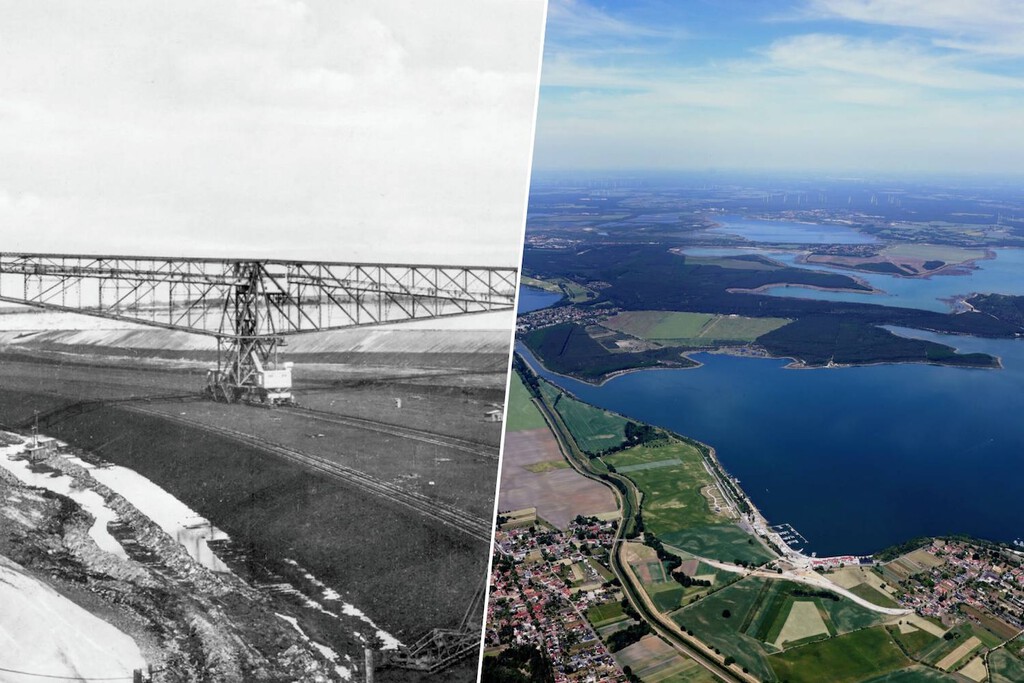
The Lusatian Lake District — Lausitzer Seenland in German — is a network of 23 artificial lakes covering some 13,600 hectares, built within the craters of exhausted lignite mines. Coordinated by LMBV, the state-owned company responsible for rehabilitating former mining sites in eastern Germany, the project has progressed over more than two decades. Ten of the lakes are now linked by navigable canals, producing a continuous water surface of roughly 7,000 hectares. Where colossal bucket-wheel excavators once stripped the earth in terraces, marinas, beaches, cycling paths, and tourism infrastructure have taken their place.
Engineering a Second Life for Extractive Landscapes
The technical challenge of flooding an open-pit mine is far from trivial. Lignite extraction in Lusatia left behind pits that in some cases reached depths of more than a hundred meters, with unstable slopes and acidic groundwater. Filling these voids required careful hydrological planning: controlling water inflow rates to prevent landslides, treating acidity, and designing canal locks that allow small vessels to pass between lakes at different elevations. The process of flooding a single pit can take years, and water quality monitoring continues long after a lake is nominally complete.
Germany's experience in Lusatia sits within a broader European tradition of post-mining rehabilitation. The Ruhr Valley, once the beating heart of German coal and steel, underwent its own decades-long metamorphosis beginning in the 1980s, converting slag heaps and derelict factories into parks, cultural venues, and university campuses. Finland and the Czech Republic have pursued similar, if smaller-scale, conversions of mining sites. What distinguishes the Lusatian project is its sheer scale and its explicit orientation toward water-based recreation and tourism — a bet that leisure economies can replace extractive ones in regions that lost their economic rationale when the mines closed.
Tourism as Remediation Strategy
The economic logic is straightforward in principle, though difficult in execution. Lusatia was among the regions hardest hit by German reunification and the subsequent decline of lignite. Population loss and structural unemployment persisted for years. Turning the lakes into a tourism destination offers a pathway — partial, at least — toward new employment and regional identity. Hotels, water sports operators, and gastronomy businesses have begun to cluster around the more developed lakes, and cycling routes connecting the district have drawn visitors from Berlin and Dresden alike.
Yet the model carries tensions worth watching. Tourism employment tends to be seasonal and lower-paid than the industrial jobs it notionally replaces. The long-term ecological stability of artificial lakes built on former mining substrates remains an open question; acid mine drainage and sediment behavior can produce surprises decades after flooding. And the very success of the concept could generate pressure to accelerate development in ways that compromise the environmental remediation goals that justified the project in the first place.
What Lusatia offers is less a finished template than a live experiment. It demonstrates that post-extractive landscapes need not remain sacrifice zones — but it also surfaces the harder question of whether recreational redevelopment can sustain communities at the scale that mining once did. The lakes are filling. Whether the economic and ecological promises attached to them will prove equally durable is a matter the coming decade will test.
With reporting from Xataka.
Source · Xataka