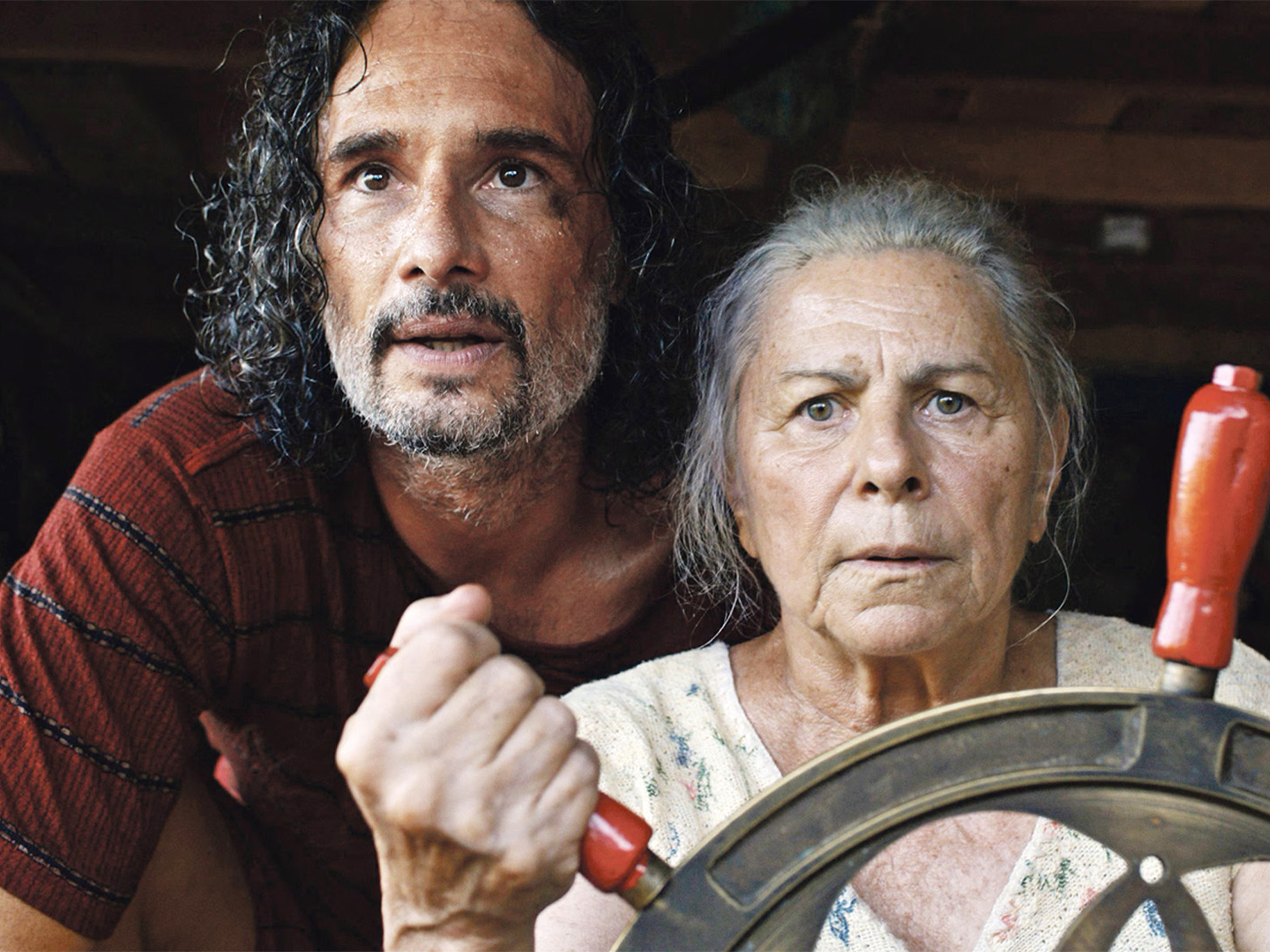
In Gabriel Mascaro's The Blue Trail, the state's interest in the elderly is framed as a "patriotic duty," though the reality is far more clinical. The film presents a dystopian Brazil where citizens, upon reaching a certain age, are marked with gold-plated laurels and eventually carted off to senior citizen colonies. It is a world where the "wrinkle wagon" serves as a tool of social hygiene, clearing the streets of the aged to unburden the productive youth.
The narrative centers on 77-year-old Tereza, played with weary defiance by Denise Weinberg. Her world collapses when the government abruptly lowers the mandatory relocation age from 80 to 75, stripping her of her professional life and placing her under the total guardianship of her daughter. Rather than submit to a state-sponsored erasure, Tereza flees, turning a story of forced retirement into a surreal voyage of resistance.
Dystopia as Social Diagnosis
Mascaro has built a body of work around the quiet violence of Brazilian institutions. His earlier features — Neon Bull (2015), set among rodeo workers in the Northeast, and Divine Love (2019), which imagined a near-future Brazil governed by evangelical fervor — share a method: take a recognizable social pressure, push it a few degrees past the present, and observe what it reveals about the structures already in place. The Blue Trail applies the same logic to aging and state care. The mandatory relocation policy at the film's center is fictional, but the anxieties it dramatizes are not. Across much of the industrialized world, governments grapple with the fiscal and social implications of aging populations. Debates over pension reform, elder care infrastructure, and intergenerational economic burden are perennial. Mascaro's contribution is to render these policy abstractions as lived experience — to ask what it feels like to be reclassified from citizen to liability.
The film's dystopian apparatus — gold-plated laurels, state-run colonies, the euphemistic "wrinkle wagon" — carries echoes of speculative traditions that stretch from Soylent Green to Kazuo Ishiguro's Never Let Me Go. But where those works often lean toward allegory about mortality or resource scarcity, The Blue Trail stays closer to the bureaucratic texture of exclusion. The horror is not spectacular. It is procedural: a form signed, an age threshold lowered, a life quietly reclassified.
Visual Tension and the Body in Landscape
Mascaro and cinematographer Guillermo Garza use a boxy aspect ratio to heighten the sense of claustrophobia, yet the landscapes — rivers choked with rubber tires and winding waterways — feel expansive and untamed. This visual tension mirrors Tereza's own struggle: an attempt to break free from the rigid boundaries of a society that views her existence as a logistical problem to be solved. The choice of aspect ratio is deliberate in its discomfort. The narrowed frame confines Tereza even as she moves through open terrain, a formal reminder that escape from institutional logic is never simply a matter of geography.
Denise Weinberg's performance anchors this tension physically. Tereza's resistance is not articulated through speeches or dramatic confrontation. It is carried in the body — in the pace of her movement, in her refusal to perform frailty on the state's terms. The film asks its audience to sit with the dissonance between a woman who is evidently capable and a system that has already decided she is not.
Mascaro's Brazil is recognizable enough to unsettle. The bureaucratic language of care, the paternalism dressed as concern, the administrative efficiency with which lives are reorganized — none of it requires much imaginative distance. What remains open is whether the film's surreal register ultimately sharpens or softens that critique. The journey downriver gives Tereza a kind of freedom, but the world she has fled does not dissolve behind her. The structures persist. The question the film leaves is not whether Tereza can outrun the state, but whether a society that designs such systems can still recognize what it has chosen to discard.
With reporting from Little White Lies.
Source · Little White Lies