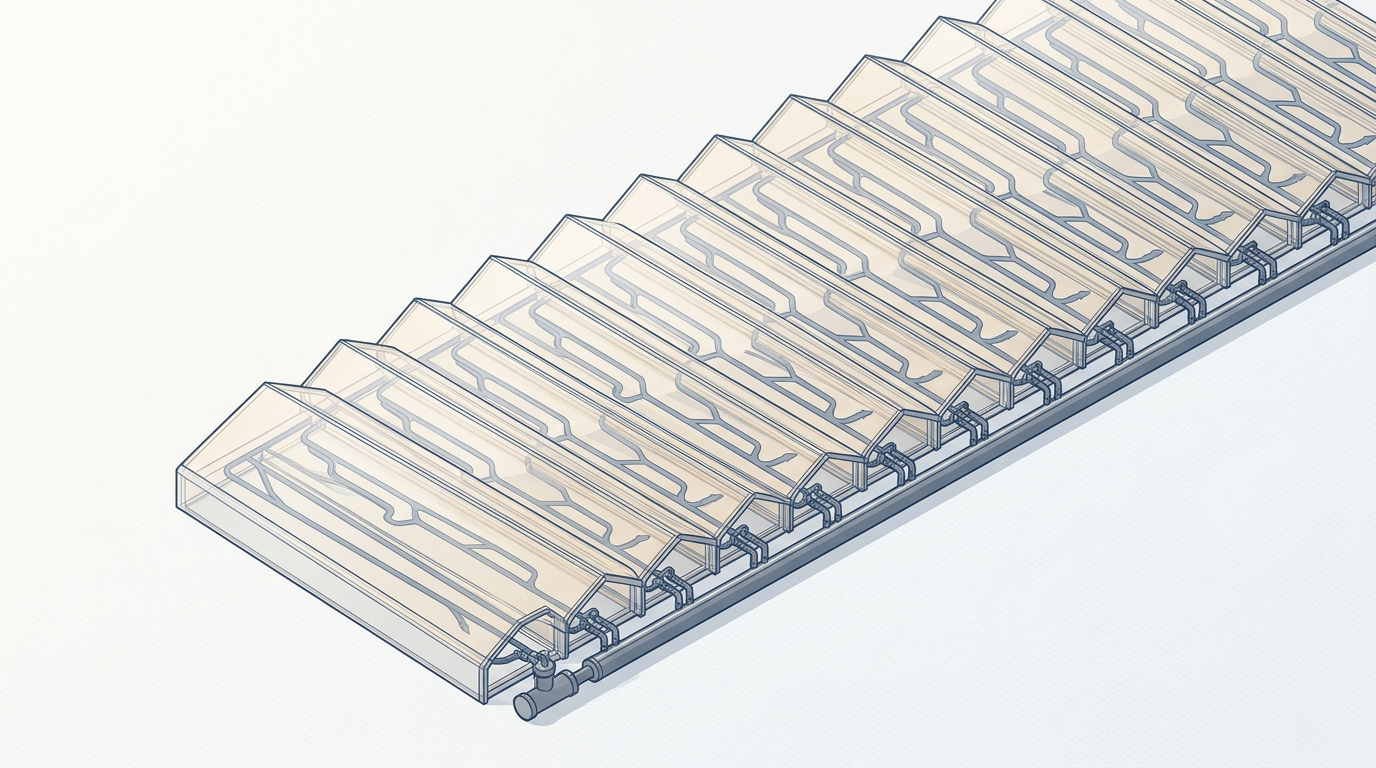
The prevailing strategy for decarbonizing heavy industry centers on green hydrogen, usually produced via massive electrolyzers powered by wind or solar farms. It is a process defined by scale, complexity, and significant capital expenditure. Researchers at the Karlsruhe Institute of Technology (KIT), however, are exploring a more direct alternative: a photoreactor that produces hydrogen from sunlight without routing energy through the electrical grid at all.
The KIT device resembles the translucent roofing panels of a modern greenhouse. Rather than generating electricity first and then feeding it into a separate electrolyzer — the two-step process that defines the current green hydrogen paradigm — the reactor uses photocatalytic water splitting. Specialized materials inside the panel absorb solar photons and use that energy to break water molecules into hydrogen and oxygen in a single integrated step. The approach eliminates the intermediate conversion losses inherent in conventional electrolysis chains, where energy is lost at each handoff between generation, transmission, and chemical conversion.
A simpler path to the same molecule
Photocatalytic water splitting is not a new concept. Research into semiconductor materials that can drive the reaction dates back to the early 1970s, when Japanese scientists first demonstrated the principle using titanium dioxide electrodes. For decades, the field struggled with two persistent problems: the efficiency of available photocatalysts was too low to be commercially meaningful, and the materials that performed best tended to be expensive or unstable under prolonged sunlight exposure.
What distinguishes the KIT effort is its emphasis on industrial practicality over laboratory performance records. The team has designed the reactor around inexpensive, mass-producible materials and a modular form factor intended for deployment across large surface areas. The logic is straightforward: if individual panel efficiency remains modest, the economics can still work if the panels themselves are cheap enough to blanket open land — particularly in regions with high solar irradiance. It is a philosophy borrowed, in some respects, from the early solar photovoltaic industry, which achieved grid parity not through dramatic efficiency breakthroughs alone but through relentless manufacturing cost reduction.
The greenhouse analogy is more than cosmetic. Agricultural greenhouses already occupy vast tracts of land in southern Europe, North Africa, and the Middle East. A hydrogen-producing panel system designed to integrate with or replace such structures could, in theory, repurpose existing infrastructure and land-use patterns rather than compete with them.
Decentralization as a design principle
The broader significance of the KIT approach lies in what it implies for the architecture of a future hydrogen economy. The dominant model today assumes centralized production: large electrolysis plants co-located with offshore wind farms or dedicated solar parks, connected to industrial consumers through pipelines or compressed-gas transport. That model carries substantial infrastructure costs and depends on regulatory frameworks for hydrogen transport that, in most jurisdictions, remain incomplete.
A modular photoreactor system points toward a different topology — one in which hydrogen is produced close to the point of use, in smaller quantities, without grid interconnection. For agricultural operations, remote industrial sites, or developing economies with limited grid infrastructure, decentralized production could sidestep the bottleneck of transmission entirely.
The technology remains in the transition between laboratory demonstration and commercial viability. Photocatalytic efficiencies reported in academic literature still trail those of mature electrolyzer systems by a considerable margin. Whether the cost advantages of simpler manufacturing can compensate for lower conversion rates at scale is an open engineering and economic question — one that field trials, rather than laboratory benchmarks, will ultimately answer.
The tension is clear: the established electrolysis pathway offers higher efficiency but demands grid-scale infrastructure and capital; the photoreactor pathway trades peak performance for radical simplicity and lower entry costs. Which model prevails may depend less on the chemistry itself than on where the hydrogen is needed and what infrastructure already exists to support its production.
With reporting from t3n.
Source · t3n