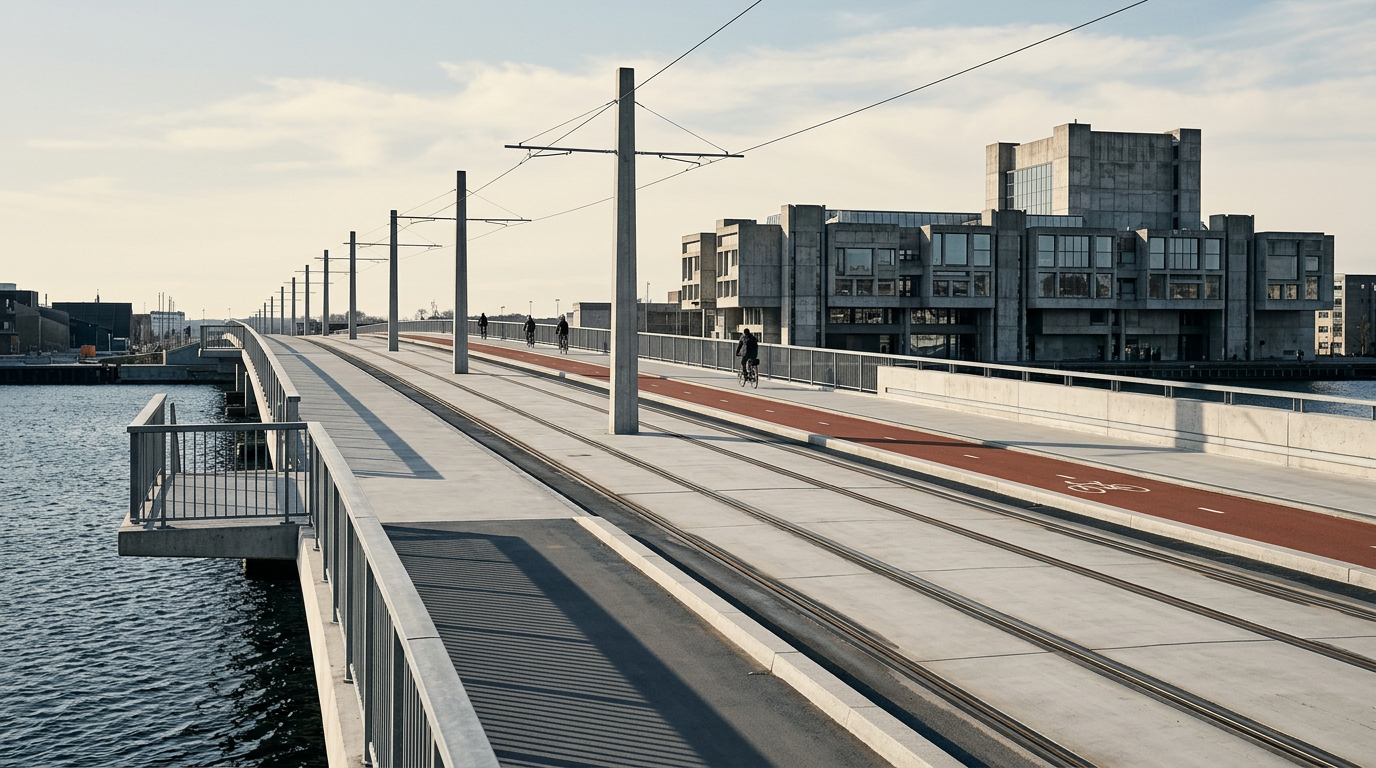
In mid-April, Helsinki inaugurated the Kruunuvuori Bridge, a 1.2-kilometer span that now stands as the longest in Finland. Despite its massive scale, the structure is notably absent of car lanes. Designed exclusively for pedestrians, cyclists, and the city's tram network, the bridge represents a significant material commitment to a post-automobile urbanism. During its opening weekend, more than 50,000 residents crossed the water on foot and bike, many wearing crowns in a nod to the bridge's name, which translates to "Crown Mountain."
The project, known as Kruunusillat (the Crown Bridges), has been a fixture of Helsinki's political discourse since 2002. It consists of three bridges forming a transit corridor to the eastern island of Laajasalo. While the planning took decades, construction only began in late 2021. The Kruunuvuori is the centerpiece of this effort, connecting Korkeasaari to the mainland with an engineering ambition typically reserved for major highways, yet repurposed here for the slow-moving rhythms of public life.
Infrastructure as ideology
The decision to exclude private vehicles from a bridge of this scale is not merely a traffic-management choice. It is an infrastructural statement about which modes of movement a city considers worth subsidizing with permanent, high-cost structures. Most long-span bridges built in the last century—from suspension crossings to cable-stayed motorway links—have been justified primarily by the throughput of automobiles. The Kruunuvuori inverts that logic. Its lanes are allocated to trams, which carry far more passengers per meter of roadway than private cars, and to cyclists and pedestrians, whose spatial footprint is a fraction of a vehicle's.
Helsinki is not the first Nordic capital to pursue this kind of reallocation. Copenhagen has spent decades expanding its cycling network and restricting car access in its center, while Oslo has progressively removed parking spaces from its downtown core. But the Kruunuvuori Bridge differs in degree: it is not a retrofit of existing space but a purpose-built piece of heavy infrastructure conceived from the outset without automotive accommodation. That distinction matters. Retrofitting streets for bikes and trams is politically reversible; a bridge designed for a 200-year lifespan is not.
The 200-year design target itself deserves scrutiny. Most modern infrastructure is engineered for service lives of 50 to 100 years. Designing for double that horizon implies not only higher material standards—denser concrete, more corrosion-resistant steel, wider tolerances for climate stress—but also a philosophical wager. It assumes that the modal priorities embedded in the structure today will remain relevant across a timeframe that encompasses technological shifts no engineer can predict. In that sense, the bridge is less a forecast than a declaration: Helsinki is building as though car-free transit corridors are not experimental but foundational.
The politics of permanence
Long planning timelines are common in Nordic infrastructure, but the Kruunusillat project's two-decade journey from proposal to ribbon-cutting illustrates the friction that accompanies even popular urban ideas. The corridor to Laajasalo had to survive multiple city council cycles, budgetary debates, and competing visions for eastern Helsinki's development. That it emerged intact—and without the addition of car lanes as a political compromise—speaks to a durable consensus in Finnish urban policy that may not translate easily to cities with different governance structures or automotive cultures.
The bridge also arrives at a moment when European cities are grappling with the economics of low-emission zones, congestion pricing, and transit expansion. Each of these policies faces pushback from residents and industries dependent on car access. Helsinki's approach sidesteps the retrofit debate entirely by creating new capacity that is car-free by design. Whether this model is replicable depends on geography—few cities have the island topography that makes a dedicated bridge corridor logical—and on the willingness of municipal governments to commit large capital budgets to non-automotive infrastructure.
The tension worth watching is between the bridge's intended permanence and the pace of urban change around it. Laajasalo's development will now be shaped by the transit link the Kruunuvuori provides, much as suburban growth in the twentieth century was shaped by highway access. The question is whether the communities that grow around a tram-and-bike corridor develop differently—denser, more walkable, less car-dependent—than those built along motorways. Helsinki has placed a 200-year bet that they will.
With reporting from Xataka.
Source · Xataka