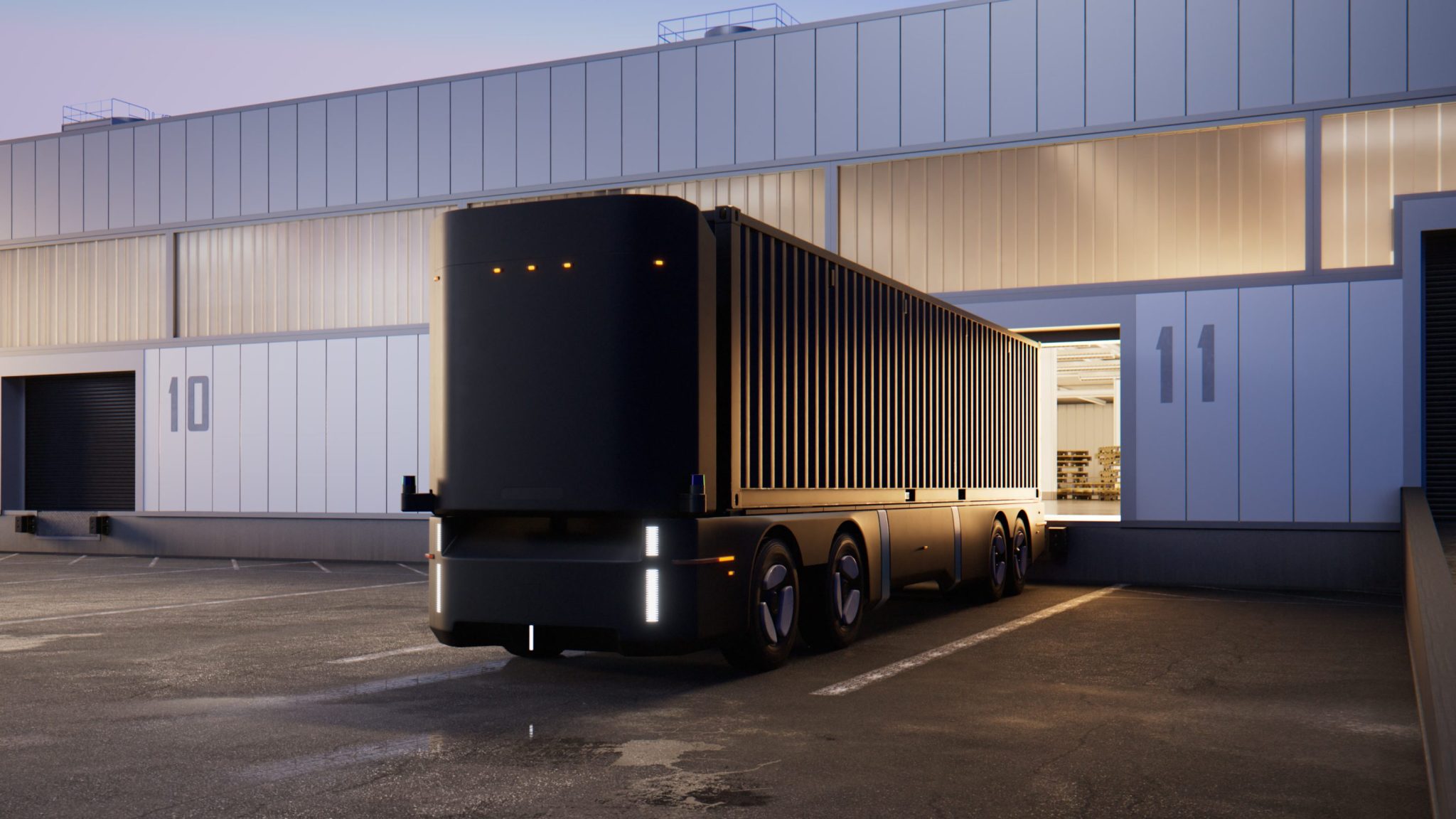
Humble, a San Francisco-based startup founded by former Otto engineer Eyal Cohen, has emerged from stealth with a $24 million seed round led by Eclipse to develop the Humble Hauler — a cabless, fully electric autonomous truck designed for dock-to-dock freight delivery. The vehicle eliminates the traditional driver's cab entirely, a design choice that the company says enables 360-degree sensor coverage and increased payload capacity.
The Hauler is built to transport standard 40-foot and 53-foot containers directly between loading docks, targeting the structured, repetitive middle-mile routes that dominate commercial freight logistics. Its autonomy stack relies on vision-language-action models rather than conventional rule-based systems, marking a departure from the approach that has defined most autonomous trucking efforts over the past decade.
A different entry point into autonomous freight
The autonomous trucking sector has, until now, been shaped largely by companies retrofitting existing cab-forward truck designs with sensor arrays and compute hardware. Aurora Innovation, Kodiak Robotics, and Gatik have each pursued variations of this strategy, layering autonomy onto platforms originally engineered around a human driver. The results have been mixed: sensor placement is constrained by the cab's geometry, and the economics of maintaining a full truck chassis — whether or not a driver is present — remain punishing.
Humble's approach sidesteps these constraints by designing the vehicle from scratch around the absence of a driver. Removing the cab frees up the entire forward profile for sensor placement, eliminates blind spots created by the cab structure, and reduces the vehicle's overall weight — potentially allowing more cargo per trip within regulatory weight limits. The concept is not entirely novel; several logistics-focused robotics companies have explored cabless or "skateboard" freight platforms in recent years. But Humble appears to be the first to pair a cabless electric chassis specifically with the latest generation of multimodal AI models for its autonomy stack.
The choice of vision-language-action (VLA) models is notable. These architectures, which have gained traction in robotics research since 2024, integrate visual perception with language-based reasoning and physical action planning in a single end-to-end framework. In theory, VLA models can generalize more effectively across novel driving scenarios than traditional modular stacks that rely on separate perception, prediction, and planning pipelines. Whether that theoretical advantage translates into the reliability required for unsupervised freight operations on public roads remains an open and consequential question.
The dock-to-dock bet
By targeting dock-to-dock operations — fixed routes between warehouses, distribution centers, and port terminals — Humble is narrowing its operational domain in a way that may accelerate deployment. Middle-mile freight corridors tend to be more predictable than last-mile urban delivery or long-haul interstate routes. The endpoints are controlled environments with standardized infrastructure, and the routes themselves often repeat daily with minimal variation.
This operational focus echoes a broader pattern in autonomous vehicle development: companies that constrain their initial deployment domain tend to reach commercial viability faster than those attempting general-purpose autonomy. Nuro's sidewalk delivery robots, Waymo's geofenced robotaxis, and Gatik's fixed-route box trucks all followed this logic. Humble's dock-to-dock framing fits squarely within that tradition.
The $24 million seed round, while substantial for a pre-revenue hardware startup, is modest relative to the capital intensity of autonomous vehicle development. Aurora and TuSimple each consumed billions before reaching limited commercial operations. Eclipse's involvement as lead investor signals confidence in the team — Cohen's background at Otto, the autonomous trucking company acquired by Uber in 2016, provides direct domain experience — but the path from seed funding to a commercially operating fleet will require significantly more capital and, critically, regulatory clearance for cabless vehicles on public roads.
That regulatory dimension may prove as consequential as the technology itself. Most U.S. states have not yet established clear frameworks for vehicles that lack any provision for a human operator on board. A cabless truck is not merely a driverless truck; it is a vehicle that cannot accommodate a driver even in principle. How federal and state regulators classify such a platform — and what safety standards they impose — will shape the timeline for any commercial deployment.
Humble enters a freight industry under persistent pressure from driver shortages, rising labor costs, and decarbonization mandates. The question is whether a cabless electric platform powered by frontier AI models can meet the reliability threshold that commercial shippers demand — or whether the design, however elegant in concept, encounters the same operational friction that has slowed every autonomous trucking program before it.
With reporting from Fortune.
Source · Fortune