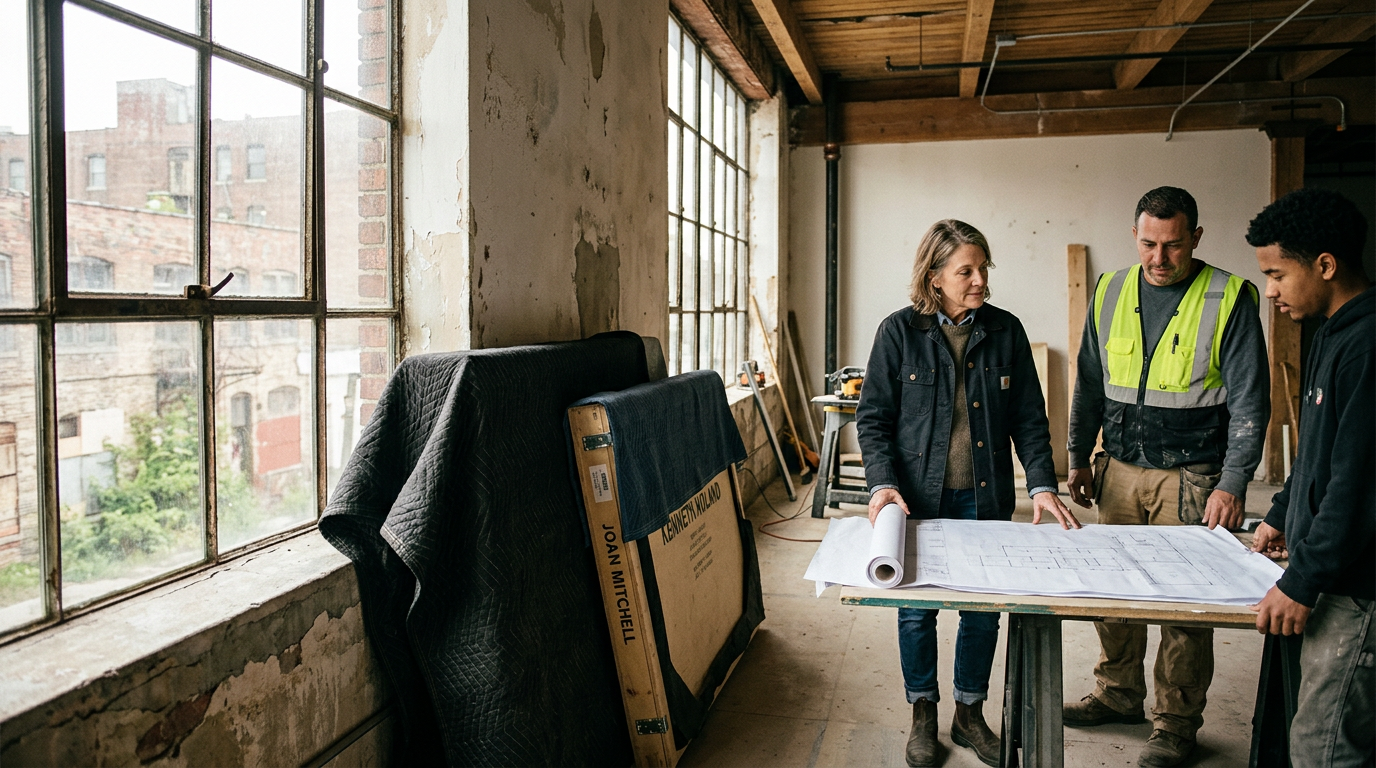
In an era where the art market often functions as a high-stakes storage facility for capital, philanthropist Jennifer Gilbert is attempting a strategic conversion. This spring, Gilbert will consign a curated selection of blue-chip midcentury works to Sotheby's, with the proceeds earmarked for Lumana — a burgeoning arts nonprofit and incubator located in Detroit's Little Village neighborhood. The sale, split between Sotheby's contemporary and design auctions, highlights a deliberate shift from private accumulation toward the creation of public-facing cultural infrastructure.
The consignment is anchored by Joan Mitchell's Loom II (1976), estimated at $5 million to $7 million, and Kenneth Noland's Circle (1958), which could set a new auction record for the artist if it reaches its $6 million upper estimate. Additional works by George Rickey and Harry Bertoia round out the offering. These selections reflect a calculated bet on stability: midcentury abstraction remains a dependable, if non-speculative, corner of the market at a time when demand for more volatile contemporary names has softened.
Liquidating the Canon to Build Something New
The mechanics of Gilbert's decision are worth examining on their own terms. Selling art to fund a nonprofit is not unprecedented, but the deliberateness of the portfolio construction here is notable. Mitchell and Noland occupy secure positions in the postwar American canon — the kind of artists whose auction results rarely collapse but also rarely spike. By choosing works with deep institutional recognition rather than speculative upside, Gilbert is optimizing for certainty of proceeds rather than maximum return. The logic mirrors that of an endowment liquidating conservative holdings to fund a capital project: the goal is not to win at auction but to convert stored value into operational capacity.
This approach also reflects a broader tension within the art market. Over the past decade, the secondary market for blue-chip postwar and midcentury work has functioned increasingly as a wealth-preservation mechanism — paintings as bearer assets, traded quietly between private collections and freeport storage. Gilbert's consignment moves in the opposite direction, pulling works out of that circuit and redirecting their value toward institution-building. Whether this registers as an anomaly or the beginning of a pattern may depend on how Lumana performs as a cultural venture.
Detroit's Long Arc of Creative Reinvestment
Lumana is set to occupy Stanton Yards, a site being reimagined as a multidisciplinary hub for artists and designers. Early programming plans involve a partnership with the Cranbrook Art Museum, nodding to the region's deep-seated history of industrial and furniture design. Cranbrook, located in nearby Bloomfield Hills, has for nearly a century served as one of the country's most influential incubators for design and architecture — its alumni include Charles and Ray Eames, Florence Knoll, and Eero Saarinen. A formal link between Lumana and Cranbrook would situate the new project within a lineage rather than presenting it as a blank-slate intervention.
For Detroit, a city whose architectural and artistic legacy is frequently cited but often under-resourced, the project represents a significant reinvestment in the local creative economy. The city has seen waves of cultural investment over the past fifteen years, some driven by institutional actors, others by individual philanthropists and developers. Results have been uneven. Initiatives that arrive with substantial capital but thin local ties have sometimes struggled to sustain programming beyond their launch phase. Lumana's location in Little Village and its emphasis on incubation rather than exhibition suggest an awareness of that history, though the test will come in execution.
There is a certain symmetry in the funding mechanism: midcentury American abstraction — the aesthetic output of a confident, industrializing nation — being liquidated to seed creative infrastructure in a city that was once the engine of that same industrial economy. Whether that symmetry carries real meaning or is merely poetic coincidence depends on what Lumana becomes. The capital is being unlocked. The harder question is whether a single philanthropic conversion, however well-structured, can anchor the kind of sustained cultural ecosystem that Detroit's creative community has long needed — or whether it will require the slower, less dramatic accumulation of public funding, local networks, and institutional patience that no single auction can provide.
With reporting from ARTnews.
Source · ARTnews