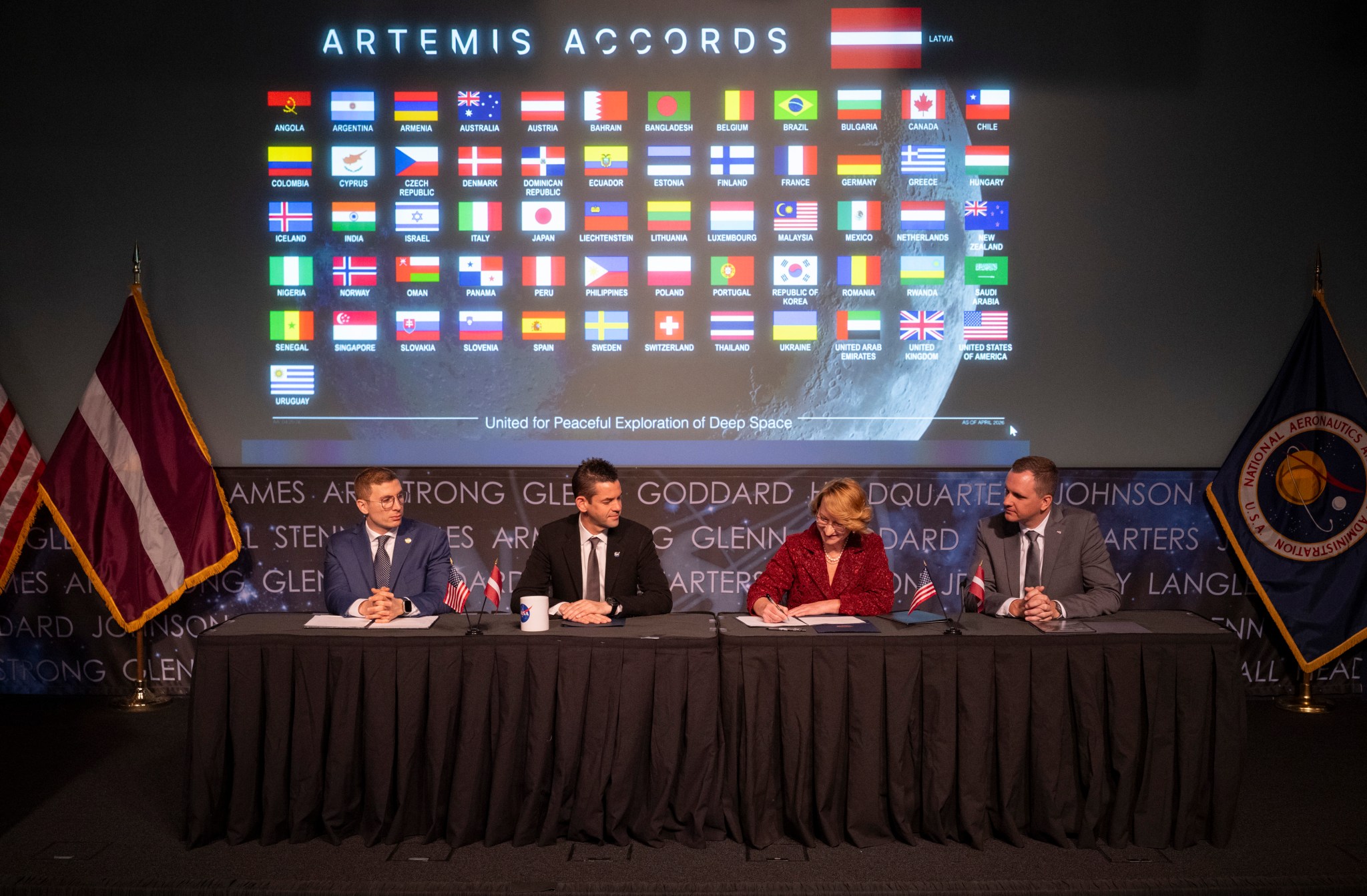
On April 20, 2026, the Republic of Latvia became the 62nd nation to sign the Artemis Accords, a non-binding multilateral agreement designed to govern the expanding landscape of lunar exploration. During a ceremony at NASA's headquarters in Washington, Minister for Education and Science Dace Melbārde formally committed the Baltic nation to a framework that emphasizes transparency, interoperability, and the peaceful use of space.
The Accords, established in 2020, serve as a diplomatic extension of the Outer Space Treaty of 1967, seeking to manage the logistical and ethical complexities of a sustained return to the Moon. For NASA, the inclusion of nations like Latvia is part of an ongoing effort to build broad geopolitical consensus around lunar norms. NASA Administrator Jared Isaacman noted that each new signatory reinforces a coalition aimed at establishing standards for "real missions and real cooperation" on the lunar surface.
A Small State With Strategic Alignment
Latvia is not typically associated with spacefaring ambition. It has no launch infrastructure, no crewed program, and no indigenous satellite manufacturing base of significant scale. Yet the decision to sign the Artemis Accords follows a pattern visible across dozens of smaller nations that have joined since 2020: alignment with the framework is less about immediate operational capability and more about positioning within an emerging governance architecture.
For a Baltic state that joined both NATO and the European Union in 2004, the logic is familiar. Latvia has consistently pursued security and economic integration through multilateral institutions. Signing the Accords extends that posture into a domain — outer space — where norms are still being written. The agreement's provisions on the registration of space objects, the release of scientific data, and the deconfliction of activities on the lunar surface offer a rules-based scaffold that smaller nations can invoke even without the capacity to mount their own missions.
Latvia's accession also carries a quiet signal within European space politics. The European Space Agency, of which Latvia is not a full member, has maintained a measured posture toward the Accords, with some major ESA contributors signing individually while the agency itself has pursued its own cooperative frameworks. Each European signatory shifts the center of gravity slightly, reinforcing the Accords' claim to represent a genuinely international — rather than narrowly American — consensus.
The Accords at Scale: Governance Without Enforcement
With sixty-two signatories, the Artemis Accords now encompass nations from every inhabited continent. The coalition spans spacefaring powers with active lunar programs and countries whose engagement with space remains largely aspirational. That breadth is both the framework's strength and its most conspicuous vulnerability.
The Accords are non-binding. They carry no enforcement mechanism, no dispute resolution body, and no penalties for non-compliance. Their authority rests on political commitment and the gravitational pull of the Artemis program itself — the logic being that nations wishing to participate in future lunar missions, or to benefit from the scientific and commercial activity those missions generate, will have strong incentives to adhere to the agreed principles.
Critical questions remain open. The provisions on the extraction and utilization of space resources, while grounded in Article II of the Outer Space Treaty, are not universally accepted as settled international law. Russia and China, neither of which has signed the Accords, are pursuing a separate lunar governance framework through the International Lunar Research Station initiative. The result is a bifurcated landscape in which two competing visions for lunar order are taking shape simultaneously, each backed by significant state investment and each claiming fidelity to the principles of peaceful exploration.
Latvia's signature does not resolve that tension. No single accession can. But the steady accumulation of signatories does something subtler: it builds a body of state practice that may, over time, harden into customary international space law — the kind of norm that binds even those who never formally agreed to it. Whether that process moves fast enough to keep pace with the hardware now being tested for lunar missions is a question the Accords' architects cannot yet answer.
With reporting from NASA Breaking News.
Source · NASA Breaking News