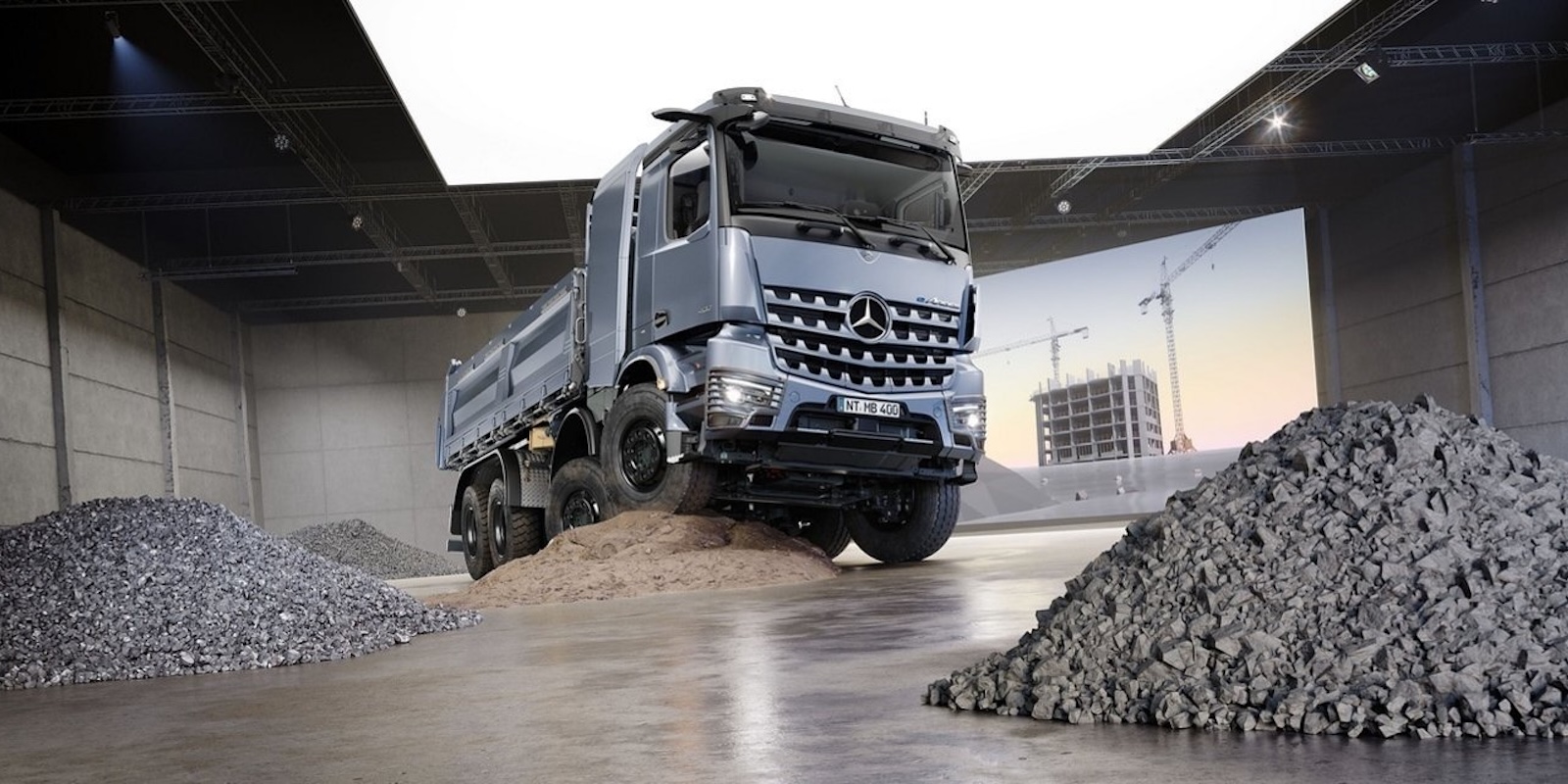
While the electrification of passenger vehicles often dominates the climate conversation, the decarbonization of heavy industry remains a more stubborn challenge. Mercedes-Benz is moving to address this with the official launch of the eArocs 400, a heavy-duty electric truck specifically designed for vocational use in construction and logistics. The company has opened order books for the vehicle, signaling that what began as a prototype has crossed the threshold into commercial readiness.
First unveiled at the Bauma construction trade fair — the world's largest exhibition for construction machinery, held in Munich — the eArocs represents a departure from the sleek, aerodynamic silhouettes of electric long-haulers. This is a machine built for the grit of the job site, prioritizing massive payload capacity and high torque over highway efficiency. By accepting orders, Mercedes-Benz is making a concrete claim: the technology has matured enough to meet the punishing duty cycles of industrial work.
Why vocational trucks are the harder problem
The commercial vehicle sector has seen a wave of electric entrants in recent years, but most have concentrated on line-haul and last-mile delivery — segments where routes are predictable, charging infrastructure can be planned in advance, and duty cycles are relatively gentle. Vocational trucks occupy a different category entirely. Construction-site vehicles face stop-start operations, steep gradients, unpaved terrain, and payloads that push gross vehicle weight ratings to their legal limits. Diesel engines have dominated this niche for decades precisely because they deliver sustained power under extreme load without the range anxiety that plagues battery-electric alternatives on long routes.
The eArocs 400 is Mercedes-Benz's answer to the question of whether battery-electric drivetrains can handle these conditions. Electric motors deliver peak torque from zero RPM — a characteristic that is theoretically well suited to hauling heavy aggregates and navigating uneven ground. The absence of a conventional transmission and the reduced number of moving parts also promise lower maintenance costs over the vehicle's lifetime, a factor that matters enormously in fleet economics where downtime translates directly into lost revenue.
Mercedes-Benz is not operating in a vacuum. Volvo Trucks has been delivering electric heavy-duty vehicles in Europe since the early 2020s, and several Chinese manufacturers have moved aggressively into the electric construction-vehicle space. The competitive pressure is real, and the eArocs positions Daimler Truck — Mercedes-Benz's commercial vehicle parent — to defend market share in a segment where it has historically held significant influence through the diesel Arocs line.
The regulatory and operational calculus
The business case for electric vocational trucks is being shaped as much by regulation as by engineering. Across Europe, low-emission zones in major cities have expanded steadily, restricting diesel-powered vehicles from operating in urban cores during certain hours or altogether. Construction projects in London, Paris, Amsterdam, and several Scandinavian cities increasingly require contractors to demonstrate compliance with emissions standards that conventional trucks cannot meet without costly aftertreatment systems. An electric truck that can operate silently and without tailpipe emissions is not merely a sustainability gesture — it is, in a growing number of jurisdictions, a prerequisite for winning contracts.
There are real constraints, however. Battery weight reduces available payload capacity, a trade-off that is particularly acute in the vocational segment where every kilogram of cargo matters. Charging infrastructure at construction sites is often nonexistent, requiring operators to invest in mobile or temporary charging solutions. And the upfront cost of electric heavy-duty trucks remains substantially higher than their diesel equivalents, even when total cost of ownership over a multi-year period may favor electrification.
The tension, then, is between a regulatory environment that is accelerating the shift away from diesel and an operational reality where electric alternatives must prove themselves under conditions that leave little margin for compromise. Mercedes-Benz is betting that the eArocs 400 can navigate that gap. Whether the construction industry's fleet operators — pragmatic, cost-conscious, and skeptical of unproven technology — agree in sufficient numbers will determine how quickly the vocational segment follows the trajectory already underway in lighter commercial categories.
With reporting from Electrek.
Source · Electrek