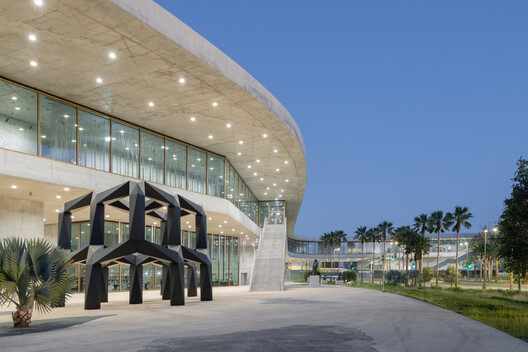
The Los Angeles County Museum of Art has opened the David Geffen Galleries, a building designed by Swiss architect Peter Zumthor that spans Wilshire Boulevard on an elevated, bridge-like form. The structure replaces several mid-century buildings that were demolished to make way for the new design, and it represents the culmination of a process that stretched across roughly two decades of planning, fundraising, public debate, and construction. It is, by most measures, the most significant new museum building to open in the United States in recent years.
Zumthor, now in his early eighties, is known for a body of work that privileges atmosphere, materiality, and restraint. His Therme Vals spa in Switzerland and the Bruder Klaus Field Chapel in Germany are frequently cited as touchstones of an architecture that treats sensory experience as its primary medium. The LACMA commission, first announced in the mid-2000s, is by far his largest project — and his first major building in the United States.
A Single Plane Against the Encyclopedic Tradition
The defining architectural gesture of the David Geffen Galleries is its single, continuous exhibition level, elevated above the ground and open to natural light. LACMA's permanent collection — comprising some 155,000 objects spanning 6,000 years of human production — is arranged on this plane without the departmental divisions that have organized encyclopedic museums since the nineteenth century. There are no separate wings for European painting, Asian art, or pre-Columbian objects. Instead, the layout is described as "non-hierarchical," designed to allow works from different cultures, periods, and media to sit in proximity.
This is a deliberate departure from the model established by institutions such as the Metropolitan Museum of Art or the British Museum, where collections are organized by geography and chronology, and where the visitor moves through a sequence of rooms that implicitly narrates a Western-centric progression of civilization. LACMA's new arrangement invites visitors to construct their own paths and draw their own connections — a curatorial philosophy that treats art history as a web rather than a timeline.
The approach carries risks. Without clear orientation, visitors may find the experience disorienting rather than liberating. And the question of whether spatial adjacency alone can produce meaningful dialogue between, say, a Benin bronze and a Rothko canvas is one that curators and critics will debate for years. The architecture, in this sense, is an argument — one that will be tested every day by the people who walk through it.
Los Angeles as Context
The building's relationship to its surroundings is as deliberate as its interior logic. By lifting the galleries off the ground, Zumthor creates a covered public space beneath the structure — a gesture that acknowledges the centrality of outdoor life in Southern California. The transparency and porosity of the ground level are intended to blur the boundary between museum and city, making the institution feel less like a fortress and more like a civic threshold.
This matters in Los Angeles, a city whose cultural infrastructure has historically been dispersed and car-dependent. The Miracle Mile corridor along Wilshire Boulevard, where LACMA sits alongside the Academy Museum of Motion Pictures and the La Brea Tar Pits, has become one of the densest concentrations of cultural institutions on the West Coast. The opening of the Geffen Galleries reinforces that corridor's claim as a destination — and raises the question of whether Los Angeles is building the institutional density to rival older cultural capitals.
Zumthor's building also arrives at a moment when the encyclopedic museum model itself is under scrutiny. Debates over provenance, repatriation, and the politics of display have forced institutions worldwide to reconsider how they present collections assembled during eras of colonial power. LACMA's non-hierarchical layout does not resolve those tensions, but it offers a spatial framework that at least acknowledges them — placing objects from different traditions on equal architectural footing, even if the histories behind their acquisition remain unequal.
Whether the building succeeds as architecture, as museum, and as civic space are three distinct questions, and they may yield different answers. What is clear is that Zumthor and LACMA have made a wager: that flattening the spatial hierarchy of a collection can open new ways of seeing — or, at minimum, make the old hierarchies harder to ignore.
With reporting from ArchDaily.
Source · ArchDaily