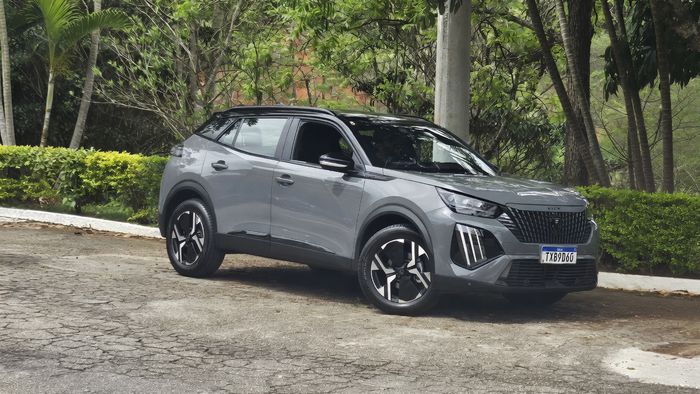
The transition toward electrification in the Brazilian automotive market rarely follows a single, linear trajectory. It advances through localized tactical moves — dealer-level promotions, regional pricing experiments, and trade-in incentives designed to test consumer appetite before broader commitments are made. A recent price adjustment on the Peugeot 2008 GT Hybrid at a São Paulo dealership, cutting more than R$ 30,000 from the model's sticker price, offers a window into how legacy automakers are navigating the hybrid transition in Latin America's largest car market.
The 2008 GT Hybrid occupies a deliberate middle ground. It pairs a 1.0-liter Turbo Flex engine producing 130 horsepower with a mild-hybrid electric system and a CVT transmission — a configuration that prioritizes incremental fuel economy gains over the full electrification leap. Peugeot's bet is that Brazilian consumers, many of whom still lack convenient access to charging infrastructure, will find this halfway proposition attractive enough to justify the premium over a conventional powertrain.
The logic behind localized discounting
The São Paulo promotion is not a clearance sale in the traditional sense. It comes with a specific condition: buyers must trade in a relatively recent used vehicle to access the reduced price. This requirement reveals a layered commercial strategy. On one side, it lowers the effective cost of entry into the hybrid segment for consumers who already own a qualifying car. On the other, it feeds Peugeot's dealer network with a pipeline of high-quality pre-owned inventory — a category that has become increasingly profitable across the Brazilian market as new-car prices have risen.
This kind of conditional discounting has precedent. Automakers operating in price-sensitive markets have long used trade-in programs to manage both demand stimulation and used-car supply simultaneously. What makes the Peugeot move notable is its application to a hybrid model, a category still establishing its footing in Brazil. The implicit message is that hybrid vehicles have matured enough commercially to warrant the same aggressive retail tactics previously reserved for high-volume combustion models.
Brazil's hybrid and electrified vehicle segment has grown steadily in recent years, driven in part by federal tax incentive structures that treat hybrids more favorably than fully electric imports in certain brackets. The compact SUV category, where the 2008 competes, is among the most contested in the country. Rivals from Asian and other European manufacturers have introduced their own electrified options at competitive price points, making share-of-voice and share-of-showroom critical battlegrounds.
What the pricing signal reveals about the broader race
A discount of the magnitude Peugeot is offering — roughly equivalent to the price of a basic motorcycle or a significant fraction of a popular entry-level car in Brazil — suggests the brand perceives urgency. Whether that urgency stems from slower-than-expected uptake of the 2008 GT Hybrid, from competitive pressure in the São Paulo metro area, or from a deliberate strategy to build installed base before a next-generation model arrives, the effect is the same: it compresses the price gap between hybrid and conventional trims, forcing consumers to weigh the calculus differently.
The broader question is whether localized promotions of this kind can scale into sustained demand or whether they remain episodic tools — effective at moving metal in a given quarter but insufficient to shift long-term purchasing habits. Hybrid adoption in Brazil still contends with consumer skepticism about battery longevity, resale value uncertainty for electrified models, and the persistent cost advantage of ethanol-powered flex-fuel vehicles, which offer their own emissions narrative.
Peugeot's São Paulo experiment sits at the intersection of these forces. It is at once a retail tactic, a market signal, and a test of whether price alone can accelerate the hybrid transition in a market where infrastructure, fuel economics, and consumer psychology pull in competing directions. The answer will likely shape not just Peugeot's next move, but the playbook for every automaker contesting Brazil's electrified middle ground.
With reporting from Canaltech.
Source · Canaltech