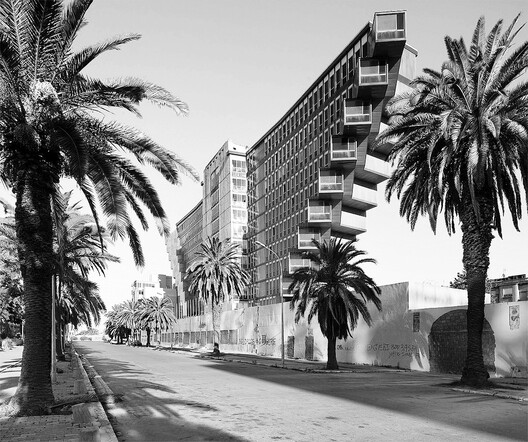
Architecture is often the most visible casualty of time, political upheaval, and urban neglect. Buildings that once defined a city's identity are demolished, repurposed beyond recognition, or simply left to decay — and with them, the institutional knowledge of how and why they were built. In an effort to arrest this cultural erosion, the Sharjah Architecture Triennial (SAT) has announced a new exhibition, A Journey into Architecture Archives: Baghdad, Damascus, Tunis. Curated by George Arbid, the show serves as a critical intervention in how the built history of the Arab world is documented and understood.
Opening in May 2026 at the Al Qasimiyah School, the exhibition is the latest output of SAT's long-term research program dedicated to safeguarding regional architectural legacies. The project moves beyond the traditional display of blueprints, instead weaving together archival materials, physical models, and newly commissioned films. These elements aim to reconstruct the narrative of cities like Tunis — exemplified by the striking, inverted form of Raffaele Contigiani's 1973 Hotel du Lac — and the modernist layers of Baghdad and Damascus.
The Archive as Active Infrastructure
The choice of Baghdad, Damascus, and Tunis is not incidental. All three cities experienced significant periods of modernist architectural production during the mid-twentieth century, often under state-led development programs that drew on both local traditions and international design movements. Baghdad's postwar building campaigns attracted figures such as Le Corbusier, Frank Lloyd Wright, and Walter Gropius, while Damascus and Tunis developed their own distinct modernist vocabularies shaped by French colonial infrastructure and post-independence nation-building. Much of this built heritage has since been damaged by conflict, neglected through rapid urbanization, or simply forgotten as political priorities shifted.
The problem is not merely physical deterioration. It is also epistemic. Architectural archives across the Arab world are dispersed, underfunded, and in many cases held in private collections with no clear path to institutional stewardship. Drawings, photographs, and correspondence that document key design decisions risk being lost not to war or demolition but to administrative indifference. Arbid's curatorial framework addresses this gap directly, treating the archive not as a passive repository but as active infrastructure — a tool through which cities can understand their own spatial logic and make more informed decisions about future development.
This approach places the exhibition within a broader movement in architectural practice that has gained traction over the past decade. Institutions from Beirut to Doha have invested in digitizing and cataloguing regional architectural records, recognizing that preservation of knowledge is a precondition for preservation of buildings. The Arab Center for Architecture, founded by Arbid himself, has been a central node in this effort, assembling one of the most comprehensive collections of architectural documentation from the region.
Beyond Nostalgia: Memory as Method
The exhibition functions as more than a retrospective; it is an inquiry into the mechanics of memory. By focusing on three specific urban centers, each with distinct political trajectories and shared architectural lineages, the curatorial structure invites comparison without flattening difference. The newly commissioned films signal an intent to move beyond static documentation toward narrative forms that can reach audiences outside the discipline — a recognition that architectural heritage, to be preserved, must first be legible to the broader public.
The venue itself carries resonance. The Al Qasimiyah School is part of Sharjah's own heritage district, a zone where the emirate has invested in adaptive reuse of older structures for cultural programming. Hosting an archival exhibition on Arab modernism inside a repurposed educational building creates a layered dialogue between the subject matter and its physical setting.
The deeper question the exhibition raises is whether archival work can translate into material outcomes — whether documenting what was built can influence what gets built, or what gets saved. In cities where development pressure is intense and institutional memory is fragile, the archive occupies an uneasy position: essential in theory, often marginal in practice. The tension between the scholarly rigor of preservation research and the political economy of urban land use remains unresolved. How that tension plays out in Baghdad, Damascus, and Tunis — cities where the stakes are existential rather than academic — is precisely what makes this exhibition worth watching.
With reporting from ArchDaily.
Source · ArchDaily