Architecture is frequently evaluated as a finished object — a static arrangement of materials frozen at the moment the ribbon is cut. Región Austral, the Buenos Aires-based firm named winner of ArchDaily's 2025 Next Practices Awards, operates under a different premise: that the real design process begins only after the scaffolding comes down. Their body of work treats public space not as monument but as infrastructure for what the firm calls the "architecture of everyday life," where a project's success is measured less by formal coherence than by its capacity for adaptation and social negotiation over time.
The award, part of ArchDaily's annual recognition program spotlighting practices that challenge conventional architectural thinking, places Región Austral's approach squarely within a broader conversation about what public space owes to the communities it serves — particularly in contexts shaped by urban inequality.
From Object to Process
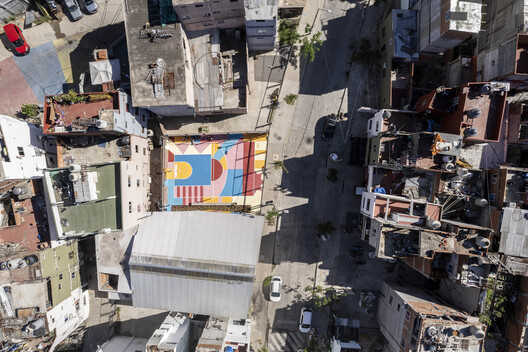
The firm's philosophy is most legible in projects such as the Playón de Chacarita network and the Olympic Neighborhood Square. Both sit within Buenos Aires neighborhoods where urban fragmentation, informal settlement patterns, and socioeconomic disparity define daily life. Rather than imposing a fixed formal vocabulary, Región Austral designs what might be described as spatial baselines — physical interventions that establish the minimum conditions for collective activity while leaving substantial room for communities to appropriate, modify, and extend the space over time.
This is not a novel idea in the abstract. Participatory design and incremental urbanism have deep roots in Latin American practice, stretching back at least to the work of architects and planners who engaged with informal urbanization across the continent from the mid-twentieth century onward. What distinguishes Región Austral is the degree to which post-occupancy activation — the life of the space after handover — is treated as the primary design objective rather than a secondary concern. The built form is deliberately incomplete, conceived as a framework that gains meaning only through sustained use.
The approach carries echoes of Chilean architect Alejandro Aravena's incremental housing model, where residents complete the structure according to their own needs and resources. But where Aravena's work centers on the dwelling unit, Región Austral applies similar logic to the commons — plazas, streetscapes, and shared civic ground. The shift from private to public introduces a different set of variables: maintenance responsibilities, competing claims on space, the politics of who gets to define "appropriate" use.
The Unfinished as Resilience
By employing incremental strategies and deep participatory processes, Región Austral engages with a tension that runs through contemporary urbanism: the gap between the designed city and the lived city. Masterplans and polished renderings tend to assume stable conditions — predictable users, consistent funding, durable political will. In neighborhoods marked by inequality, those assumptions rarely hold. Spaces that are too precisely programmed risk becoming irrelevant the moment conditions shift.
Región Austral's counter-proposition is that the most resilient urban spaces are those that remain deliberately unfinished — vessels designed to absorb the unpredictable, sometimes messy, and always essential movements of the public. It is a stance that privileges the lived experience of the commons over the aesthetic purity of the plan.
The recognition from ArchDaily lends institutional visibility to this position, but it also raises questions that the award alone cannot answer. Incremental, process-driven design depends on sustained community engagement and long-term institutional support — resources that are often the first to be cut in fiscally constrained municipal budgets. A space designed to evolve requires stewardship structures that evolve with it. Without those, the "unfinished" risks becoming simply neglected.
The tension, then, is not between form and use, but between a design philosophy that demands continuity and a political economy that frequently rewards completion. Whether Región Austral's model can scale beyond specific neighborhood interventions — or whether it remains most effective precisely because it stays local and embedded — is a question that the practice itself, and the cities it works within, will continue to negotiate.
With reporting from ArchDaily.
Source · ArchDaily