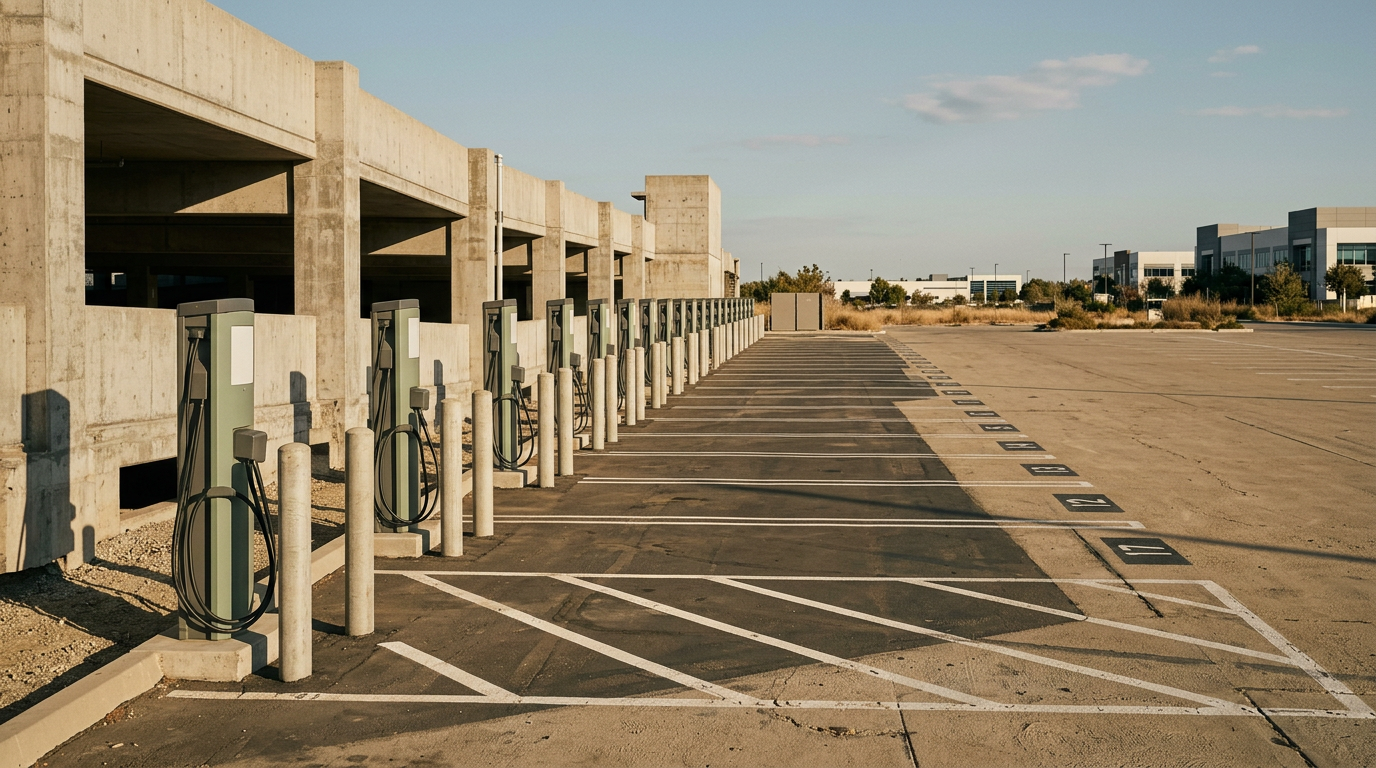
California's long-running romance with the electric vehicle is entering a period of cooling. According to the California New Car Dealers Association's Auto Outlook report for the first quarter of 2026, Tesla registrations in the state plummeted by 24.3% year-over-year. The automaker sold over 10,000 fewer vehicles in its home territory than it did during the same window last year, signaling a sharp departure from its once-uninterrupted growth trajectory.
The slump is not isolated to a single brand. The report reveals that California's overall zero-emission vehicle (ZEV) market share has retrenched to 13.7%, the lowest level recorded since the end of 2021. For a state that has served as the global laboratory for the EV transition — home to Tesla's headquarters, the nation's densest public charging network, and the most aggressive emissions mandates in the country — the figures carry weight that extends well beyond regional sales charts.
The end of the early-adopter runway
The pattern visible in California mirrors a dynamic familiar from previous technology adoption cycles. The initial cohort of buyers — motivated by environmental commitment, novelty, or status signaling — has been largely absorbed. What remains is the broader consumer base, a population more sensitive to sticker price, financing costs, and the practical calculus of range, charging convenience, and resale value.
That calculus has grown more complicated. Interest rates, while off their recent peaks, remain elevated relative to the near-zero environment that accompanied the first wave of mass EV purchases. Higher borrowing costs compress the monthly payment advantage that EVs once held over comparable internal combustion vehicles, particularly when federal and state incentive structures shift or expire. At the same time, a growing supply of used EVs with uncertain battery degradation profiles has introduced downward pressure on residual values, making leasing and financing terms less attractive for new purchases.
For Tesla specifically, the decline raises questions about product cycle fatigue. The Model 3 and Model Y, which account for the vast majority of the company's volume, have been on the market for several years. Competitive entries from legacy automakers and newer EV-focused manufacturers have expanded the options available to California buyers. Brand loyalty, once a near-automatic advantage in Tesla's home market, appears to be eroding as the field widens.
A non-linear transition
California's Advanced Clean Cars II regulation, which mandates that an increasing share of new vehicle sales be zero-emission, remains on the books and continues to tighten. Yet mandates set the ceiling of regulatory ambition; actual market behavior determines the floor. The gap between the two is now widening rather than narrowing.
This is not without precedent in the history of energy transitions. The adoption of rooftop solar in the United States followed a similar arc — rapid early growth driven by incentives and enthusiast demand, followed by a plateau as subsidy structures changed and the easiest installations were completed. The transition resumed, but on a different timeline and with different economics than initial projections assumed.
The EV market may be entering an analogous phase. Automakers that built production capacity around aggressive adoption curves now face the prospect of underutilized factories and margin compression. For California regulators, the data introduces a tension between the pace of mandated adoption and the pace the market is willing to sustain. Relaxing mandates risks undermining long-term climate targets; enforcing them rigidly risks penalizing manufacturers and dealers already navigating a demand slowdown.
What the California numbers do not reveal is whether the current retreat represents a structural ceiling or a temporary pause before the next leg of adoption. The answer likely depends on forces still in motion: the trajectory of battery costs, the evolution of charging infrastructure beyond urban cores, the competitive pricing strategies of both legacy and startup automakers, and the willingness of policymakers to absorb political friction in defense of long-term electrification goals. The state that once made the EV transition look inevitable is now illustrating just how contingent that trajectory remains.
With reporting from Electrek.
Source · Electrek