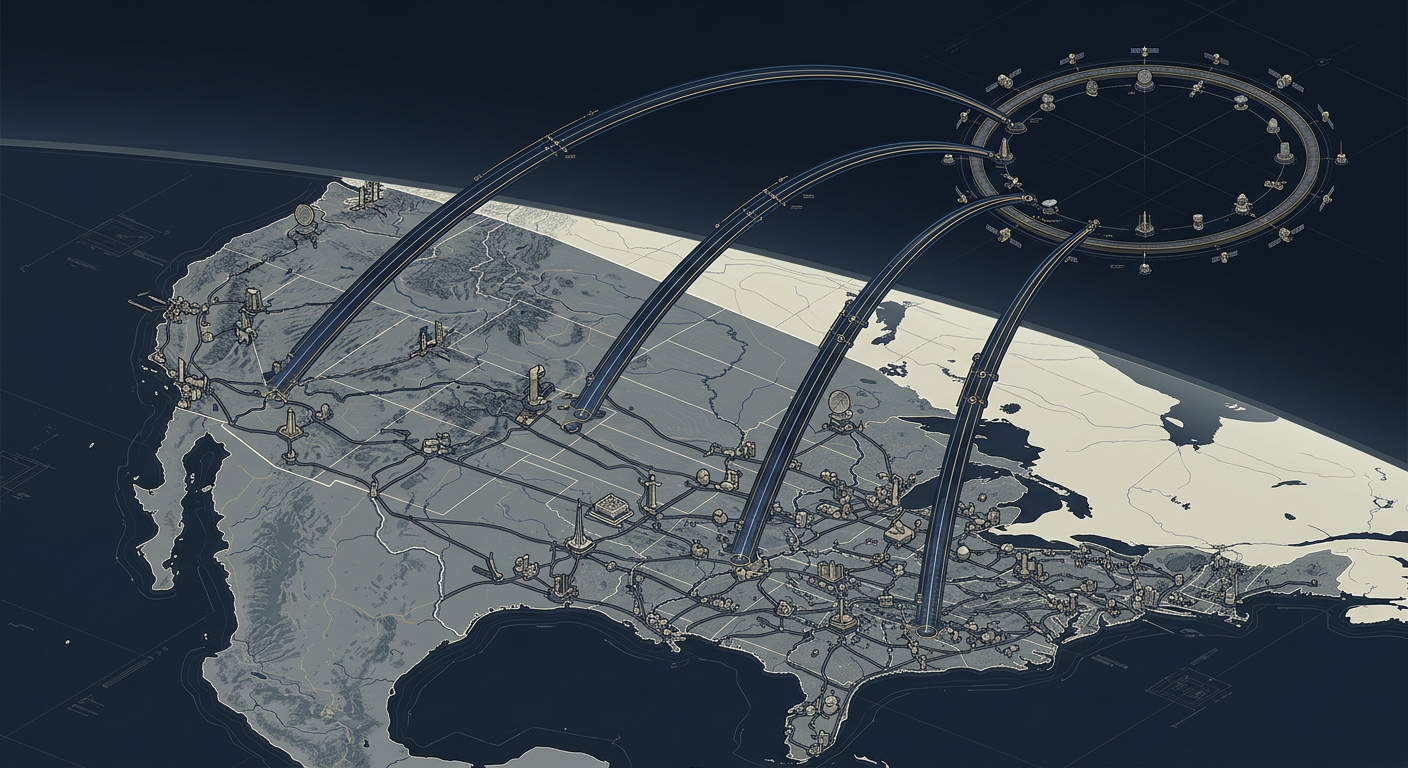
The pursuit of an impenetrable national shield has moved from political rhetoric to a massive industrial mobilization. Rebranded in May 2025 as the "Golden Dome," the $175 billion missile defense program represents the most ambitious overhaul of U.S. homeland missile defense architecture in decades. The system aims to establish a four-layer network of sensors and interceptors spanning terrestrial sites and orbital platforms, designed to detect and neutralize threats before they reach their targets. In both name and concept, the program is a domestic evolution of the principles behind Israel's Iron Dome — scaled to continental dimensions and layered into space.
Under the oversight of Space Force General Michael Guetlein, the program has triggered what amounts to a gold rush within the defense sector. The Missile Defense Agency's Scalable Homeland Innovative Enterprise Layered Defense (SHIELD) program has already cleared more than 2,000 companies to compete for contracts, with a $151 billion contract vehicle at stake. The participant list is a cross-section of the modern military-industrial complex, pairing legacy aerospace primes with agile, venture-backed newcomers — a composition that reflects how deeply the commercial space and defense startup ecosystems have become intertwined since the mid-2020s.
A layered architecture with deep historical roots
The idea of a multi-layered missile defense shield is not new. Its lineage traces back to the Strategic Defense Initiative of the 1980s — colloquially known as "Star Wars" — which proposed space-based interceptors and directed-energy weapons to counter Soviet ballistic missiles. That program never reached operational status, but it seeded decades of research into boost-phase intercept, midcourse tracking, and terminal defense. Subsequent programs, from the Ground-based Midcourse Defense system to the Aegis Ballistic Missile Defense, addressed pieces of the puzzle without attempting to integrate them into a unified continental shield.
What distinguishes the Golden Dome from its predecessors is the ambition to fuse all four defensive layers — boost, ascent, midcourse, and terminal — into a single command architecture. Each layer addresses a different phase of an incoming threat's trajectory, and each demands different sensor capabilities and interceptor profiles. The integration challenge is not merely technical but organizational: it requires data fusion across satellite constellations, ground-based radars, and sea-based sensors in near-real time. The proliferation of low-Earth orbit satellite technology, driven in part by commercial launch cost reductions over the past decade, has made the orbital sensor layer more plausible than it was during earlier missile defense efforts.
The gap between ambition and timeline
While the administration has set a target for the shield to be operational by January 2029, the technical hurdles remain formidable. A fully realized, four-layer system within four years would require simultaneous advances in sensor integration, interceptor development, space-based infrastructure deployment, and command-and-control software — each of which historically has followed its own protracted development arc. A technology demonstration is considered within reach; a deployable operational capability is another matter.
Current efforts, including work by Lockheed Martin, are focused on proving the viability of the integrated sensor network — a necessary first step before the system can function as designed. The sensor layer is foundational: without persistent, high-fidelity tracking across all threat phases, the interceptor layers have nothing to act on. The emphasis on sensors first echoes a broader doctrinal shift in defense procurement, where the value of the "kill chain" increasingly resides in detection and decision speed rather than in the kinetic endpoint alone.
The scale of industrial mobilization — more than 2,000 cleared companies competing across a $151 billion vehicle — suggests the Pentagon is betting on breadth of innovation rather than concentrating risk in a handful of prime contractors. That approach carries its own tensions. Coordination across hundreds of subcontractors and technology providers introduces integration risk, and the history of large-scale defense programs offers no shortage of cautionary precedents where ambitious timelines met bureaucratic and engineering friction.
The Golden Dome sits at the intersection of several forces: a geopolitical environment where hypersonic and advanced missile threats are proliferating, a commercial space sector that has dramatically lowered the cost of orbital access, and a defense-industrial base that is more diverse — and more fragmented — than at any point since the Cold War. Whether the program produces a functional shield or a technology demonstration that reshapes future defense architecture may matter less than the industrial and strategic realignment it has already set in motion.
With reporting from Payload Space.
Source · Payload Space