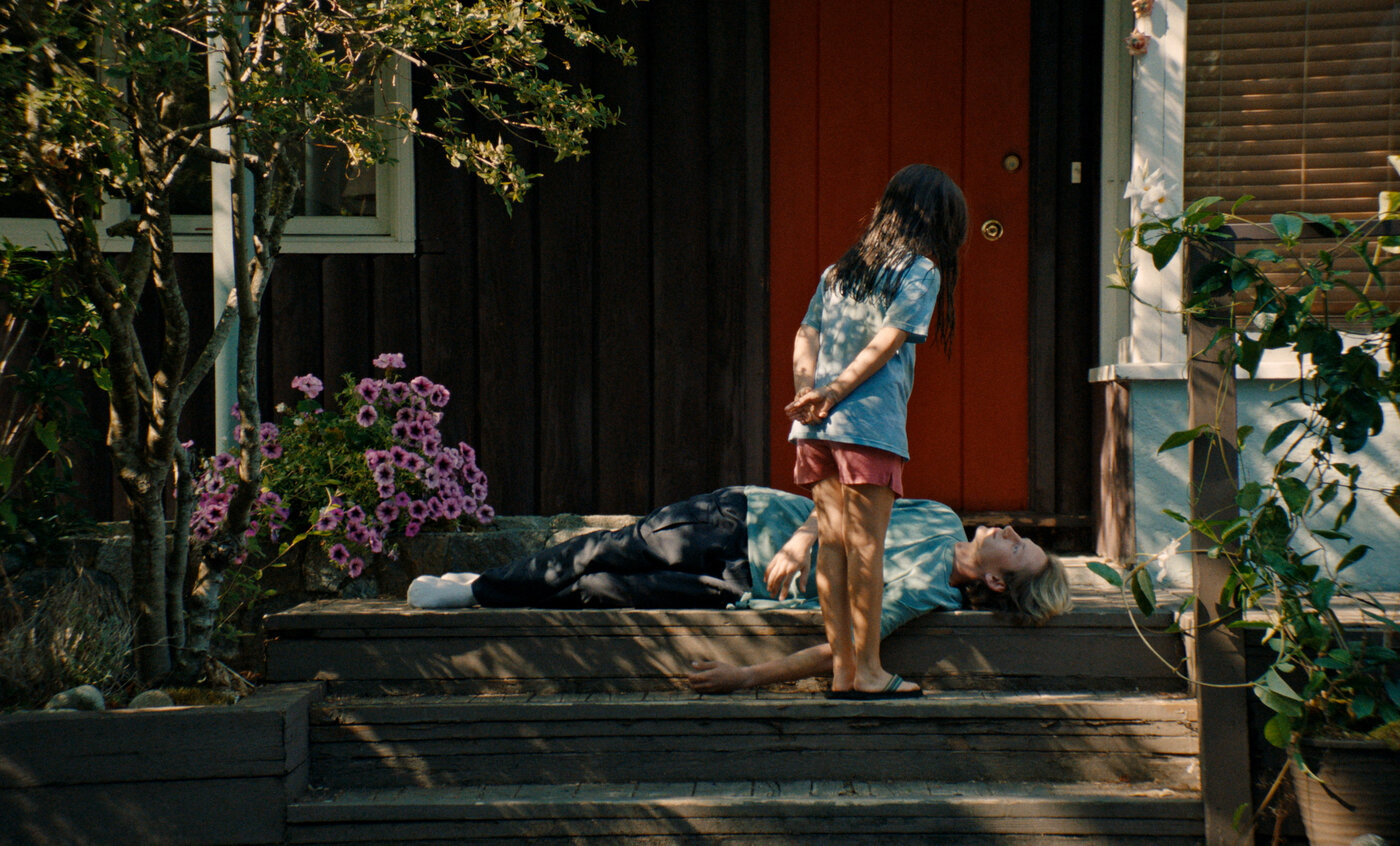
For filmmaker Sophy Romvari, the debut feature Blue Heron (2025) arrives less as a beginning than as a synthesis. Over the course of a decade spent crafting short films, Romvari has meticulously mapped a specific emotional geography: the intersection of family history, the displacement of migration, and the inherent unreliability of memory. Her work treats the past as something simultaneously vital and unreachable — a texture felt through the screen but never quite grasped in the hand.
The daughter of Hungarian immigrants who settled in Vancouver as the Iron Curtain fell, Romvari occupies a singular position as the only member of her family born in Canada. This distance from her ancestral home is compounded by a storied, if quiet, cinematic lineage. Her father trained as a cinematographer, and her grandfather was a renowned production designer who worked with directors such as István Szabó. Yet these professional identities were often obscured by the mundane reality of family life; for Romvari, the camera was less a tool of industry and more a witness to the domestic, a way of touching at a distance.
The Short Films as Rehearsal
Romvari's earlier shorts — including Nine Behind and It's Him — used the medium of film to facilitate connections with relatives who were either physically or emotionally absent. These works belong to a tradition of hybrid documentary that has gained increasing visibility in international festival circuits over the past decade, a mode in which the boundary between personal archive and cinematic construction is deliberately left porous. Filmmakers working in this register — from Chantal Akerman's late-career investigations of maternal memory to Agnès Varda's essayistic self-portraits — share a conviction that the home movie and the art film are not opposites but points on a continuum.
What distinguishes Romvari within this lineage is the specificity of her diasporic position. The Hungarian emigration of the late Cold War era produced a generation of families caught between two systems of meaning: the cultural memory of a Central European homeland and the practical anonymity of resettlement in North America. For the children born after the crossing, inheritance arrives in fragments — an accent, a surname, a reel of footage whose context has been partially lost. Romvari's shorts treated these fragments not as deficiencies to be corrected but as formal principles to be explored. Gaps in the family record became gaps in the edit. Silence on the soundtrack stood in for conversations that never took place.
From Fragment to Feature
Blue Heron expands upon those structural conceits, blending the tender intimacy of Romvari's hybrid documentaries with a more expansive narrative frame. The shift from short to feature is never merely a question of duration; it demands a different architecture of attention. A short film can sustain itself on a single gesture or juxtaposition. A feature must build accumulation — must convince the viewer that staying inside its world for an hour or more will yield something that a brief encounter cannot.
For a filmmaker whose subject is family memory, the feature format introduces a productive tension. More time allows for the layering of archival material, the patient unfolding of relationships across decades, the slow revelation of what has been kept and what has been discarded. But more time also risks domesticating the very absences that gave the shorter works their charge. The question any hybrid documentary feature must answer is whether intimacy can scale without becoming sentimentality.
Romvari's career suggests she is aware of the danger. Her shorts were notable for their formal discipline — their willingness to let an image or a silence do the work that narration might otherwise perform. Blue Heron functions as a cumulative record, one in which the act of filming is not merely about preservation but about navigating the grief and structural gaps that define a family's transit through time.
The film arrives at a moment when the festival ecosystem has shown sustained appetite for personal documentary work that resists easy categorization. Whether Blue Heron finds an audience beyond that circuit may depend on how legibly its specific Hungarian-Canadian coordinates translate into a broader grammar of displacement. The raw materials — migration, generational silence, the camera as surrogate for touch — are hardly parochial. But universality is not something a film can declare; it is something a viewer either recognizes or does not. Romvari has spent a decade earning the right to pose the question at feature length. The answer now belongs to the audience.
With reporting from MUBI Notebook.
Source · MUBI Notebook