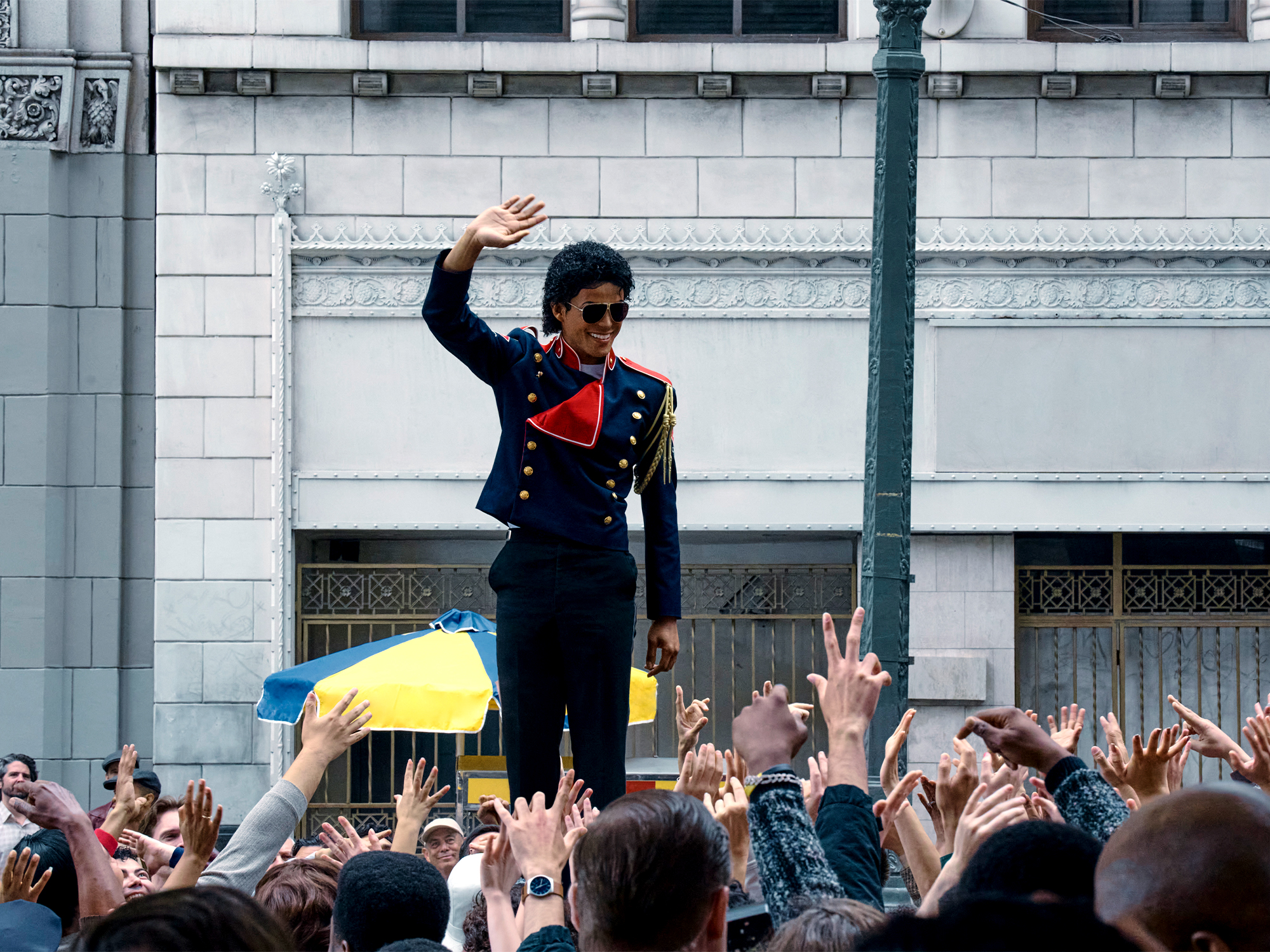
Antoine Fuqua's Michael arrives not as a traditional cinematic inquiry into one of the most consequential figures in popular music, but as a meticulously engineered piece of corporate brand restoration. Produced with the heavy involvement of the Michael Jackson estate, the film functions as a legacy management exercise, charting the artist's ascent through the 1987 release of Bad and terminating the narrative before the most harrowing chapters of Jackson's life. By drawing the curtain at that precise moment, the biopic cordons off the "King of Pop" from the legal and personal controversies that would later define — and fracture — his public image.
The choice of endpoint is itself a statement of intent. Jackson's career after Bad encompassed not only further commercial triumphs but also child sexual abuse allegations, civil litigation, erratic public behavior, and a death in 2009 that prompted worldwide mourning alongside renewed scrutiny. None of this appears in the film. The result is a portrait that emphasizes Jackson's undeniable musical genius while systematically expunging the tabloid scandals and courtroom dramas that clouded his final decades. This is not merely an omission; it is an active editorial decision designed to preserve the saleability of a personal brand.
The Biopic as Corporate Vehicle
Estate-authorized biopics have become a recognizable genre of their own. The pattern is well established: a rights-holding entity grants access to music catalogs, archival material, and family cooperation in exchange for narrative control. The Freddie Mercury biopic Bohemian Rhapsody (2018) followed a broadly similar template, softening the rougher edges of its subject's life while foregrounding stadium-sized musical sequences. That film went on to gross more than $900 million worldwide and won its lead actor an Academy Award, demonstrating that the formula carries substantial commercial logic.
Michael appears to operate from the same playbook. The estate's involvement ensures that the film's audience hears the original recordings and sees the iconography reproduced with fidelity — assets that no unauthorized production could match. In return, the narrative stays within approved boundaries. The transaction is transparent: access for control, spectacle for silence. What distinguishes Michael from earlier examples is the sheer scale of what remains unaddressed. Jackson's later life was not a footnote; it was a decades-long public reckoning that reshaped how celebrity, race, and accountability intersect in American culture. To tell his story without it is less biography than brand guidelines rendered in widescreen.
Fuqua, a director whose credits range from Training Day to The Equalizer franchise, brings competent craft to the production. The musical sequences reportedly deliver the kinetic energy one would expect from Jackson's catalog. Yet competence in execution does not resolve the structural problem at the film's core: a biopic that declines to engage with the most consequential dimensions of its subject is, by definition, incomplete.
A Broader Shift in Biographical Storytelling
The film mirrors a wider contemporary tendency in which biographical narratives are shaped less by artistic ambition than by stakeholder management. Streaming platforms and studios, eager to secure lucrative music catalogs and franchise-ready IP, have strong incentives to accommodate estate preferences. The audience, in turn, is offered a version of history that functions as confirmation rather than investigation — a cooing reassurance to existing fans rather than a challenge to their assumptions.
This dynamic raises questions that extend well beyond a single film. If the dominant mode of biographical storytelling becomes one in which the subject's heirs hold effective veto power over content, the genre risks drifting from portraiture toward hagiography. The tension between commercial imperatives and biographical honesty is not new — Hollywood has always smoothed inconvenient truths — but the degree of estate involvement in contemporary music biopics represents a qualitative shift in who controls the narrative and to what end.
Michael seeks to secure Jackson's status as a post-racial icon of pure musical achievement, ensuring that the commercial machine behind the man continues to run without the friction of complicating facts. Whether audiences accept that bargain — spectacle in exchange for silence — or begin to demand more from the genre may determine the trajectory of the estate-authorized biopic for years to come. The film's box office performance will be one data point. The more revealing measure will be whether the conversation it generates centers on Jackson's artistry, as the estate intends, or on everything the film chose not to say.
With reporting from Little White Lies.
Source · Little White Lies