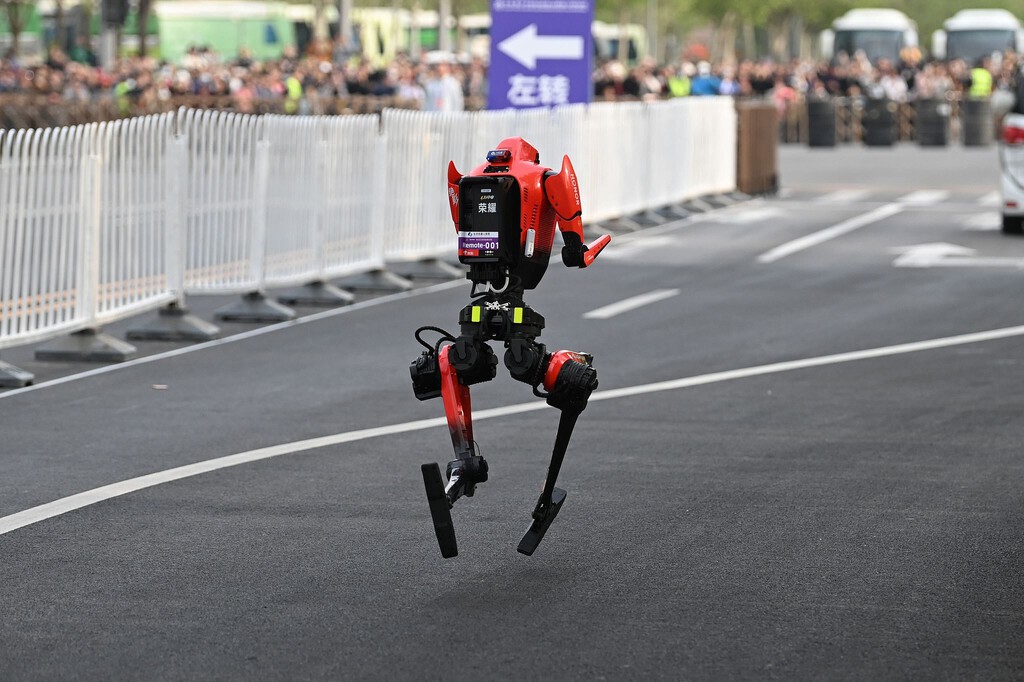
The shift from mechanical curiosity to athletic dominance happened faster than most observers anticipated. At the Beijing E-Town Half Marathon this past weekend, a humanoid robot named Lightning crossed the finish line in 50 minutes and 26 seconds. The performance did more than just win the race — it effectively reset the ceiling for bipedal locomotion, beating the human world record of 57:20 by nearly seven minutes. For a field of engineering that struggled to keep machines upright over long distances just twelve months ago, the result marks a turning point worth examining closely.
The victory represents a considerable leap in engineering over a single calendar year. During the event's inaugural run last year, the robotic field was defined by failure: only a third of the entrants finished, and those that did were largely remote-controlled, moving at a pace that posed no threat to human competitors. This year, the field grew to over 100 robots, many of which operated autonomously. Honor's Lightning models swept the podium, with the lead unit finishing 17 minutes ahead of the fastest human runner in the race. Standing 169 centimeters tall and weighing 45 kilograms, Lightning is a product of rapid optimization in power-to-weight ratios and balance algorithms.
From parlor trick to engineering benchmark
Bipedal locomotion has long been one of the hardest problems in robotics. Walking on two legs demands constant, real-time adjustments to balance — a task that biological nervous systems handle through millions of years of evolutionary refinement. Running compounds the difficulty: each stride involves a brief phase of flight where both feet leave the ground, requiring the control system to manage impacts, energy recovery, and forward momentum simultaneously. For decades, humanoid robots could barely walk across a flat stage without toppling. Boston Dynamics' Atlas, perhaps the most publicly visible bipedal platform of the past decade, demonstrated impressive agility in controlled environments, but sustained distance running at competitive speed remained out of reach for any humanoid system.
The Beijing half marathon has emerged as a proving ground precisely because it forces robots out of the lab and into unpredictable, real-world conditions. Road surfaces vary. Weather is uncontrolled. The course demands sustained output over 21 kilometers — a test not just of peak capability but of mechanical endurance, thermal management, and software reliability. That the majority of entrants failed last year underscored how far the field still had to go. That one machine shattered the human record this year underscores how nonlinear progress in robotics can be, particularly when advances in battery density, actuator efficiency, and reinforcement learning converge on a single platform.
The question behind the spectacle
It is tempting to frame Lightning's performance as a simple human-versus-machine narrative, but the more consequential story lies elsewhere. A humanoid robot that can sustain a pace of roughly 15.6 kilometers per hour for nearly an hour is not merely a sports curiosity — it is a proof of concept for sustained bipedal operation in environments designed for human bodies. Warehouses, disaster zones, urban infrastructure, and elder care facilities are all built around human proportions and human movement patterns. A machine that can move through such spaces with endurance and stability has applications that extend well beyond a finish line.
The competitive dynamics of the robotics industry add another layer. Honor, better known as a consumer electronics brand spun out of Huawei, is not a traditional robotics company. Its entry — and dominance — in this space signals that humanoid robotics is attracting investment and talent from firms whose core competencies lie in hardware miniaturization, supply chain scale, and software integration. The same pattern played out in electric vehicles a decade ago, when consumer technology companies began competing with legacy automakers and reshaped the industry's center of gravity.
What remains unclear is how quickly laboratory and competition gains translate into commercial deployment. A robot optimized for a half marathon is not the same as one optimized for navigating a cluttered hospital corridor or carrying loads across uneven terrain. The gap between athletic demonstration and functional utility is real, and history offers cautionary examples — autonomous vehicles performed well in structured competitions years before the commercial robotaxi market proved far harder than anticipated.
Still, the distance between last year's stumbling machines and this year's record-breaking run is difficult to dismiss. Whether the next leap comes in speed, versatility, or cost reduction will say a great deal about where humanoid robotics is actually headed — and who stands to benefit.
With reporting from Xataka.
Source · Xataka