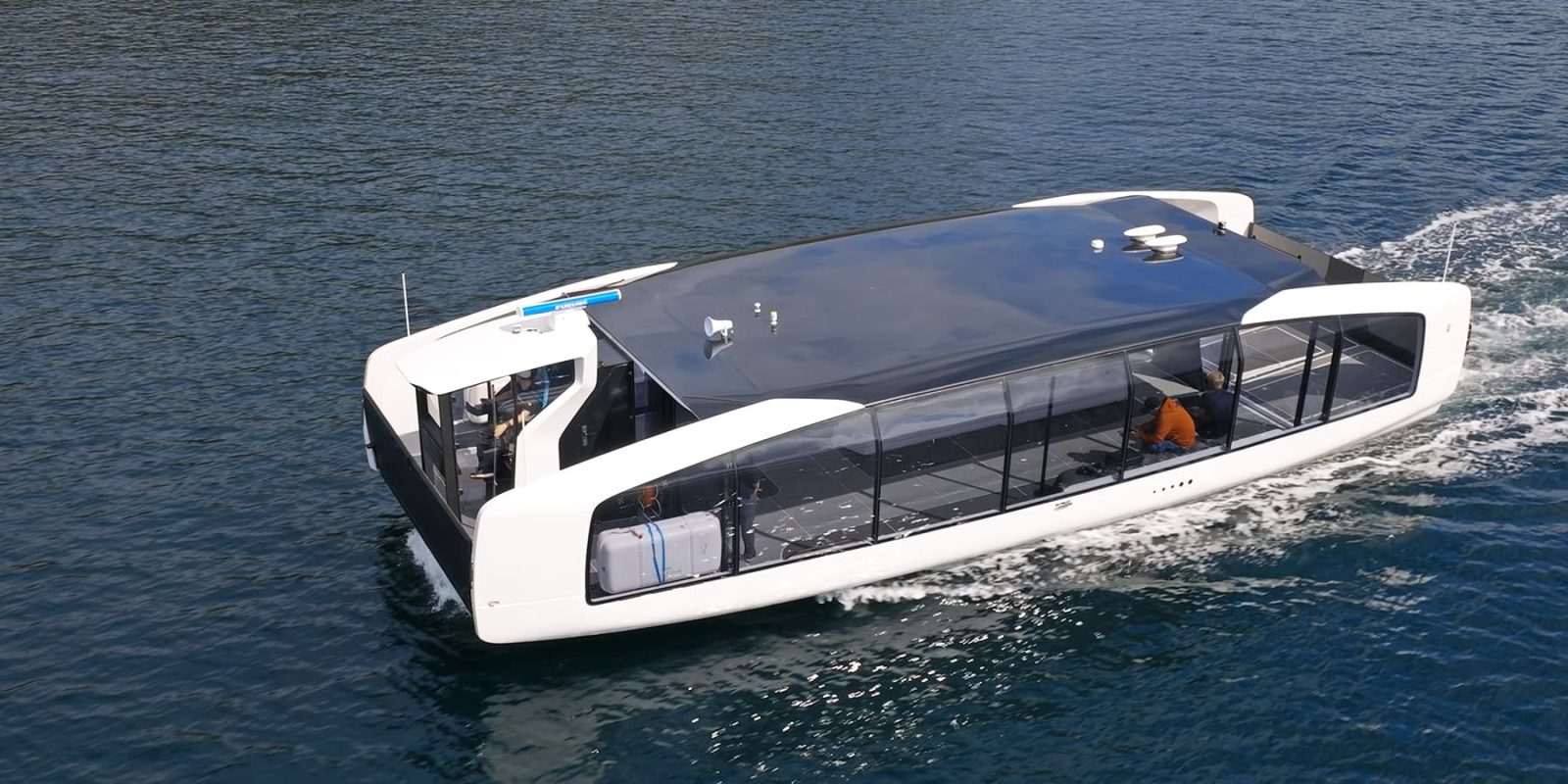
Urban planners have long treated bridges and tunnels as the default answer to bodies of water that divide cities. These are monumental projects — politically prestigious, structurally permanent, and almost invariably over budget. A pilot project in Norway is now testing a different premise: that small, autonomous electric ferries can provide urban crossings at a fraction of the cost, with none of the concrete.
The Norwegian initiative deploys zero-emission watercraft on short urban routes, replacing the need for fixed infrastructure with a fleet that can be scaled, repositioned, or redeployed as demand shifts. The vessel operates autonomously, drawing on sensor arrays and navigation software rather than a full crew, which compresses operating costs further. In a country already at the forefront of electric maritime transport — Norway has been an early mover in battery-electric ferry adoption for fjord crossings — the pilot extends the logic from rural coastal routes to dense urban environments.
Hard infrastructure versus soft mobility
The distinction at the heart of this experiment is between what transportation engineers call "hard" and "soft" infrastructure. A bridge is a fixed asset: it takes years to plan, years to build, and once completed it serves a single corridor at a capacity determined decades earlier. If population patterns shift or demand migrates to a different crossing point, the bridge remains where it was poured. Tunnels carry the same rigidity, compounded by higher maintenance costs and ventilation requirements.
Electric ferries invert this model. A fleet of small vessels operates more like a bus network on water — routes can be adjusted seasonally, frequency can respond to real-time ridership data, and additional units can be introduced without breaking ground. The capital expenditure profile is fundamentally different: rather than a single, multi-billion-dollar commitment, cities face modular procurement decisions that can be staged over time. For municipalities with constrained budgets and aging infrastructure elsewhere in their networks, the financial argument is difficult to dismiss.
The autonomous component adds another layer. Crew costs represent a significant share of operating expenses for conventional ferry services. Removing or reducing crew requirements — subject to regulatory approval, which varies widely by jurisdiction — could make short urban crossings economically viable even at low ridership levels, a threshold that has historically killed waterborne transit proposals before they reach implementation.
Waterfronts as transit corridors, not barriers
There is a broader urbanist argument embedded in the Norwegian pilot. For much of the twentieth century, city waterfronts were industrial zones — noisy, polluted, and functionally hostile to residential life. The shift toward post-industrial waterfront development has reclaimed many of these areas for housing, commerce, and public space. Yet the transit connections serving these neighborhoods still tend to follow road and rail corridors designed for an earlier era.
Electric propulsion changes the environmental calculus of waterborne transit. Diesel ferries brought noise, exhaust, and wake damage that made them poor neighbors for residential waterfronts. Battery-electric vessels eliminate tailpipe emissions and operate at significantly lower noise levels, removing two of the primary objections that urban residents and planners have historically raised against ferry service.
Norway's geography makes it a natural laboratory for this kind of experiment — fjords and island archipelagos create transit challenges that roads alone cannot solve efficiently. But the underlying logic is not limited to Scandinavian topography. Cities built around harbors, rivers, and estuaries exist on every continent, and many face the same combination of aging bridge stock, rising construction costs, and growing pressure to decarbonize transport networks.
Whether autonomous electric ferries can move from pilot curiosity to mainstream urban transit depends on several unresolved tensions: regulatory frameworks for autonomous vessels remain fragmented across jurisdictions; battery energy density still limits range and payload for larger craft; and public acceptance of crewless boats on busy waterways is largely untested at scale. The Norwegian experiment does not resolve these questions, but it sharpens them — and it reframes urban water not as a problem to be engineered over, but as infrastructure that already exists.
With reporting from Electrek.
Source · Electrek