In Baltimore, the relationship between the city and its water is increasingly fraught. As sea levels rise and mid-century infrastructure begins to buckle under demands it was never designed to meet, the simple act of a rainstorm has become a source of systemic stress. Every gallon of water that hits the pavement becomes a carrier for pollutants — motor oil, heavy metals, nitrogen — rushing through low-lying neighborhoods and overwhelming the local streams that feed into the Chesapeake Bay.
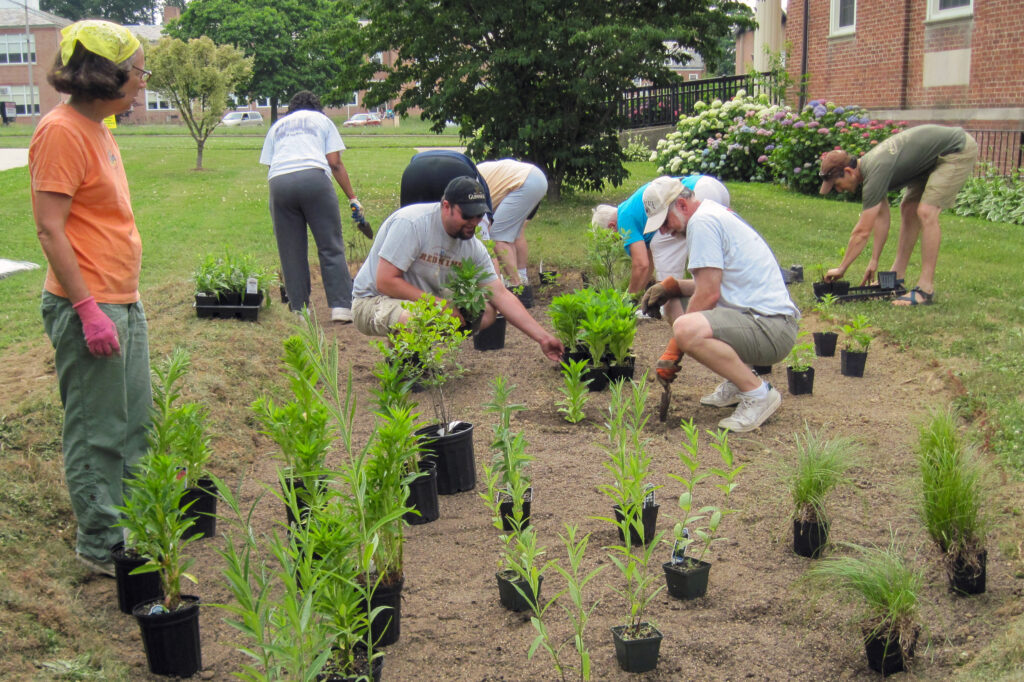
Faith Presbyterian Church, along with several other local congregations, is attempting to intervene at the most granular level possible: the land beneath its own buildings. By replacing impermeable surfaces — parking lots, concrete walkways, compacted lawns — with biophilic landscapes designed to absorb and filter stormwater, these institutions are transforming their grounds into ecological sponges rather than conduits for runoff. The goal is deceptively simple: slow the water down and let the earth do what engineered drainage systems increasingly cannot.
Green infrastructure and the logic of the sponge
The concept at work is often described as green infrastructure, a category of urban design that uses vegetation, soil, and natural processes to manage water and create healthier environments. Rain gardens, bioswales, permeable pavement, and tree canopy expansion all fall under this umbrella. The underlying logic is that urban surfaces sealed by asphalt and concrete prevent rainwater from infiltrating the ground, forcing it instead into overtaxed storm drains and combined sewer systems. When those systems overflow — a frequent occurrence in older cities like Baltimore — untreated sewage and stormwater discharge directly into rivers and bays.
Baltimore's vulnerability is compounded by geography and history. The city sits at the head of the Chesapeake Bay, the largest estuary in the United States and one already under severe ecological pressure from nutrient pollution and sediment runoff across its vast watershed. Much of Baltimore's sewer infrastructure dates to the mid-twentieth century, an era when combined sewer systems — which channel both stormwater and sewage through the same pipes — were standard engineering practice. The result is a city where heavy rain events routinely trigger sewage overflows into the harbor and surrounding waterways.
In this context, the decision by Faith Presbyterian and peer congregations to convert their grounds into stormwater management sites carries significance beyond the symbolic. Religious institutions in American cities often control substantial parcels of land — church buildings, fellowship halls, parking areas, and open grounds — that sit largely impervious during the week. Repurposing even a fraction of that footprint for infiltration and filtration can reduce the volume of runoff entering the municipal system during peak storm events.
Civic land stewardship as climate adaptation
The Baltimore church initiative fits within a broader pattern visible across several American cities where decentralized, community-led green infrastructure projects are emerging as complements — and sometimes alternatives — to large-scale capital investments in gray infrastructure. Philadelphia's ambitious Green City, Clean Waters program, launched over a decade ago, pursued a similar philosophy at municipal scale, incentivizing property owners to reduce impervious cover. Washington, D.C., and Detroit have experimented with comparable approaches in neighborhoods where aging pipes and rising rainfall intensity make conventional upgrades prohibitively expensive.
What distinguishes the congregational model is the institutional continuity it offers. Churches, mosques, and synagogues tend to hold property across generations, providing a stability of land stewardship that individual homeowners or commercial landlords may not. They also occupy a distinctive civic position — trusted, community-facing, and often located in the neighborhoods most exposed to flooding and pollution.
The tension worth watching is whether these localized interventions can operate at a scale that materially changes outcomes for a city like Baltimore, or whether they remain valuable but insufficient demonstrations of principle. Green infrastructure is not a substitute for repairing failing sewer mains or adapting coastal zones to rising tides. It is, at best, a layer in a broader strategy — one that depends on public investment, regulatory frameworks, and coordination across hundreds of individual landowners and institutions.
The question, then, is not whether nature-based solutions work at the level of a single church parking lot. The evidence on infiltration and filtration is well established. The harder question is political and logistical: whether a city with constrained budgets and competing priorities can weave enough of these small interventions together to shift the aggregate math of stormwater management — before the next major storm makes the calculation for it.
With reporting from Inside Climate News.
Source · Inside Climate News