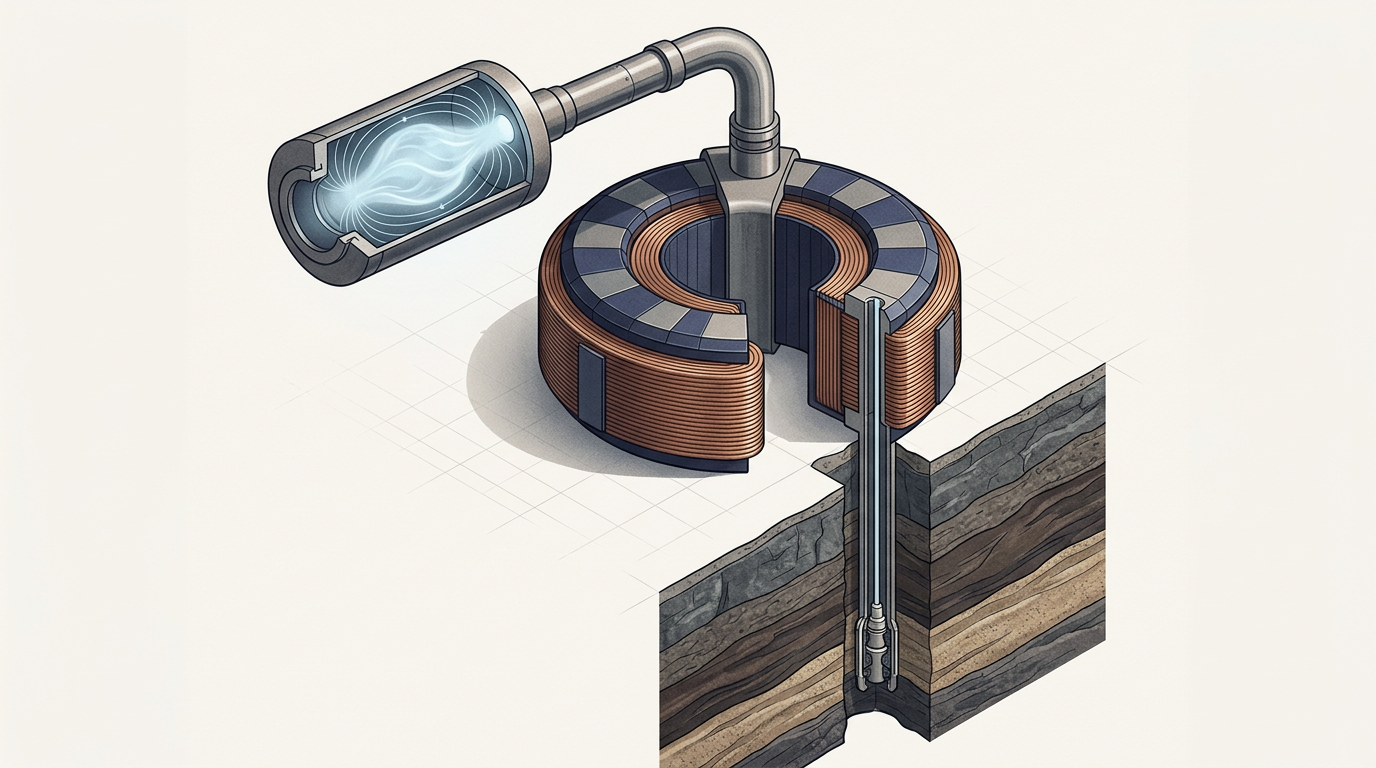
The technical requirements for fusion energy — the containment of plasma at temperatures exceeding the sun's core — have historically been viewed as a singular, hermetic engineering challenge. Recent developments at MIT's Plasma Science and Fusion Center (PSFC), however, suggest that the high-temperature superconducting (HTS) magnets designed for fusion reactors may solve a very different problem: drilling through the Earth's most stubborn crust to access deep geothermal heat.
During a recent visit by Representative Jake Auchincloss (D-Mass.), MIT researchers demonstrated how HTS magnets enable more compact and cost-effective fusion reactor designs by generating significantly higher magnetic fields. Those same magnets, it turns out, are also critical to the operation of gyrotrons — high-power microwave sources that can be repurposed for what is known as millimeter-wave drilling. The demonstration marks a rare moment of technical convergence between two disparate clean-energy frontiers.
From plasma containment to rock vaporization
High-temperature superconducting magnets represent a generational leap over the low-temperature superconductors that dominated magnet design for decades. Conventional superconducting materials require cooling to near absolute zero and produce comparatively modest magnetic fields, which in turn demand enormous reactor vessels to confine plasma. HTS materials, by contrast, operate at somewhat higher temperatures and can generate far stronger fields in a smaller footprint. That advantage is what makes compact fusion reactor concepts viable in the first place.
The same magnetic intensity, however, is what allows gyrotrons to produce the concentrated beams of millimeter-wave energy needed for a fundamentally different task. Unlike traditional mechanical drill bits, which degrade rapidly when encountering the extreme heat and pressure found several kilometers below the surface, millimeter-wave technology uses directed microwave energy to melt or vaporize rock. The approach sidesteps the core limitation of conventional drilling: the deeper the hole, the faster the equipment fails.
This matters because the most promising geothermal resources — so-called superhot rock reservoirs where temperatures can exceed 400 degrees Celsius — sit at depths that remain economically unreachable with existing drilling technology. Accessing that heat would open a path toward baseload clean energy that is independent of weather, geography, or time of day, a characteristic that neither solar nor wind power can reliably offer.
The infrastructure gap between lab and field
The physics of millimeter-wave drilling have been demonstrated in laboratory settings, but the distance between a controlled experiment and a utility-scale borehole is considerable. Drilling operations require sustained power delivery, thermal management systems capable of functioning in hostile subsurface environments, and engineering solutions for removing vaporized material from the borehole in real time. None of these challenges are trivial, and none have been solved at commercial scale.
There is also a question of institutional alignment. Fusion research and geothermal development have traditionally occupied separate funding streams, separate regulatory frameworks, and separate communities of expertise. The fact that a single enabling technology — the HTS magnet — now sits at the intersection of both fields creates an unusual opportunity for shared investment, but also a coordination problem. Government agencies, private capital, and research institutions would need to recognize the dual-use nature of the technology and fund accordingly.
The broader pattern is worth noting. Historically, some of the most consequential energy technologies have emerged not from linear development within a single domain but from lateral transfer between domains. Gas turbines moved from aviation to power generation. Hydraulic fracturing techniques developed for oil extraction reshaped the natural gas market. If HTS magnets follow a similar trajectory — proving their value first in fusion research, then migrating to geothermal drilling — the implications for clean energy infrastructure could be substantial.
What remains uncertain is timing and sequence. Compact fusion reactors are still years from commercial operation. Deep geothermal drilling, while less technically exotic, faces its own capital and regulatory hurdles. Whether the two applications advance in parallel, or whether one subsidizes the development of the other, may depend less on physics than on how funding and policy decisions unfold over the next several years. The technology, at least, appears to be converging. Whether the institutions around it converge as well is a different question entirely.
With reporting from MIT News.
Source · MIT News