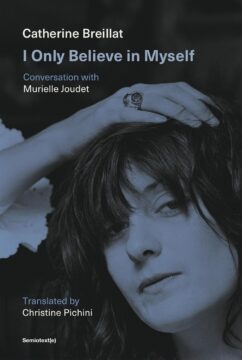
Catherine Breillat's fascination with Rhett Butler might seem like a glitch in the matrix of French transgressive cinema. In a new collection of interviews, I Only Believe in Myself, the director of some of the most confrontational films of the last fifty years repeatedly invokes the classical Hollywood archetype played by Clark Gable. For an auteur whose work has been banned, censored, and celebrated for its unflinching look at human sexuality, the reference to a cinema governed by the restrictive Hays Code is a striking paradox — one that illuminates the deeper architecture of Breillat's artistic project.
Yet this tension defines Breillat's career. While she may harbor a secret affinity for the polished charm of Gone with the Wind, her artistic lineage is more directly traced to the "absolute violence" of the poet Comte de Lautréamont, the nineteenth-century French-Uruguayan writer whose Les Chants de Maldoror scandalized literary Paris with its hallucinatory cruelty and became a foundational text for the Surrealists. Breillat operates under the conviction that beauty is not a comfort but something that "ought to be cruel and frightening." From her 1968 debut novel, L'Homme facile, published when she was just seventeen, to her latest film, Last Summer (2023), she has consistently sought to dismantle the boundaries between the private and the public, the erotic and the grotesque.
Classical form, transgressive content
The Rhett Butler reference is more than biographical trivia. It points to a structural principle in Breillat's filmmaking that critics have often overlooked in their preoccupation with her subject matter. Classical Hollywood cinema, for all its moral codes and narrative tidiness, understood something about the power of withholding — the charged glance, the closed door, the implication that what lies beyond the frame is more dangerous than anything shown. Breillat's work inverts this logic: she opens the door, shows what lies behind it, but retains the formal discipline of classical composition. Her shots are deliberate, her pacing controlled, her framing precise. The provocation is never chaotic.
This combination places Breillat in a lineage distinct from many of her contemporaries in French extreme cinema. Directors such as Gaspar Noé and Bruno Dumont, who emerged in the same cultural moment, often deploy formal disruption — long unbroken takes, disorienting camera movement, abrasive sound design — as a complement to their transgressive content. Breillat's approach is closer to that of a novelist who writes about violence in measured prose. The calm of the form intensifies the shock of the content, rather than competing with it.
Her debt to Lautréamont reinforces this reading. The Chants de Maldoror is not a formless howl; it is elaborately structured, borrowing the cadences of Romantic poetry to deliver images of extraordinary brutality. Breillat's cinema operates on a similar principle: classical beauty as the vessel for material that polite culture would prefer to suppress.
The refusal of moral resolution
In Last Summer, Breillat depicts a lawyer's affair with her teenage stepson with a clinical, non-judgmental eye that challenges the viewer's desire for easy ethical resolution. The film does not excuse, condemn, or psychologize. It observes. This refusal to provide moral scaffolding is perhaps the most genuinely transgressive element of Breillat's work — more so than any explicit image. Audiences and censors have historically found it easier to tolerate graphic content when it arrives packaged with clear moral instruction. Remove the instruction, and discomfort becomes something the viewer must manage alone.
As she notes in her interviews, Breillat feels no shame in depicting "every kind of depravity," seeing it not as provocation for its own sake but as a necessary exploration of the human condition. The distinction matters. Provocation without inquiry is spectacle; inquiry without flinching is what Breillat has pursued across more than five decades of work.
The publication of I Only Believe in Myself arrives at a moment when debates over the limits of artistic representation — in cinema, literature, and visual art — have grown more polarized. On one side, a renewed appetite for moral clarity in storytelling; on the other, a defense of art's right to inhabit uncomfortable territory without apology. Breillat's career sits squarely at the fault line. Whether her insistence on cruelty as a form of honesty represents a necessary corrective or an aesthetic dead end depends largely on what one believes art owes its audience — a question the interviews pose but, characteristically, decline to answer.
With reporting from 3 Quarks Daily.
Source · 3 Quarks Daily