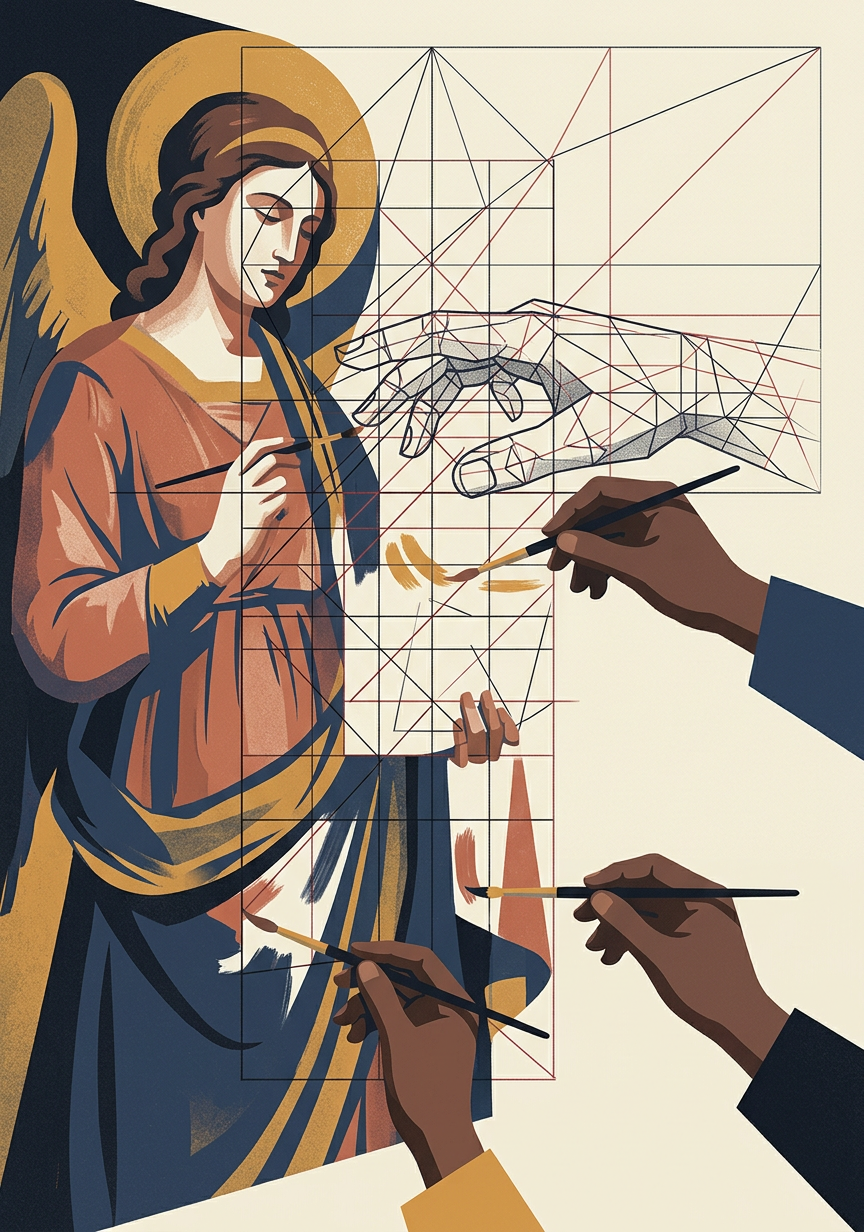
The workshop system of the Spanish Renaissance was a collaborative machine, often blurring the lines between the master's hand and those of his apprentices. For art historians, disentangling these contributions has long been a matter of connoisseurship — an intuitive, if rigorous, visual analysis built on decades of looking. Now, a multi-disciplinary team at Case Western Reserve University is augmenting that intuition with a machine-learning model named PATCH, short for "pairwise assignment training for classifying heterogeneity." The tool operates at a microscopic scale, analyzing one-centimeter-square segments of a canvas to identify the subtle, almost subconscious signatures embedded in brushwork and paint texture.
The researchers, whose backgrounds span physics, anthropology, and art history, trained PATCH on works known to be the product of a single artist, creating a baseline of stylistic consistency. That baseline can then be used to interrogate pieces with more ambiguous origins. Applied to the oeuvre of Doménikos Theotokópoulos — the Cretan-born painter known as El Greco — the model compared the solo-attributed Christ on the Cross with the more contentious The Baptism of Christ. The latter has long been suspected of being a posthumous collaboration involving El Greco's son, Jorge Manuel Theotocópuli, and other workshop assistants. PATCH offers a quantitative framework for those suspicions, mapping zones of stylistic heterogeneity across the canvas surface.
From connoisseurship to computation
The question of authorship in Renaissance workshops is not new, nor is it simple. Masters from Raphael to Rubens ran large studios where apprentices routinely executed backgrounds, drapery, and secondary figures under the master's supervision. The resulting paintings were sold under the master's name, a practice that was neither deceptive nor unusual — it was the economic and pedagogical structure of artistic production. Attribution debates have therefore persisted for centuries, fueled by shifts in taste, market incentives, and evolving standards of evidence.
Traditional connoisseurship relies on the trained eye: the ability to detect characteristic rhythms in brushwork, preferences in color mixing, and idiosyncratic handling of form. It is a discipline with a distinguished lineage, from Giovanni Morelli's focus on minor anatomical details in the nineteenth century to the technical art history practiced in major museum conservation labs today. Yet connoisseurship has always carried an irreducible element of subjectivity. Two experts examining the same passage of paint may reach different conclusions, and the reasoning behind those conclusions can be difficult to formalize or reproduce.
PATCH does not replace that expertise. What it introduces is a layer of statistical rigor. By breaking a painting into hundreds of small segments and comparing the textural features of each against a trained baseline, the model can flag areas of inconsistency that might escape even a practiced eye — or confirm what the eye already suspects. The approach shares conceptual ground with earlier computational efforts in art authentication, such as the use of wavelet analysis on drawings attributed to Pieter Bruegel the Elder, but operates at a finer spatial resolution and with a more explicit framework for handling multi-hand canvases.
The limits of the digital lens
The implications extend beyond a single altarpiece. If models like PATCH prove reliable across a broader range of artists and periods, they could reshape how museums, auction houses, and scholars approach contested works. Attribution carries significant consequences — financial, historical, and curatorial. A painting firmly attributed to El Greco occupies a different place in the market and in art history than one classified as "workshop of."
But the tool also raises questions that its creators are unlikely to resolve with computation alone. Workshop paintings were not forgeries; they were products of a legitimate system of artistic labor. Parsing them into zones of "master" and "assistant" imposes a modern framework of individual authorship onto a pre-modern mode of production. Whether that framework clarifies or distorts the historical record depends on how the results are interpreted — and by whom.
There is also the matter of training data. Machine-learning models are only as reliable as the ground truth on which they are built. If the "securely attributed" works used to train PATCH themselves contain undetected workshop contributions, the baseline shifts, and so do the conclusions. The circularity is not fatal, but it demands caution.
What PATCH ultimately demonstrates is less a verdict on any single painting than a methodological proposition: that the idiosyncrasies of a brushstroke can be not only seen but measured, and that measurement can sit alongside — rather than above — the judgment of the human eye. Whether the art world embraces that proposition, or resists it, will depend on how the next generation of contested attributions plays out.
With reporting from ARTnews.
Source · ARTnews