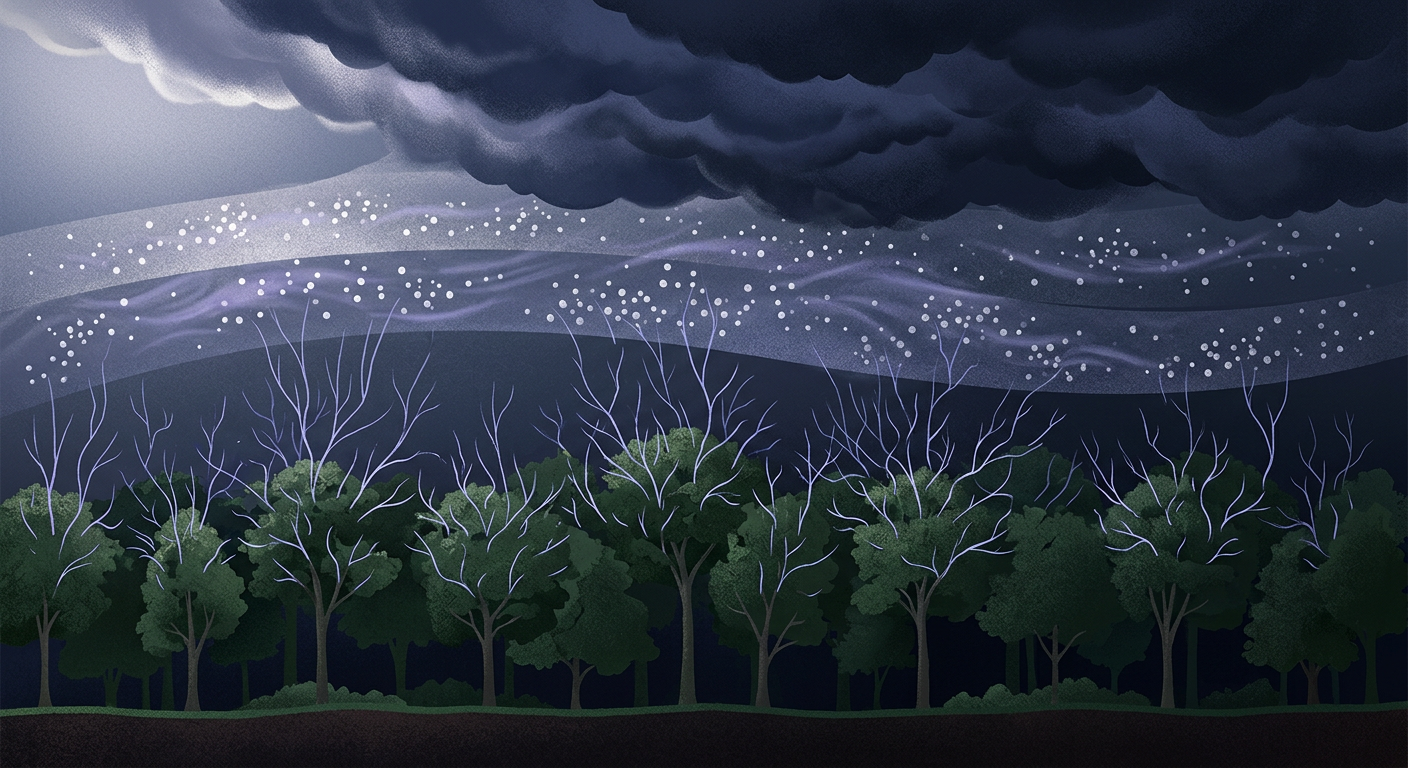
For decades, the idea that trees might glow during a thunderstorm remained a theoretical curiosity, confined to laboratory simulations and the margins of atmospheric physics. Corona discharges — faint electrical emissions that occur when a strong electric field ionizes the air around a sharp conductive point — had been observed on aircraft wings, ship masts, and high-voltage power lines. That the pointed tips of leaves might behave similarly under storm conditions was plausible in theory but had never been captured in a natural setting. Recently, however, researchers operating from a retrofitted minivan equipped with ultraviolet-sensitive instruments managed to document the phenomenon in the wild, recording faint ultraviolet shimmers emanating from treetops during active thunderstorms.
The observation moves a long-standing hypothesis out of the laboratory and into the field. Under the intense electric fields generated by a passing storm, the sharp geometry of leaves and branch tips concentrates charge density to the point where surrounding air molecules are stripped of electrons. The result is a cascade of tiny, luminous discharges — invisible to the naked eye but detectable with the right instruments.
From spectacle to chemistry
The significance of the finding extends well beyond the visual. When air is ionized in this manner, the process generates hydroxyl radicals (OH) — short-lived but extraordinarily reactive molecules sometimes described as the atmosphere's primary detergent. Hydroxyl radicals are central to tropospheric chemistry: they initiate the oxidation of methane, carbon monoxide, and volatile organic compounds, breaking pollutants down into less harmful substances. Atmospheric scientists have long tracked OH production from known sources, chiefly the photolysis of ozone by ultraviolet sunlight in the presence of water vapor. If forests generate additional hydroxyl radicals through corona discharges during storms, it introduces a mechanism that existing atmospheric models do not account for.
The scale of the effect remains an open question. A single leaf tip produces a negligible discharge. But the planet's forested area — roughly four billion hectares, much of it in tropical regions where thunderstorm activity is most intense — presents an enormous aggregate surface of potential discharge points. The interaction between storm frequency, canopy structure, and local atmospheric composition could mean that the chemical contribution varies dramatically by geography and season. Boreal forests in summer, tropical rainforests year-round, and even temperate woodlands during convective storm seasons may each play distinct roles.
Reframing the forest
The discovery invites a broader reconsideration of what forests do. Ecological science has long valued forests as carbon sinks — absorbing CO₂ through photosynthesis and storing it in biomass and soil. More recently, attention has turned to the role of biogenic volatile organic compounds emitted by trees, which influence cloud formation and regional climate. Corona discharges add a third dimension: forests as electrochemical actors, participating in atmospheric chemistry through a mechanism driven not by biology but by geometry and physics.
This reframing carries potential implications for climate modeling and land-use policy. If deforestation reduces not only carbon sequestration but also a distributed source of atmospheric oxidants, the chemical consequences of forest loss may be broader than currently estimated. Conversely, reforestation efforts — particularly in storm-prone regions — might carry atmospheric benefits that extend beyond the carbon ledger.
Much depends on quantification. The researchers have demonstrated that the phenomenon exists outside the laboratory, but the rate of radical production per unit of canopy area during a storm, the persistence of those radicals in turbulent storm air, and the net effect on regional pollutant concentrations all remain unmeasured. Laboratory analogs can offer estimates, yet the chaotic conditions of a real thunderstorm — wind shear, rain, variable electric field strength — make direct extrapolation uncertain.
What is clear is that the boundary between a forest and the atmosphere above it is more electrically active than previously documented. Whether that activity is chemically significant at the planetary scale, or merely a fascinating footnote to storm physics, is the question the field now faces.
With reporting from Science Daily.
Source · Science Daily