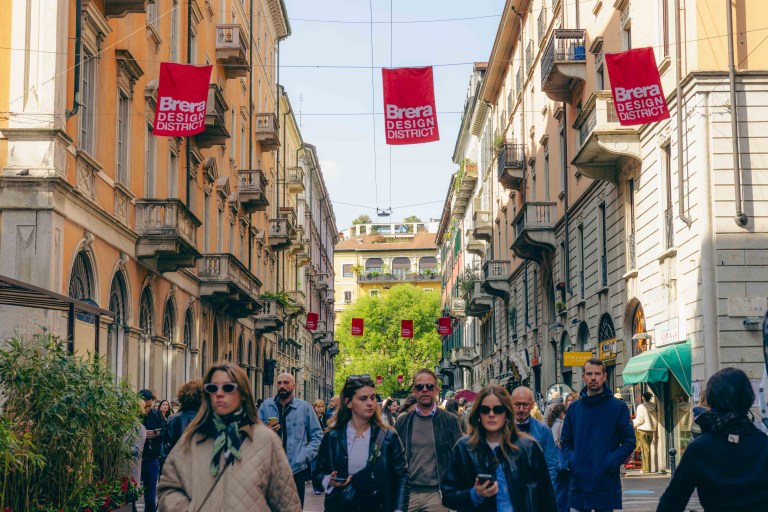
Despite the persistent hum of global economic and political uncertainty, Milan remains the undisputed center of the design world's gravity. As the 2026 edition of Milan Design Week approaches, the Brera Design District stands as its most concentrated expression. Now in its 17th year, the district has evolved from a collection of temporary galleries into a permanent ecosystem of creativity, blending its historic architecture with the avant-garde demands of modern industry.
The scale of the upcoming week is formidable: over 300 events are slated to occupy the district's cobblestone streets, supported by a network of 217 permanent showrooms and nearly 90 temporary exhibitions. According to Paolo Casati, co-founder of Studiolabo, the district's growth is fueled by a desire for continuity. For many brands, Brera is no longer just a destination for a week-long sprint but a place to establish a year-round presence, fostering direct, long-term relationships with both the industry and the public.
From Object to Process
This year's theme, "Be the Project," signals a shift in the philosophical underpinnings of the fair. It suggests that design should be viewed not merely as the production of finished objects or formal results, but as a rigorous cultural process. By framing design as a responsibility — one that builds essential links between people, places, and communities — the district aims to move beyond the superficiality of "newness" toward a more sustainable and relational form of practice.
The pivot is not without precedent. Over the past decade, the broader design world has grappled with a tension between spectacle and substance. Milan Design Week itself, known formally as the Salone del Mobile and its sprawling network of Fuorisalone events across the city, has periodically faced criticism for prioritizing Instagram-ready installations over meaningful discourse about materials, labor, and environmental cost. Brera's curatorial choice this year reads as a deliberate response to that critique — an attempt to reposition the district not as a marketplace of novelty but as a forum for examining how design intervenes in the world.
The emphasis on process over product also reflects a broader current in design education and criticism. Movements around circular design, participatory urbanism, and material honesty have gained traction in European design schools and institutions over the past several years. When a district as commercially significant as Brera adopts this language as its organizing principle, it suggests the conversation has migrated from the margins to the center of the industry.
Brera's Structural Advantage
Brera's ability to host this kind of thematic ambition rests on a structural advantage that most design fair districts lack: permanence. Unlike pop-up zones that materialize for a single week and vanish, Brera's 217 permanent showrooms provide a physical infrastructure that sustains relationships between designers, manufacturers, and audiences year-round. The district's cobblestone streets, Renaissance-era courtyards, and proximity to the Pinacoteca di Brera — one of Italy's most significant art collections — lend the area a cultural density that temporary pavilions cannot replicate.
This permanence also changes the economic calculus for participating brands. A year-round showroom in Brera is not a marketing expense written off after a single week of foot traffic; it is an investment in ongoing visibility and dialogue. That distinction matters in an industry where the relationship between designer and client increasingly depends on trust built over time rather than transactions completed in a rush.
The question, then, is whether the thematic ambition of "Be the Project" will translate into the actual programming and installations that fill the district, or whether it will function primarily as curatorial framing around business as usual. Design fairs have long excelled at articulating lofty intentions in their press materials while the showroom floors tell a more commercial story. The tension between those two registers — the aspirational and the transactional — is not a flaw unique to Brera. It is the central friction of every major design event that aspires to cultural relevance while operating within a commercial ecosystem.
What makes Brera worth watching in 2026 is not the resolution of that tension but the seriousness with which it appears willing to hold it. A district that has spent seventeen years building physical and institutional permanence now asks whether the design industry can extend that same commitment to its values — not just its real estate.
With reporting from Cool Hunting.
Source · Cool Hunting