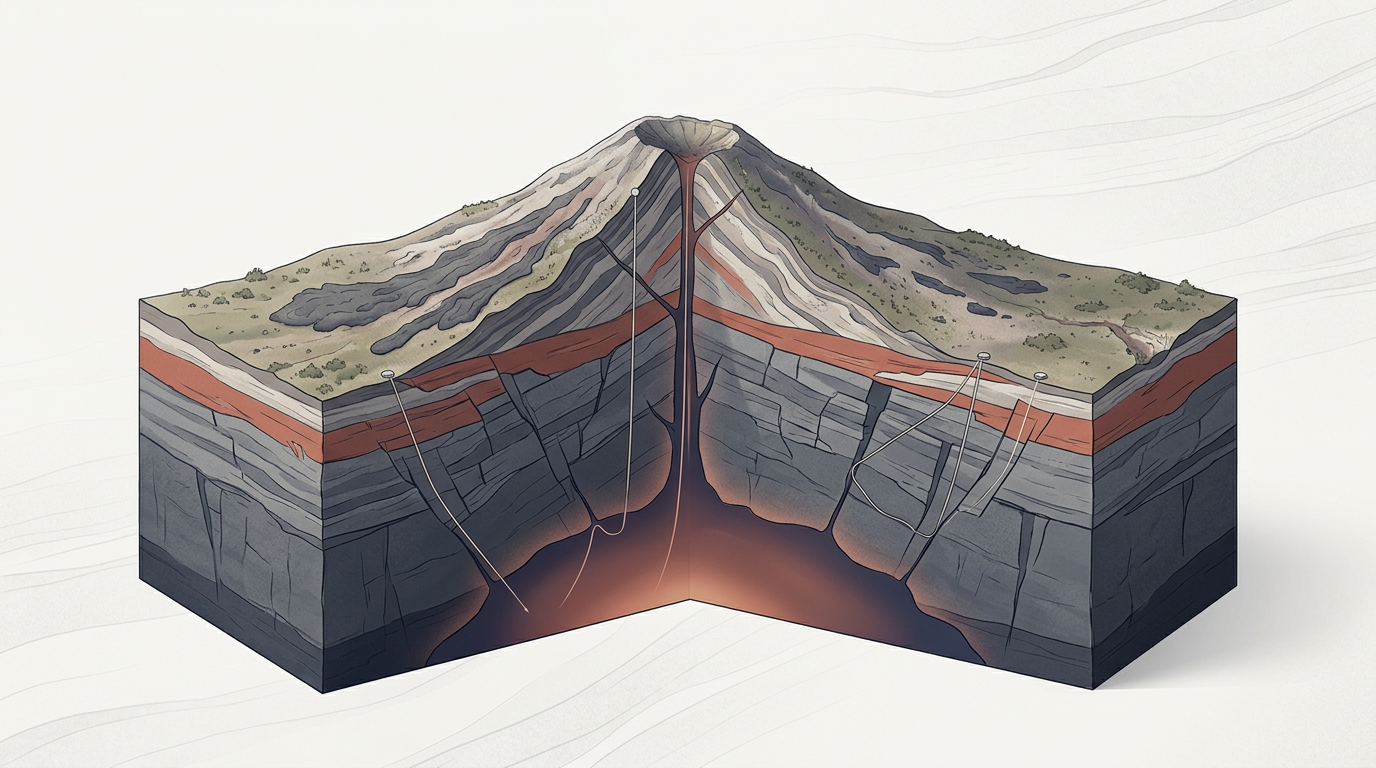
Deep within the pressurized interiors of Uranus and Neptune, the familiar boundaries between phases of matter appear to dissolve. According to new advanced simulations, the intense heat and crushing gravitational forces inside these ice giants may forge a hybrid state of matter that is neither entirely solid nor purely liquid. The finding, if confirmed by future observation, could resolve one of the more persistent puzzles of planetary science: why the magnetic fields of Uranus and Neptune look so different from those of every other planet in the solar system.
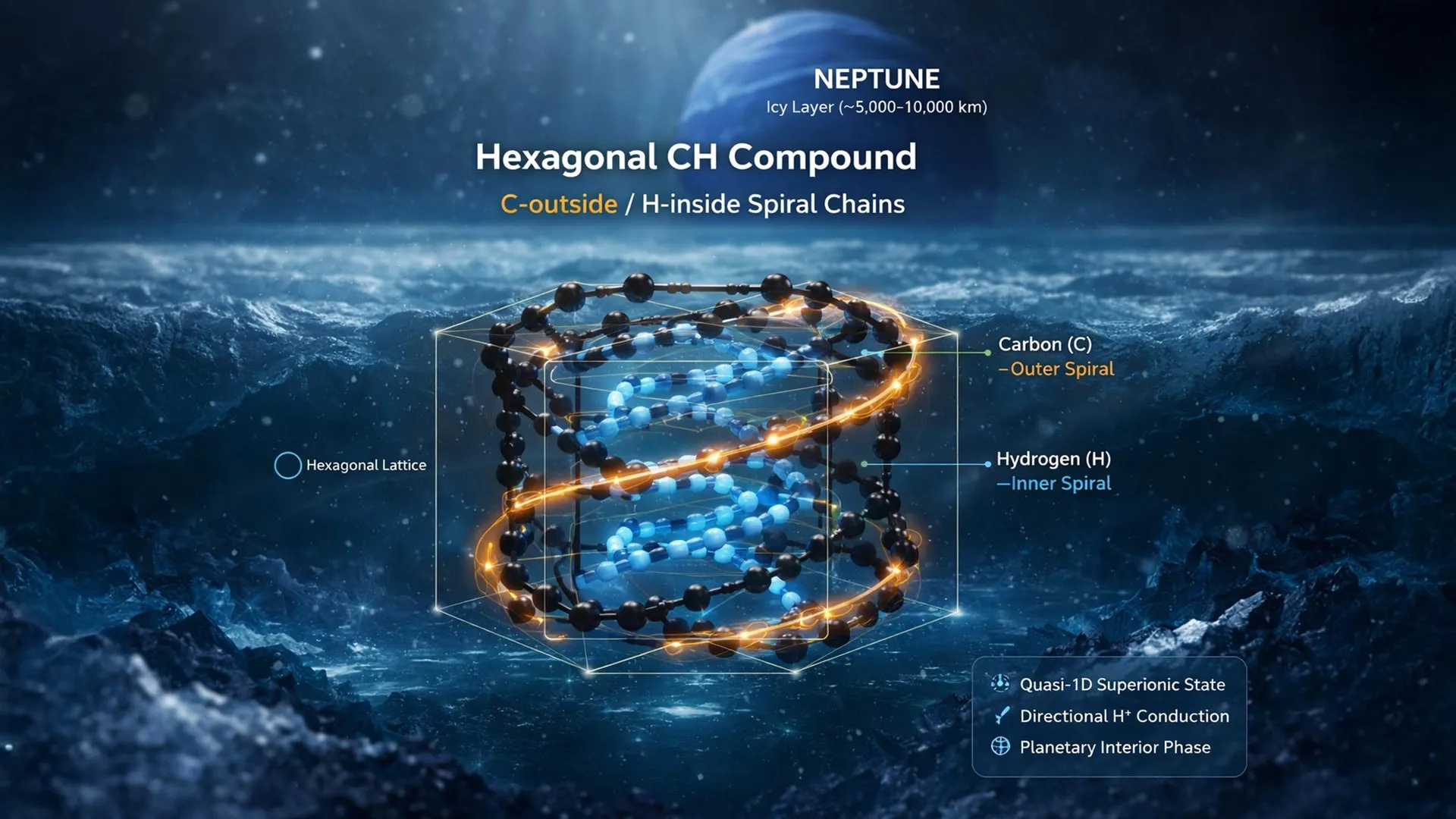
In this "superionic" phase, carbon and hydrogen behave with a strange, coordinated autonomy. Carbon atoms lock into a rigid, crystalline framework while hydrogen atoms remain mobile, spiraling through the solid lattice like a fluid. The result is a material that possesses the structural integrity of a solid but the transport properties of a liquid — a duality that sits outside the neat categories of classical thermodynamics and challenges conventional planetary interior models.
Why ice giants remain poorly understood
Uranus and Neptune occupy an awkward position in planetary science. They are far less studied than the gas giants Jupiter and Saturn, which have been visited by multiple spacecraft, and far less accessible than the rocky inner planets. Voyager 2 remains the only probe to have flown past either world, doing so in 1986 and 1989 respectively. The data it returned revealed magnetic fields that were strikingly offset from the planets' rotational axes and far more asymmetric than the roughly dipolar fields of Earth, Jupiter, or Saturn. For decades, no interior model has convincingly accounted for that geometry.
Most magnetic field generation in planets is attributed to convective motion in electrically conductive fluid layers — the dynamo mechanism. On Earth, this takes place in a molten iron outer core. On Jupiter and Saturn, metallic hydrogen serves a similar role. But Uranus and Neptune lack sufficient metallic hydrogen, and their interiors are thought to consist largely of water, ammonia, and methane compressed under extreme pressure. The conventional assumption was that these compounds form a hot, dense ionic fluid. The superionic hypothesis introduces a more nuanced picture: a layer where part of the material is frozen in place and part flows freely, creating conductive pathways that are inherently irregular. Such a layer would generate a dynamo whose output is asymmetric by nature, not by accident.
Implications beyond the solar system
The relevance extends well past Uranus and Neptune. Exoplanet surveys conducted over the past two decades have revealed that ice-giant-sized worlds are among the most common type of planet in the galaxy, even though the solar system contains only two. Understanding what happens inside such bodies is therefore central to characterizing a large fraction of known exoplanets. If superionic states are a generic feature of ice giant interiors, models of planetary magnetic fields, thermal evolution, and atmospheric retention may all require revision.
The concept of superionic matter is not entirely new. Laboratory experiments using diamond anvil cells and laser-driven shock compression have previously produced superionic phases of water ice at extreme pressures. What the new simulations add is a detailed picture of how carbon-hydrogen compounds — rather than water alone — behave under the specific pressure and temperature gradients expected inside Uranus and Neptune. That distinction matters because it shifts the focus from a single exotic phase to a broader class of hybrid states that may coexist at different depths within the same planet.
Confirmation will likely require either a dedicated ice giant mission — a priority identified in recent planetary science roadmaps — or laboratory experiments capable of replicating the relevant conditions with greater precision. Until then, the superionic model remains a simulation-derived hypothesis. But it is one that aligns with observed magnetic data more naturally than its predecessors, and it reframes the interiors of ice giants not as simpler versions of gas giant cores but as environments where matter itself behaves in ways that terrestrial intuition does not easily anticipate.
With reporting from Science Daily.
Source · Science Daily