The Infant Spectator: A Mid-Century Theory of Everything
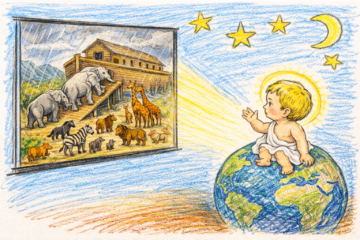
William Benzon, born in 1947 in the coal and steel country of mid-century Pennsylvania, has described a childhood cosmology that is at once disarmingly simple and surprisingly resonant with contemporary philosophical debates. As a boy of six or seven, attending Lutheran Sunday school, Benzon arrived at a sweeping ontological conclusion: the world was a movie, produced by God for the sole entertainment of the Baby Jesus. The theory emerged not from formal instruction but from the vivid biblical illustrations that populated his early religious education — images so saturated with narrative purpose that they suggested to a young mind that all of existence must be similarly scripted and staged.
Benzon has reflected that in a different era, his metaphysical temperament might have led him toward the role of shaman or priest. Instead, growing up amid the industrial gravity of steel mills and coal mines, he reached for the dominant storytelling technology of his time — cinema — to construct a framework for the universe. The result was a cosmology that recast the divine not merely as a creator but as a director, and the infant Christ as the ultimate audience.
Metaphor as Epistemological Constraint
The instinct to map the infinite onto familiar technology is not unique to a child in postwar Pennsylvania. Across intellectual history, prevailing metaphors have shaped — and constrained — how thinkers conceptualize reality. The ancient Greeks reached for geometry and harmony. The Enlightenment favored clockwork mechanisms, casting God as a watchmaker who set the universe ticking and stepped back. The industrial age produced thermodynamic models of cosmic order and entropy. In the twentieth century, the computer gave rise to information-theoretic accounts of physics and, eventually, to simulation theory — the proposition, explored most prominently by the philosopher Nick Bostrom, that observable reality might be a computational artifact generated by a more advanced civilization.
Benzon's childhood model anticipates this last framework with striking structural fidelity. A divine producer, a passive spectator, a constructed reality indistinguishable from the "real" thing — the architecture is remarkably close to the simulation hypothesis, arrived at decades earlier and without any of the formal apparatus. The difference is one of medium: where Bostrom's argument depends on computational substrate, Benzon's depends on celluloid. Both, however, rest on the same underlying intuition — that the experienced world might be a deliberate production, designed for an audience.
What makes Benzon's account particularly instructive is his candid acknowledgment of the model's internal tensions. Even as a child, he was troubled by the geometric dissonance between the flatness of a movie screen and the spherical reality of the earth. The problem of dimensionality — how a two-dimensional medium could contain a three-dimensional world — was not something he could resolve, and he has noted that the puzzle remains open for him. This is not a trivial observation. It mirrors a genuine difficulty in simulation theory and in representational philosophy more broadly: the gap between the medium of representation and the thing represented.
The Technology of Theology
The divergent spiritual paths within Benzon's own family add a further layer. His sister eventually converted to Shinnyo-en Buddhism, a Japanese lay Buddhist order with its own distinct cosmological commitments. That two members of the same household, raised in the same industrial landscape and the same Lutheran tradition, could arrive at radically different metaphysical frameworks underscores how contingent such frameworks are — shaped not only by culture and doctrine but by individual temperament and the particular metaphors that happen to be available at the right developmental moment.
This contingency is worth sitting with. If a mid-century American child naturally reaches for cinema to explain existence, and a medieval European child might have reached for cathedral architecture or liturgical drama, then the question is not which metaphor is correct but what each metaphor reveals and conceals. Every model of totality is also a model of limitation. The cinematic frame gives narrative coherence and directorial intent, but it imposes a proscenium — a boundary beyond which the spectator cannot see.
Benzon's recollection, then, functions less as autobiography and more as a case study in how minds construct cosmologies from the raw materials at hand. The tools change; the impulse does not. Whether the governing metaphor is a movie screen, a clockwork mechanism, or a computational substrate, the underlying drive — to find pattern, audience, and purpose in the structure of reality — remains constant. What shifts is only the vocabulary. And vocabulary, as Benzon's childhood puzzle about flat screens and round earths suggests, always carries its own blind spots.
With reporting from 3 Quarks Daily.
Source · 3 Quarks Daily