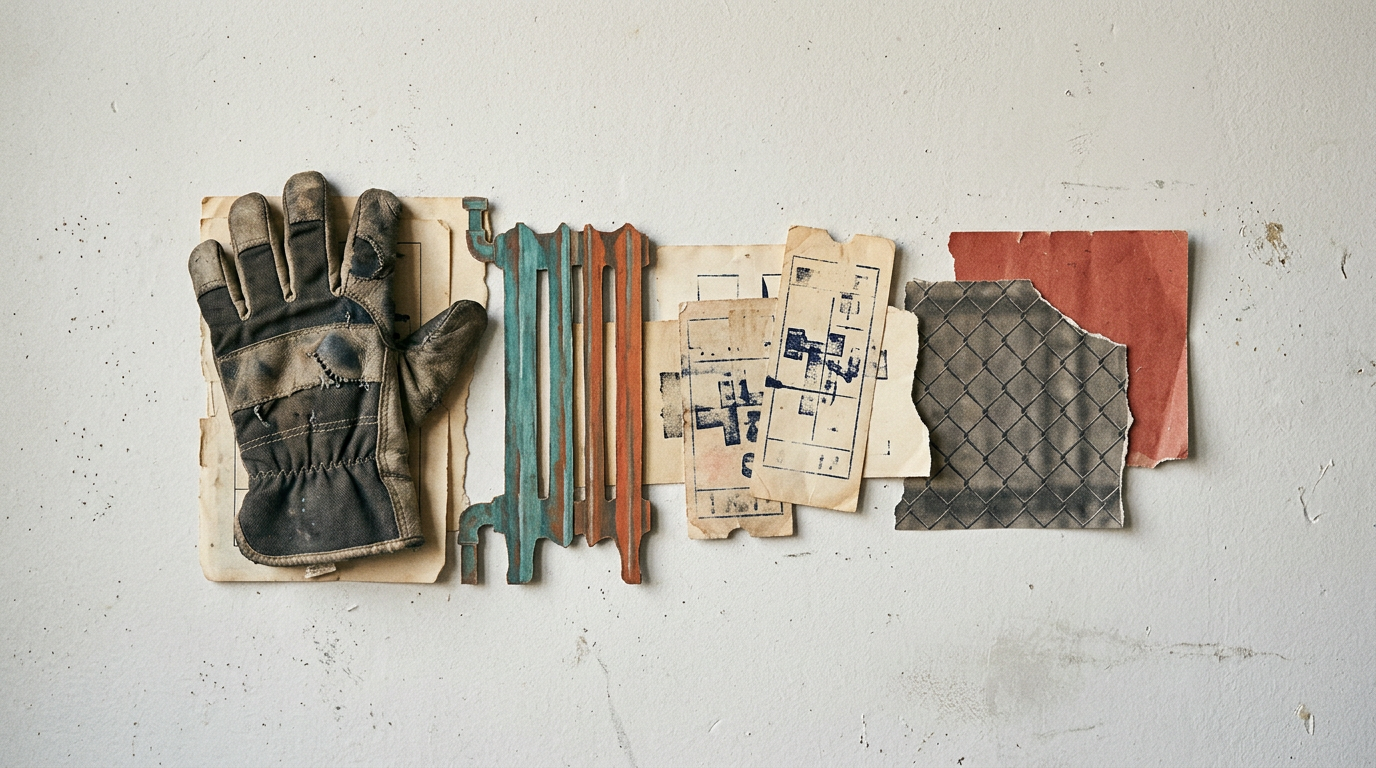
The latest iteration of Greater New York, the recurring survey exhibition at MoMA PS1, functions as a cartography of the city's current psyche. Spanning three floors of the repurposed public school building in Long Island City that has served as PS1's home since the 1970s, the show moves beyond abstract prestige to capture what might be called the city's lived texture — a collection that finds resonance in the mundane and the gritty. Among its subjects: the makeshift mittens of e-bike delivery drivers, the vertical geometry of steam radiator poles, and the ubiquitous presence of the city's resilient rodent population.
The exhibition, which has served since its 2000 debut as a periodic barometer of emerging and under-recognized art in the five boroughs, has always carried a curatorial thesis about what New York is at a given moment. This edition appears to argue that the city's identity is best understood not through its skyline or its institutions but through the material details of daily survival and improvisation.
A City Read Through Its Surfaces
Greater New York has historically oscillated between two impulses: the desire to canonize rising talent and the ambition to document a city in perpetual transformation. Earlier iterations leaned toward the former, functioning as launching pads for artists who would go on to gallery representation and museum retrospectives. The current survey tilts toward documentation — an ethnographic sensibility that treats the city itself as the primary subject.
This shift mirrors broader tendencies in contemporary art, where social practice, documentary photography, and object-based storytelling have gained institutional traction. The inclusion of artifacts drawn from the gig economy and urban infrastructure suggests a curatorial interest in labor, precarity, and the informal economies that sustain New York beneath its polished surface. The delivery driver's improvised glove is not merely an object; it is an index of a workforce that remains largely invisible to the cultural establishment even as it keeps the city fed.
The focus on the granular reality of urban life extends to the figures moving through the city's halls of power. Rama Duwaji, the First Lady of New York City, is currently navigating a narrative that transcends the tabloid-driven scrutiny of her teenage social media presence. In recent conversations, Duwaji emerges as an artist whose work and perspective are deeply integrated into the city's creative fabric, offering a counterpoint to the often-flattened public image of political figures. Her presence in the cultural conversation raises a recurring question about New York's relationship between art and power — whether proximity to civic authority amplifies or distorts an artist's voice.
Joan Semmel and the Long View
On the other side of the city's chronological and geographic spectrum sits Joan Semmel. A nonagenarian fixture of the Spring Street art scene, Semmel has spent decades painting the human body with an unflinching directness that places her work in dialogue with feminist art history, the legacy of figurative painting, and the politics of looking. Her provocative and strange portraits — currently on view at the Jewish Museum and Alexander Gray Associates — provide a necessary bridge between New York's historical avant-garde and its contemporary anxieties.
Semmel's career arc itself tells a story about the city's art world. She came to prominence during the 1970s, when feminist artists in downtown Manhattan were challenging the male-dominated canon of Abstract Expressionism and Minimalism. That her work continues to command institutional attention speaks both to its enduring formal power and to a broader recalibration within museums, which have spent the past decade revisiting artists who were sidelined during their most productive years.
Taken together, these three threads — the PS1 survey's ethnographic turn, Duwaji's navigation of art and public life, and Semmel's decades-long insistence on the body as subject — sketch a portrait of a city that resists any single narrative. New York's cultural identity has always been defined by the friction between its competing constituencies: the institutional and the informal, the emerging and the historical, the political and the aesthetic. Whether the current moment represents a genuine democratization of whose textures get exhibited, or simply a new curatorial fashion that will rotate out with the next survey cycle, remains an open question — one that the city's artists, rather than its curators, will ultimately answer.
With reporting from Hyperallergic.
Source · Hyperallergic