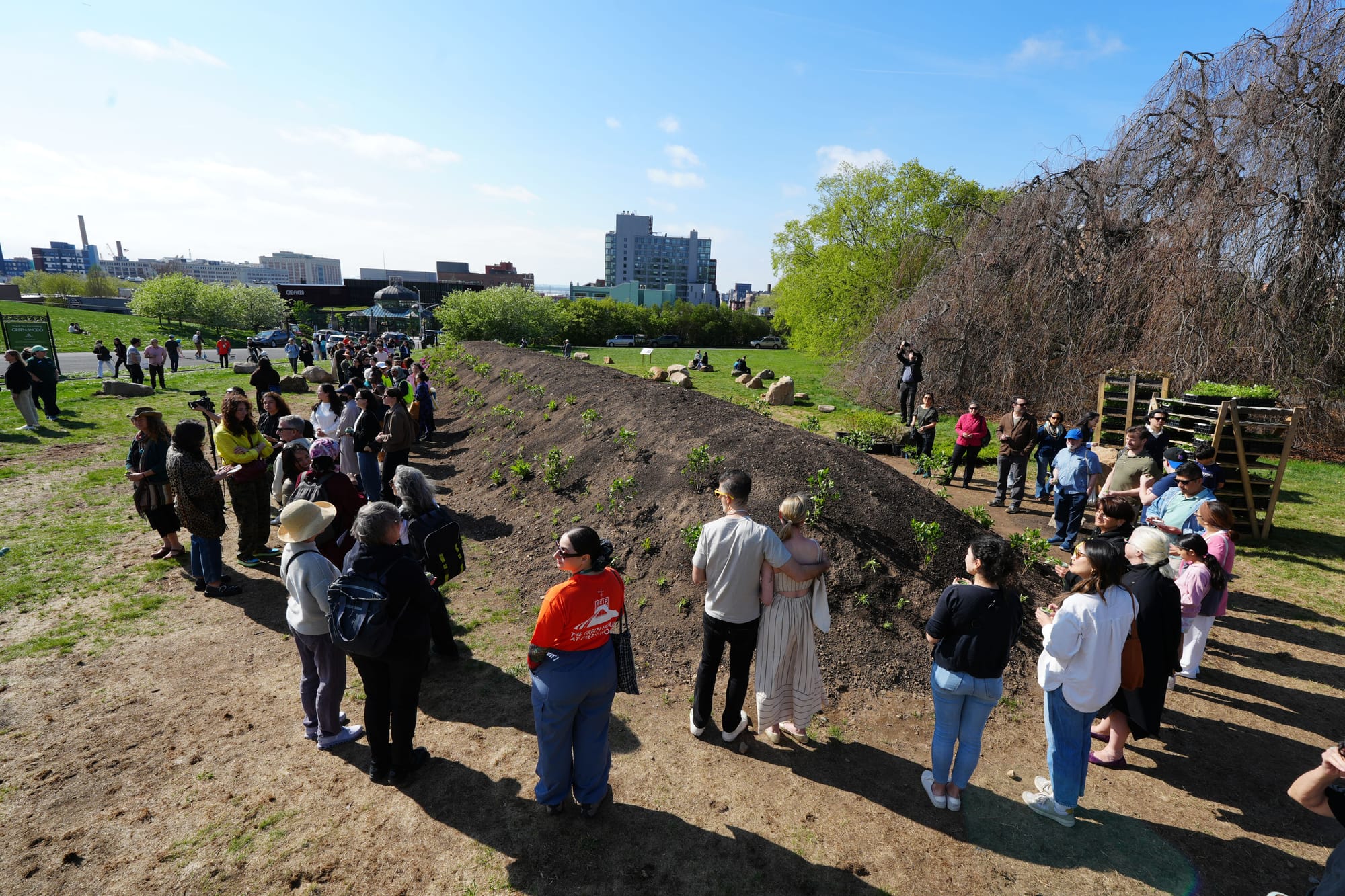
Green-Wood Cemetery in Brooklyn has long served as a nexus for the rituals of human mortality, but a new installation by artist Jean Shin shifts the focus toward the landscape's own life cycles. Her work, Offering, is a regenerative earthwork situated near the cemetery's Gothic Revival gates. It functions as a site-specific memorial dedicated to the trees that have spent their entire lives within the grounds, framing the cemetery's arboretum not just as a backdrop for human grief, but as a subject of its own commemorative history.
The installation draws heavily from the tumulus — artificial burial mounds of earth and stone found in various cultures. Shin was specifically inspired by the rounded, hill-like mounds of traditional Korean funerary practices, which offer a distinct silhouette compared to the vertical monuments typical of American graveyards. By utilizing found materials from the cemetery itself, the work bridges the gap between the site's historical function and a contemporary ecological sensibility.
Earthworks and the grammar of mourning
The tumulus tradition stretches back millennia across multiple civilizations, from the royal tombs of the Silla dynasty on the Korean peninsula to Neolithic barrows in Northern Europe. What distinguishes the Korean form — often called bongbun — is its emphasis on gentle, rounded contours that echo the surrounding hillsides, suggesting a return to the earth rather than a defiance of it. Where Western funerary architecture has historically reached upward — obelisks, spires, crosses — the Korean mound settles into the ground, treating burial as an act of reintegration with the landscape.
Shin's adaptation of this form at Green-Wood is notable for its subject as much as its shape. The memorial is not dedicated to a person but to trees — organisms that, in the context of a 19th-century rural cemetery, were always part of the designed experience but rarely acknowledged as having their own mortality. Green-Wood, established in 1838, was among the earliest rural cemeteries in the United States, part of a movement that treated burial grounds as landscaped parks meant to offer solace through nature. The irony embedded in Offering is that the very trees planted to console the bereaved have their own finite lifespans, and no tradition existed to mark their passing.
By constructing the earthwork from materials found on the grounds — fallen wood, soil, organic debris — Shin closes a material loop. The trees that once shaded graves become the substance of their own memorial. This circularity aligns with a broader tendency in contemporary land art to treat site-specificity not merely as an aesthetic constraint but as an ethical one, where the work's meaning is inseparable from the matter it is made of.
The cemetery as living institution
For Green-Wood, the project represents an institutional experiment in large-scale, site-specific art. Harry Weil, the cemetery's vice president of education and public programs, noted that the goal was to challenge the institution to create something significant using its own "raw materials." That ambition places Green-Wood within a small but growing cohort of historic cemeteries and cultural landscapes that have begun commissioning contemporary art as a way to remain relevant beyond their original function.
The tension is instructive. Cemeteries are, by design, conservative institutions — custodians of permanence in a culture that increasingly favors impermanence. Introducing a regenerative earthwork, one that will change over time as organic materials decompose and new growth emerges, inverts that mandate. Offering is not meant to last forever. Its transformation is the point.
This places Shin's work in dialogue with earlier land art interventions — Robert Smithson's Spiral Jetty, Agnes Denes's Wheatfield — that treated entropy and ecological process as artistic media. But where those projects often operated on remote or industrial sites, Offering sits within an active memorial landscape, surrounded by the headstones and mausoleums of nearly two centuries of burial. The juxtaposition sharpens the question the work poses: whether the rituals developed to process human loss can be extended to non-human life, and what it means for an institution built around permanence to host a work defined by decay.
Whether Green-Wood's experiment signals a broader institutional shift or remains an isolated gesture depends in part on how visitors and peer institutions respond. The deeper question — whether Western commemorative culture can absorb forms of mourning that treat dissolution as sacred rather than tragic — remains open.
With reporting from Hyperallergic.
Source · Hyperallergic