The Long Lineage of Letting Go
The boundaries between psychology, philosophy, and spirituality have always been porous. They bleed into one another until the distinctions feel more like academic jargon than functional differences. Modern Cognitive Behavioral Therapy (CBT), for instance, finds its DNA in the Rational Emotive Behavior Therapy (REBT) developed by Albert Ellis in the 1950s, which itself was a direct descendant of Stoic thought — the Hellenistic school that taught practitioners to distinguish between what is within their control and what is not. Both systems operate on the premise that suffering stems not from events themselves, but from the mistaken core beliefs we wrap around them. The implication is uncomfortable for an industry built on novelty: the "hacks" of modern wellness are often ancient wisdom rebranded for a secular age.
From the Stoa to the Consulting Room
The philosophical genealogy is more direct than it might appear. Epictetus, the formerly enslaved Stoic philosopher, wrote in the Discourses that people are disturbed not by things but by the views they take of them — a formulation Ellis cited explicitly when constructing REBT in mid-twentieth-century New York. CBT, which Aaron Beck later refined into the dominant modality of evidence-based psychotherapy, retained the same structural logic: identify the distorted belief, examine it against reality, replace it with something more functional. The therapeutic mechanism is, at its core, an exercise in applied Stoic epistemology.
This synthesis extends further into the realm of existential psychotherapy, where the works of Irvin Yalom and Otto Rank serve as a bridge between the clinical and the metaphysical. By drawing on the existentialism of Sartre and Camus — and reaching further back to Plato's dialogues on the soul and mortality — these practitioners emphasize the radical acceptance of death as a prerequisite for authentic life. Yalom's concept of "death anxiety" as a primary engine of psychological distress is, in structure, a Western echo of the Buddhist prescription to meditate on one's own mortality, a practice designed to strip away the ego's illusions and confront the raw fact of impermanence. The Buddhist term anicca — the doctrine that all conditioned phenomena are transient — maps onto the existentialist insistence that meaning is not given but constructed in the face of finitude.
What makes the convergence notable is not that two traditions arrived at similar conclusions, but that they did so through radically different epistemological paths. Buddhism proceeds through contemplative observation of the mind's own processes. Stoicism proceeds through rational argument and the disciplined application of logic to emotion. Existential psychotherapy borrows from both, adding the clinical scaffolding of the therapeutic relationship. The destination is shared; the routes are not.
The Difficulty of the Buy-In
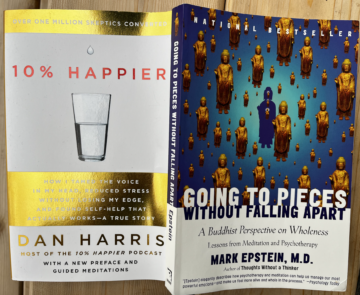
Despite the historical weight of these ideas, the friction of daily life often prevents engagement with them. Intellectual assent to impermanence is cheap; lived acceptance is not. This struggle is documented by contemporary figures like Dan Harris, whose transition from a televised panic attack to skeptical meditation advocate highlights the gap between knowing and doing. Harris's journey, guided by thinkers like psychiatrist Mark Epstein — whose work explicitly bridges Buddhist psychology and Western clinical practice — underscores a fundamental tension: the awareness that change is the only constant coexists with a lifetime spent constructing elaborate defenses against it.
The pattern is not unique to individuals. Entire cultural systems function as collective buffers against impermanence. Consumer economies thrive on the promise of acquisition as permanence. Social media architectures reward the curation of a fixed identity. Even the wellness industry, which ostensibly teaches acceptance, often packages it as another product to be obtained and held. The ancient insight keeps arriving, and the modern apparatus keeps finding ways to domesticate it.
Ultimately, these disparate traditions converge on the Heraclitean observation that no one steps into the same river twice. Whether through the lens of Buddhist meditation, Stoic journaling, or the existentialist confrontation with absurdity, the task remains structurally identical: to navigate the inevitable mourning that accompanies change without collapsing under its weight. The philosophical question is settled — impermanence is the substrate, not the exception. The harder question, the one no tradition has fully resolved, is operational: how to build a life that genuinely accommodates what every serious thinker since Heraclitus has known to be true, rather than merely acknowledging it on the way to the next distraction.
With reporting from 3 Quarks Daily.
Source · 3 Quarks Daily