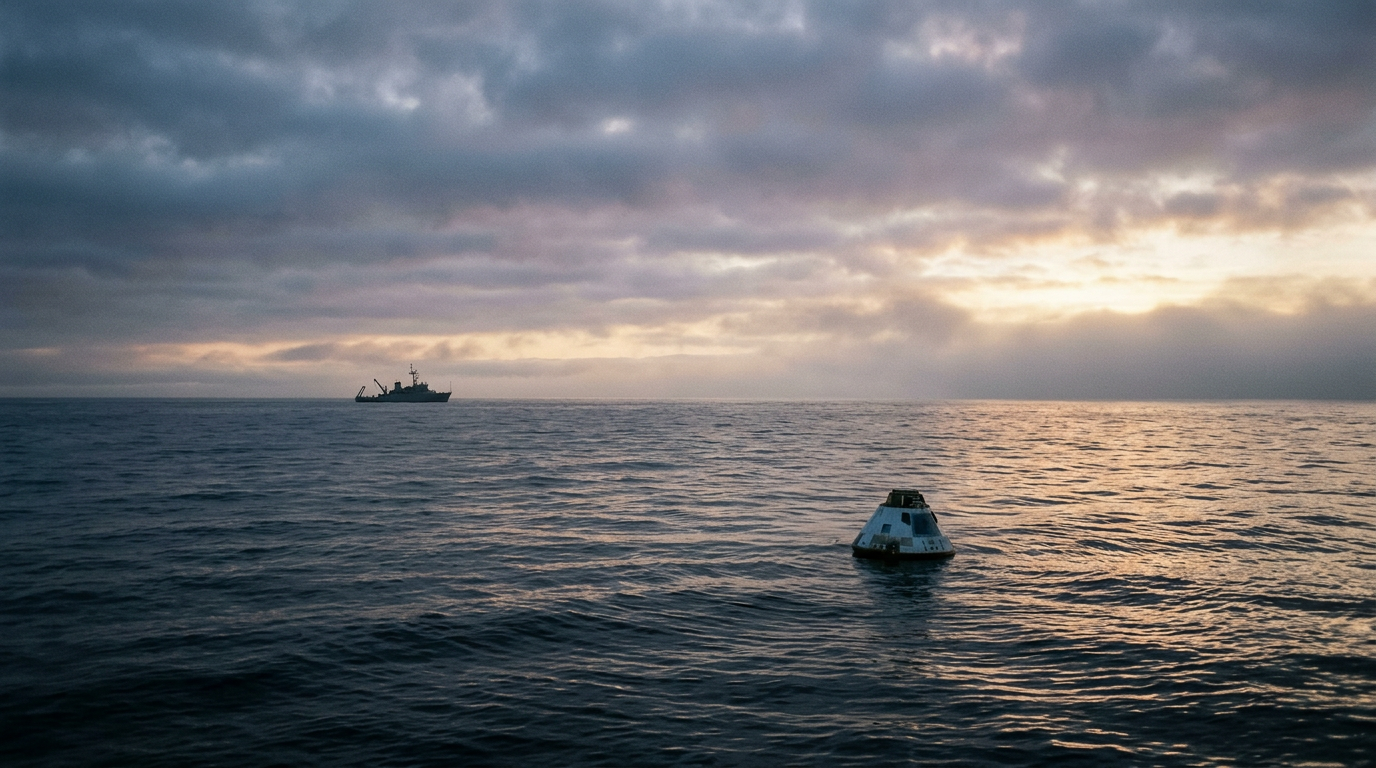
The splashdown of the Orion spacecraft in the Pacific Ocean on April 10 marked the quiet conclusion of a historic ten-day odyssey. Carrying a crew of four — NASA's Reid Wiseman, Victor Glover, and Christina Koch, alongside the Canadian Space Agency's Jeremy Hansen — Artemis II was more than a proof of concept. It was a reassertion of human presence in deep space, the first crewed mission beyond low Earth orbit since Apollo 17 returned from the Moon in December 1972.
During their voyage, the crew reached a distance of 252,756 miles from Earth, the furthest any human has ever traveled from the home planet. The previous record, set by the crew of Apollo 13 in April 1970, had stood for more than half a century — a measure less of technological limitation than of shifting political and budgetary priorities that kept human spaceflight tethered to Earth orbit for decades.
A Visual Record with Scientific Weight
The mission's imagery offers a perspective shift rarely seen since the Apollo era. From the windows of Orion, the crew captured the Earth eclipsed by the Sun, framed by the glow of auroras and zodiacal light, with Venus visible in the void. These are not merely photographs. They function as scientific data points and cultural artifacts simultaneously, documenting the translunar injection burn and the stark topography of the lunar surface observed from a proximity no human eyes had experienced in fifty years.
The distinction matters. Apollo-era imagery — most famously "Earthrise," taken by the crew of Apollo 8 in 1968 — reshaped public consciousness about the planet's fragility. Whether the Artemis II visual record carries similar cultural weight remains to be seen, but it arrives in a media environment radically different from the broadcast-television monopoly of the late 1960s. The images must compete for attention in a fragmented information landscape, even as they document something genuinely rare: the view from beyond the Van Allen belts, where the magnetosphere's protection thins and deep-space radiation becomes a tangible engineering problem rather than an abstraction.
That radiation environment is itself one of the mission's quieter but more consequential test subjects. Orion's shielding and life-support systems faced real deep-space conditions with a human crew aboard for the first time. The data collected on radiation exposure, thermal management, and crew habitability during the ten-day flight will feed directly into planning for Artemis III and subsequent surface missions.
From Iceland to the Lunar Surface
Preparation for Artemis II was grounded in the terrestrial. The crew undertook rigorous geological field training in the volcanic landscapes of Iceland, where basaltic terrain and sparse vegetation approximate conditions on the lunar surface more closely than most environments on Earth. This kind of analog training has a long lineage — Apollo astronauts trained in locations ranging from the deserts of Arizona to the lava fields of Hawaii — but its revival signals something about NASA's current posture. The agency is treating the Moon not as a destination for flags-and-footprints visits but as a sustained operational environment requiring systematic geological literacy from its crews.
This methodical approach reflects the broader architecture of the Artemis program, which envisions a progression from flyby to orbit to surface presence to, eventually, a permanent or semi-permanent lunar outpost. Each phase is designed to retire specific technical and operational risks before the next begins. The inclusion of a Canadian astronaut on the crew also underscores the international partnership model that distinguishes Artemis from Apollo — a framework in which contributions from allied space agencies help distribute both cost and political commitment.
The strategic logic extends further. NASA has consistently framed lunar operations as preparatory infrastructure for eventual crewed missions to Mars, a journey that would last months rather than days and impose qualitatively different demands on life support, crew psychology, and autonomous decision-making. Whether the Moon-to-Mars pipeline proves as linear as program documents suggest is an open question. Budget cycles, political transitions, and the growing role of commercial launch providers each introduce variables that could accelerate or redirect the timeline.
What Artemis II has established, at minimum, is that the Orion vehicle can carry humans to deep space and return them safely — a capability the United States last demonstrated when the Apollo program ended. The distance between proving that capability and building a permanent human presence beyond Earth orbit remains vast. The forces now shaping that distance — institutional momentum at NASA, commercial competition, allied government investment, and the unresolved economics of lunar resource utilization — are pulling in directions that do not always align.
With reporting from NASA Breaking News.
Source · NASA Breaking News