The Beijing humanoid robot half-marathon has shed the caricatured image of its inaugural edition. While last year's competition was characterized by machines stumbling at the start and human operators requiring physical intervention, the second running of the event revealed a landscape of accelerated technical maturity. With over a hundred competitors, the race has solidified its role as a barometer for the Chinese robotics industry, which seeks global leadership in the autonomous bipedal sector.
The standout performer was the Lightning robot, developed by smartphone manufacturer Honor. Clad in red, the humanoid completed the 21-kilometer course in 50 minutes and 26 seconds. This achievement not only shattered the previous robotic record — which stood at over two hours — but also surpassed Jacob Kiplimo's human world record, set at just over 57 minutes. According to state broadcaster CCTV, Honor's machines traversed the route entirely autonomously.
From spectacle to benchmark
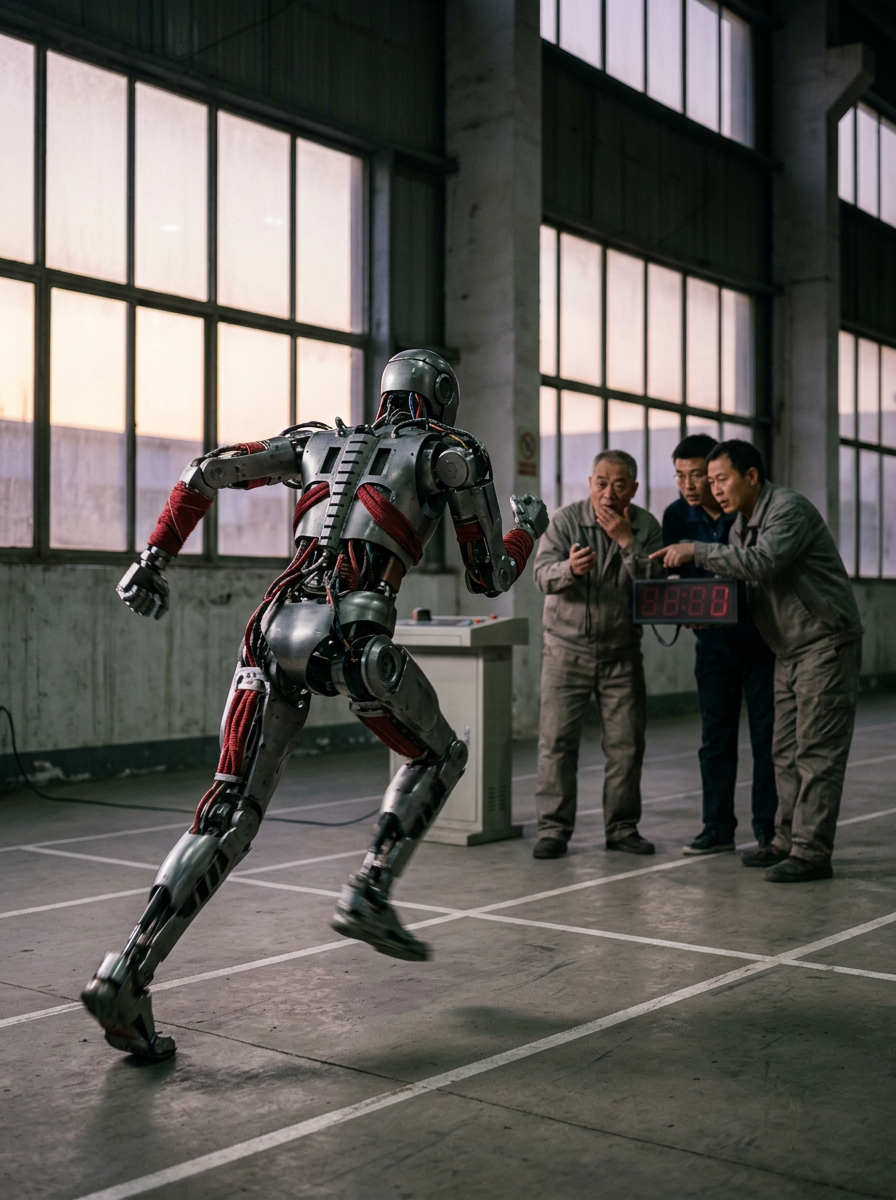
The contrast between the two editions is difficult to overstate. The inaugural race became something of an internet curiosity: robots toppling over within meters of the starting line, handlers rushing onto the course to prop machines upright, and finish times that would have embarrassed a casual jogger. That the same event, one year later, produced a time faster than any human has ever recorded over the half-marathon distance marks a rate of improvement that has few parallels in consumer-facing robotics.
Part of the explanation lies in the competitive dynamics of China's robotics sector. Dozens of companies — from established technology conglomerates to venture-backed startups — have poured resources into humanoid platforms over the past two years, driven by policy signals from Beijing that position robotics as a strategic industry. Honor's entry is itself notable: a company known primarily for smartphones chose to field a bipedal robot in a public endurance test, suggesting that the competitive perimeter of the humanoid race extends well beyond traditional robotics firms. When handset manufacturers invest engineering talent in locomotion and autonomy, the talent pool and capital base available to the sector expand considerably.
The half-marathon format, while partly a publicity exercise, serves a genuine engineering function. Sustained bipedal locomotion over 21 kilometers demands reliable power management, joint durability, real-time terrain adaptation, and thermal regulation — a combination of challenges that short demonstration runs do not expose. In that sense, the Beijing event operates as a stress test with a public audience, compressing months of lab validation into a single morning.
The gap between speed and reliability
Despite the headline result, the broader field tells a more nuanced story. Approximately 40 percent of the robots competed independently; the remainder still relied on remote control. Falls continued to punctuate the race, even among higher-performing models. A single machine breaking a human record does not mean the technology is broadly mature — it means one team solved a narrow optimization problem under favorable conditions. The distance between a fast prototype and a reliable platform capable of operating in unstructured environments remains substantial.
There is also the question of what "autonomy" means in this context. Running a fixed course on public roads, likely mapped in advance, is a constrained problem compared to navigating an unfamiliar warehouse floor or a cluttered household. The achievement is real, but its transferability to commercial or industrial applications should not be assumed without scrutiny.
What the Beijing half-marathon does reveal clearly is velocity of iteration. A sector that moved from public embarrassment to record-breaking performance in twelve months is operating on compressed development cycles. Whether that pace is sustainable — and whether it translates into machines that can do useful work beyond running in a straight line — are the questions that will determine whether events like this remain engineering showcases or become prologues to a broader shift in how physical labor is performed.
The next edition will face a different kind of pressure: not merely to go faster, but to demonstrate that speed and robustness can coexist in the same machine.
With reporting from Engadget.
Source · Engadget