The American housing crisis is often framed as a shortage of land or capital, but it is increasingly a crisis of labor and logistics. In Massachusetts alone, meeting demand requires building at least 222,000 homes over the next decade — a feat hampered by a dwindling pool of skilled tradespeople and a fragmented, carbon-intensive construction process. Reframe Systems, a startup born out of MIT, argues that the solution lies in treating the home not as a bespoke architectural project, but as a high-performance product of robotic automation.
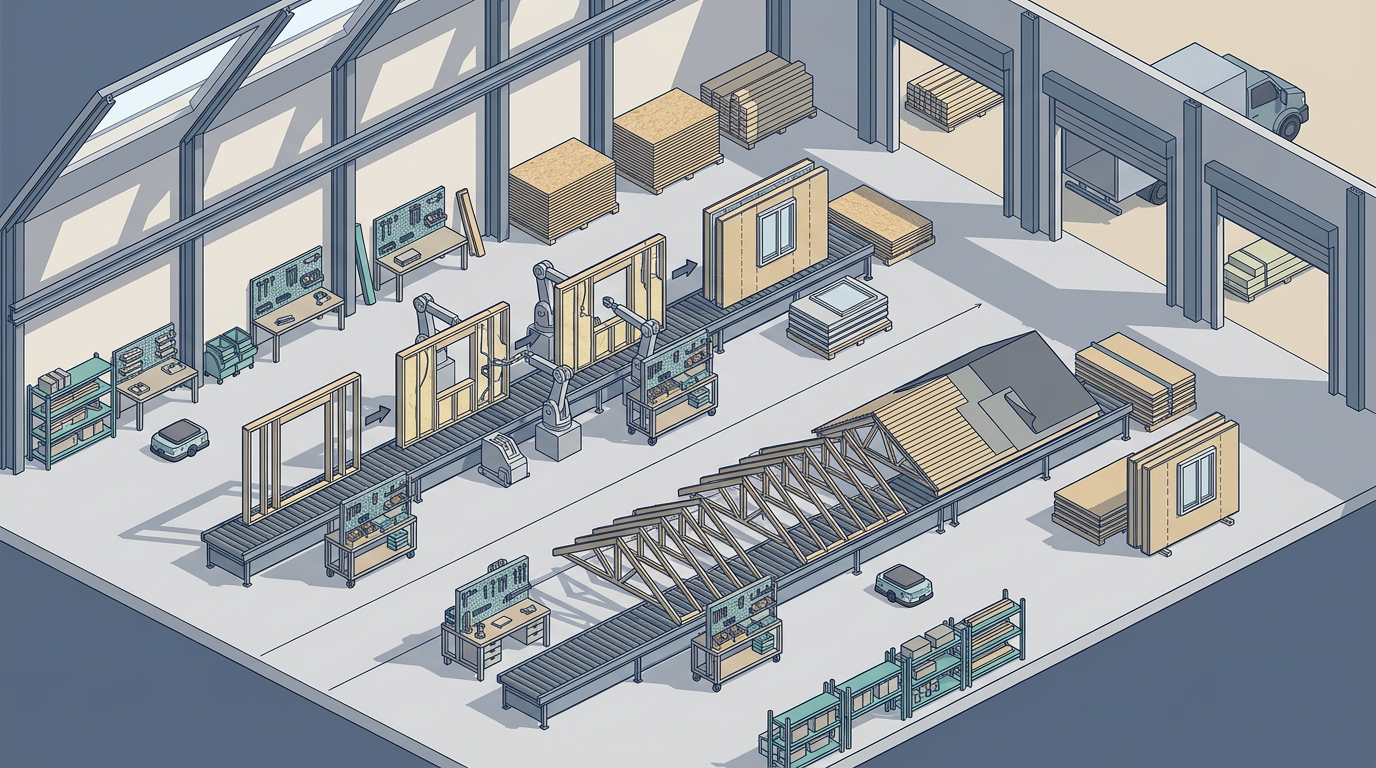
Founded in 2022 by Vikas Enti, the company utilizes "microfactories" to localize the production of housing components. Unlike traditional modular construction, which often relies on massive, centralized plants and expensive shipping, Reframe's microfactories are designed to be deployed close to the regions where homes are needed. This model integrates robotics and software to streamline the assembly of high-performance materials, bypassing the typical delays and complexities associated with coordinating dozens of independent subcontractors.
Why construction resists industrialization
The residential construction sector in the United States has long been an outlier among major industries in its resistance to productivity gains. While manufacturing, agriculture, and logistics have undergone successive waves of automation over the past half-century, homebuilding remains largely artisanal. A typical single-family home involves the sequential coordination of more than twenty specialized trades — framers, electricians, plumbers, insulators — each operating on independent schedules, often with limited digital integration between them. The result is a process prone to delays, rework, and waste.
Previous attempts to industrialize housing have followed a familiar arc. Modular and prefabricated construction companies have periodically attracted attention and capital, only to encounter persistent obstacles: the high cost of transporting volumetric modules over long distances, the difficulty of meeting varied local building codes, and consumer skepticism toward factory-built homes. The centralized factory model, in particular, tends to impose a geographic ceiling on competitiveness — the farther a module must travel from the plant, the thinner the economic advantage becomes.
Reframe's microfactory concept represents a structural response to that constraint. By designing smaller, replicable production facilities that can be stood up near target markets, the company attempts to retain the precision benefits of factory production while eliminating much of the logistics penalty. The approach borrows from a playbook more commonly seen in advanced manufacturing and semiconductor fabrication, where distributed production nodes serve regional demand rather than funneling everything through a single mega-facility.
From prototype to proof point
The efficacy of this system-level approach is already visible in the Boston suburbs of Arlington and Somerville, where the company's first manufactured homes have been completed. These early projects serve as proof points for a thesis that remains, by construction-industry standards, unconventional: that robotics and software can compress timelines and reduce carbon intensity without sacrificing the performance characteristics — thermal efficiency, structural integrity, code compliance — that regulators and buyers require.
The environmental dimension is not incidental. The built environment accounts for a substantial share of global carbon emissions, driven both by the energy consumed during a building's operational life and by the embodied carbon in its materials and construction process. By applying the principles of system design — optimizing material use, reducing site waste, and tightening tolerances through automation — Reframe aims to mitigate the industry's heavy environmental footprint while filling the gap left by a retiring workforce.
The labor question may ultimately prove as consequential as the environmental one. Construction trades across the United States face a demographic squeeze: experienced workers are aging out faster than new entrants arrive, and the sector competes poorly for younger talent against industries perceived as more technologically dynamic. A production model that shifts work from open job sites to controlled factory environments could alter that calculus, though whether it does so at sufficient scale remains an open question.
Reframe's trajectory will depend on variables that no single startup controls — the pace of permitting reform, the willingness of developers to adopt unfamiliar supply chains, and the durability of investor appetite for hardware-intensive climate ventures. The tension between the construction industry's deep institutional inertia and the mounting pressure of housing undersupply creates the conditions for disruption, but the history of construction technology is littered with promising models that failed to cross from demonstration to market standard. Whether the microfactory model breaks that pattern or joins it is a question the next several building cycles will answer.
With reporting from MIT News.
Source · MIT News