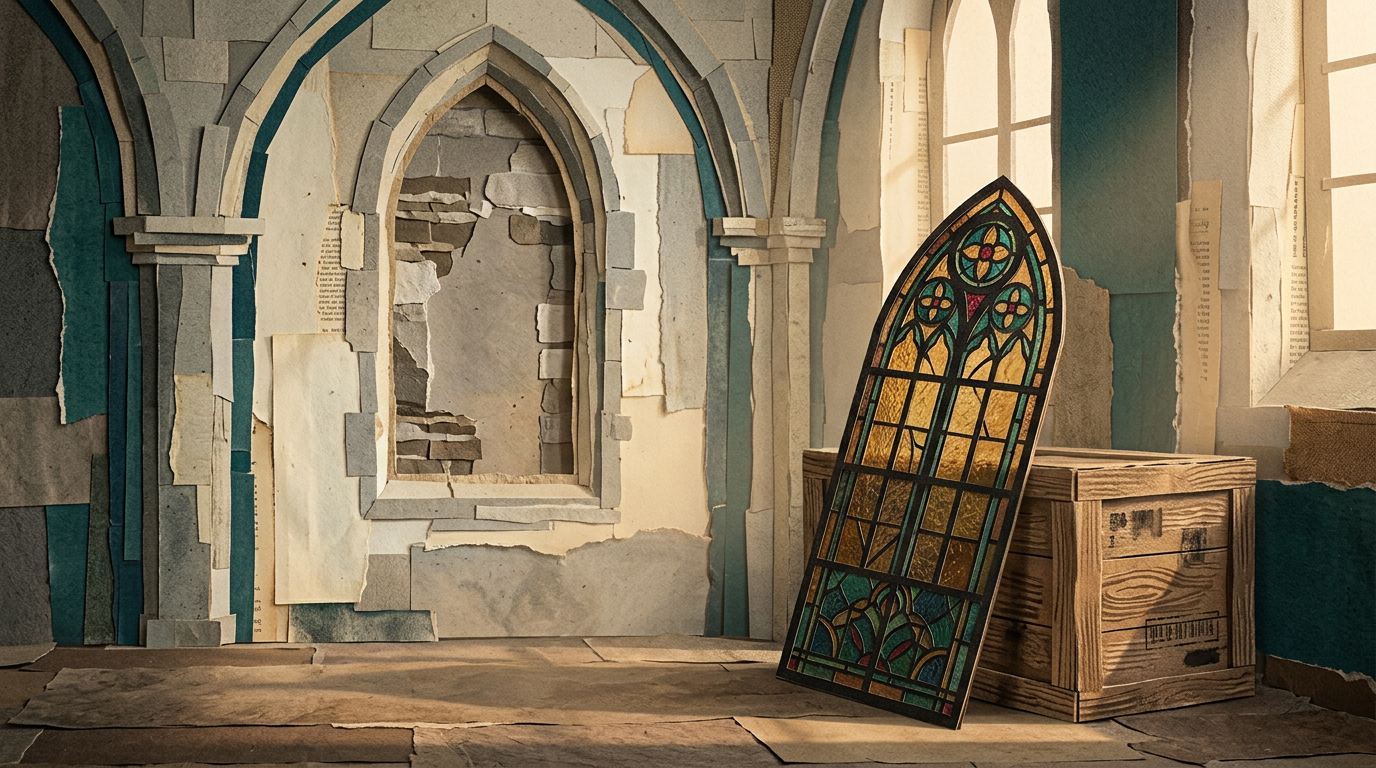
For 125 years, the Boyd Family Memorial Window has filtered light inside the Second Congregational Church in Winsted, Connecticut. This June, the two-panel Tiffany Studios work, titled The Falls, will move from its architectural home to Christie's New York, where it is expected to sell for up to $2 million. Commissioned in 1898 by Ellen Wright Boyd, the piece has remained in situ since its installation — a rare example of the studio's secular, landscape-driven ecclesiastical work now entering the open market.
The composition is notable for its departure from traditional religious imagery. It depicts a lush, sunset-soaked landscape in which a central waterfall cascades toward the viewer, framed by irises and lilies. While Tiffany windows often favor floral or figurative motifs, the waterfall is an uncommon subject in the firm's catalog. The work is further distinguished by a jeweled medallion at its apex, a hallmark of the studio's late 19th-century technical ambition.
When Architecture Becomes Inventory
The sale of The Falls fits a pattern that has accelerated over the past decade: significant architectural glass being decoupled from the buildings for which it was designed. As maintenance costs rise for aging churches, synagogues, and civic halls — many of them in small towns with shrinking congregations — institutions increasingly look to their decorative assets as a source of liquidity. A stained-glass window appraised in the seven figures can fund years of roof repairs, heating bills, and programming that keeps a congregation viable.
The logic is straightforward, but the cultural trade-off is not. A Tiffany window was conceived as an integrated element of architecture: its palette calibrated to the orientation of the wall, its scale proportioned to the nave, its subject chosen to resonate with the community that gathered beneath it. Removed from that setting and placed under gallery lighting or in a private residence, the object survives but the experience it was designed to produce does not. The tension between preservation of the object and preservation of its context is one the art market has never fully resolved — and one that recurs each time a work of site-specific craft enters an auction room.
Tiffany Studios, active from the 1880s through the early 1930s under the direction of Louis Comfort Tiffany, produced thousands of windows during its peak decades. The firm's output ranged from conventional biblical scenes to the kind of naturalistic landscape seen in The Falls, which drew on the Aesthetic Movement's conviction that beauty itself — not narrative — could serve a spiritual function. That philosophy made Tiffany's secular windows appealing to donors who wanted memorial art without doctrinal specificity, and it makes those same windows appealing today to collectors who value decorative ambition over religious iconography.
A Market Recalibrating Around Scarcity
The market for Tiffany glass has long been robust at the top end, driven by the finite supply of authenticated studio works and by periodic institutional acquisitions that reset price expectations. The Metropolitan Museum of Art's 2023 acquisition of Tiffany's Garden Landscape reinforced the category's standing within the broader decorative-arts canon, signaling that major museums still regard these works as collection-worthy rather than merely decorative.
Christie's decision to place The Falls in a summer sale suggests confidence that demand extends beyond a narrow circle of Gilded Age specialists. The window's secular subject, its documented provenance stretching back to the original commission, and its unbroken residency in a single location all function as market differentiators. Provenance continuity of this kind is increasingly rare; many Tiffany windows changed hands during the mid-20th century, when the studio's reputation was at a low ebb and works were sold, donated, or discarded with little documentation.
What remains unresolved is the broader question the sale raises for institutions holding comparable assets. Each successful auction establishes a reference price that makes the next deaccession more tempting — and the argument for keeping a fragile, expensive-to-maintain window in a drafty 19th-century building harder to sustain. Whether the destination is a climate-controlled private collection or a museum vitrine, the object is preserved. Whether something essential is lost in transit is a question the market is not structured to answer.
With reporting from ARTnews.
Source · ARTnews