The entrance to the Rijksmuseum's latest exhibition, Metamorphoses, offers a visceral introduction to the volatility of creation. Louis Finson's 1611 painting, "The Four Elements," greets visitors with a tangle of naked bodies in centripetal motion — a scene of muscular tension and distress that serves as a prelude to the exhibition's deeper inquiry. It is an image of disorder rendered with exquisite precision, capturing the inherent violence in the myths that underpin Western art.
Named after Ovid's epic poem — a sprawling compendium of some 250 myths composed around 8 CE, tracing the world from primordial chaos to the apotheosis of Julius Caesar — the exhibition functions as a temporal bridge, linking Renaissance masterpieces with antiquity and modern sculpture. The Metamorphoses has long served as the single most influential literary source for Western visual art after the Bible. Its narratives of gods, mortals, desire, punishment, and bodily transformation provided centuries of painters and sculptors with a shared lexicon of subjects: Apollo and Daphne, Narcissus, Europa, Pygmalion. That the Rijksmuseum chose this text as the organizing principle for a major show is itself a statement about the enduring structural role of classical mythology in the Western canon.
Curation as Argument
While "blockbuster" exhibitions often risk becoming mere inventories of famous names, the curators here use Ovid's text as a rigorous point of departure. The show tracks the evolution of themes like desire and "becoming," placing artists as disparate as Antonio da Correggio and Isamu Noguchi in a shared conversation about the fluidity of the human form. That pairing alone signals the exhibition's ambition: Correggio, working in early sixteenth-century Parma, rendered mythological eroticism with a soft, almost liquid brushwork that made divine transgression feel tender; Noguchi, centuries later, abstracted the human body into biomorphic stone and metal forms that owe as much to surrealism as to any classical precedent. The curatorial decision to place them in dialogue suggests that transformation — the moment a body ceases to be one thing and becomes another — is not merely a narrative motif but a formal problem that artists have solved in radically different ways across periods and media.
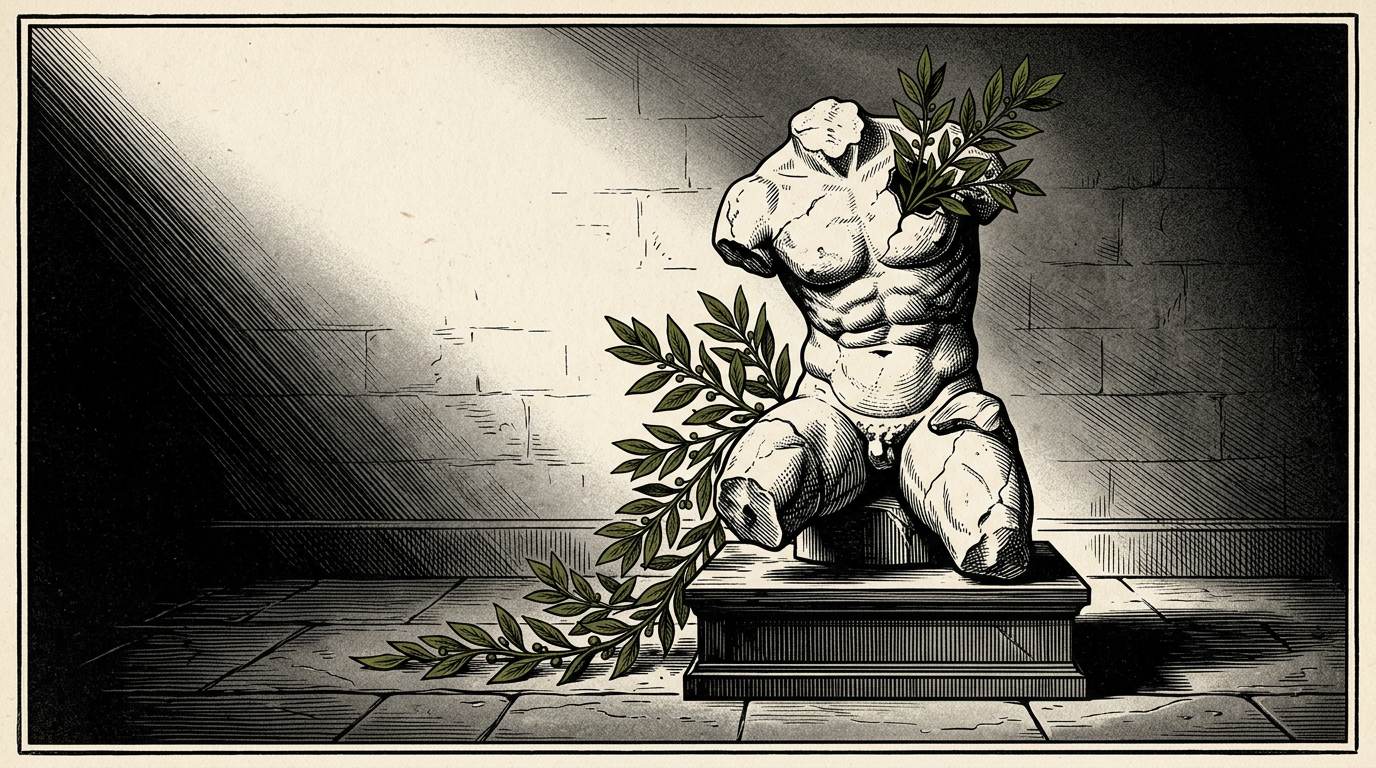
By focusing on the act of transformation rather than just the aesthetic of the myth, the Rijksmuseum avoids the trap of a substanceless retrospective. The distinction matters. Ovid's poem is not a static catalogue of gods and heroes; it is a text obsessed with process, with the instant of change itself — bark creeping over skin, limbs hardening into stone, flesh dissolving into water. Artists who engaged seriously with the Metamorphoses were forced to confront a representational paradox: how to freeze, in a fixed medium, a moment defined by its refusal to hold still. Bernini's famous Apollo and Daphne in Rome remains perhaps the most celebrated solution to that paradox in sculpture, and the lineage of attempts before and after it constitutes a rich and underexplored art-historical thread.
Beauty, Brutality, and the Constant of Change
The curation highlights how the Ovidian tradition has allowed artists across centuries to navigate the dissonance between beauty and brutality. Whether through Jean-Léon Gérôme's late-nineteenth-century "Pygmalion and Galatea" — a work that aestheticizes the male artist's fantasy of literally creating the ideal woman — or more contemporary pieces, the exhibition argues that the fascination with change, and the often-violent impulses that drive it, remains a fundamental constant in the history of making.
This is terrain that contemporary scholarship has increasingly interrogated. Ovid's tales of transformation frequently involve coercion: gods pursuing unwilling mortals, bodies altered as punishment or as the only available escape from assault. A curatorial approach that foregrounds transformation without flinching from its violent contexts places the exhibition in conversation with broader reconsiderations of how classical mythology is presented in institutional settings — a debate that has gained traction in museums across Europe and North America in recent years.
The question the Rijksmuseum leaves open is whether the Ovidian framework remains generative for contemporary artists or whether it has become a closed system — a set of references legible mainly to audiences already steeped in the Western canon. The inclusion of twentieth-century and contemporary works suggests the curators believe the tradition still breathes. But the tension between inherited mythological language and the demand for new forms of storytelling is precisely the kind of unresolved friction that makes the exhibition worth the visit — and worth the argument afterward.
With reporting from Hyperallergic.
Source · Hyperallergic